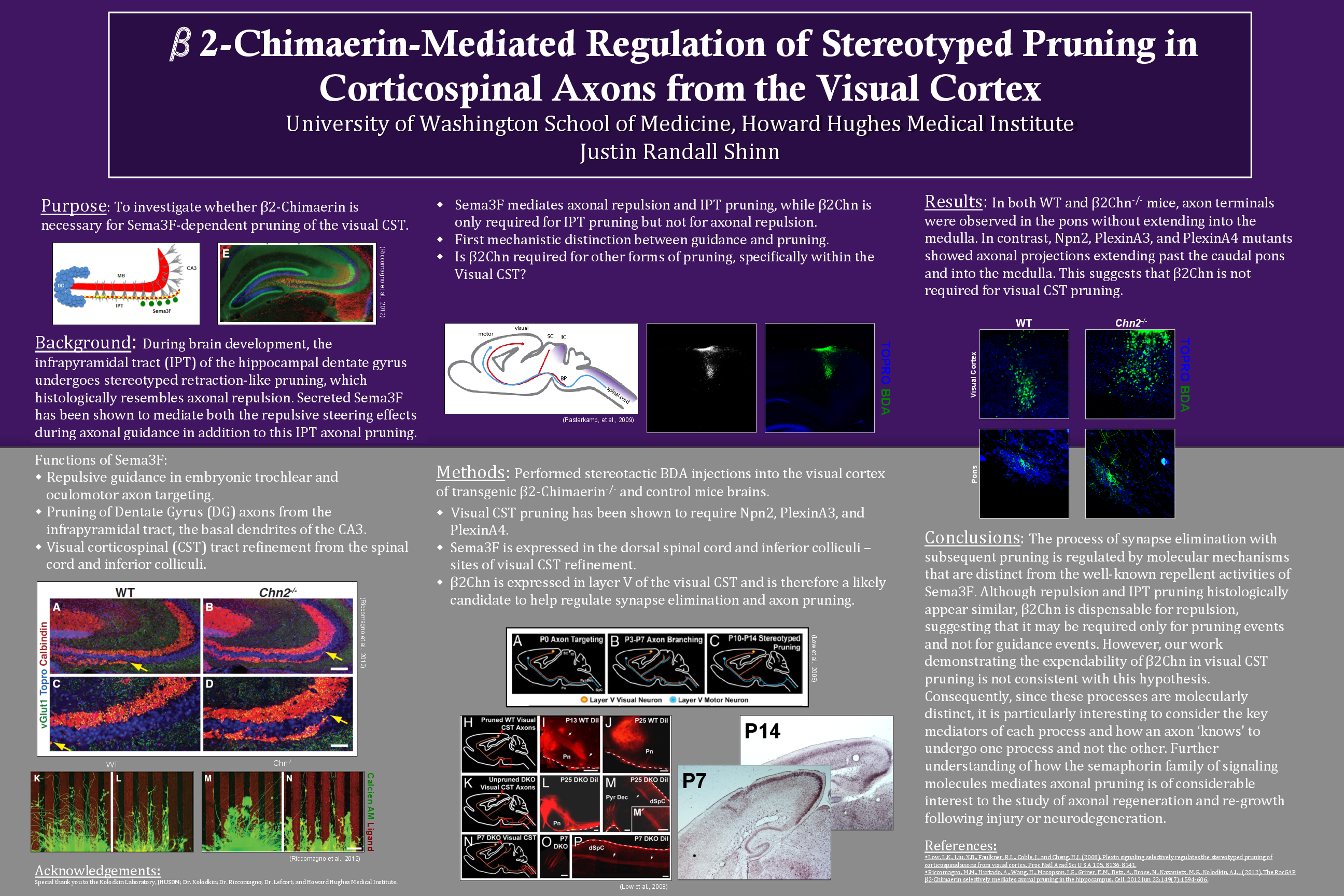
β2-Chimaerin-Mediated Regulation of Stereotyped Pruning in Corticospinal Axons from the Visual Cortex
Abstract
Purpose: During brain development, the infrapyramidal tract (IPT) of the hippocampal dentate gyrus undergoes stereotyped retraction-like pruning, which histologically resembles axonal repulsion. Secreted Sema3F has been shown to mediate both the repulsive steering effects during axonal guidance and IPT axonal pruning. Recently, it was revealed that β2-Chimaerin is required for Sema3F-mediated pruning of the IPT, but not for Sema3F-mediated axonal repulsion. This finding demonstrates that the process of synapse elimination with subsequent pruning is regulated by molecular mechanisms that are distinct from established repellent activities of Sema3F. In light of these data, we investigated whether β2Chn is necessary for Sema3F-dependent pruning of the visual CST.
Keywords: Axon Guidance, Semaphorin, β2-Chimaerin, Visual Corticospinal Tract.
Methods: Performed stereotactic BDA injections into the visual cortex of transgenic β2-Chimaerin-/- and control mice brains (n=8).
Results: In both WT and β2Chn-/- mice axon terminals were observed in the pons without extending into the medulla. In contrast, Npn2, PlexinA3, and PlexinA4 mutants showed axonal projections extending past the caudal pons and into the medulla. This suggests that β2Chn is not required for visual CST pruning.
Conclusions: The process of synapse elimination with subsequent pruning is regulated by molecular mechanisms that are distinct from the well-known repellent activities of Sema3F. Although repulsion and IPT pruning histologically appear similar, β2Chn is dispensable for repulsion, suggesting that it may be required only for pruning events and not for guidance events. However, our work demonstrating the expendability of β2Chn in visual CST pruning is not consistent with this hypothesis. Consequently, since these processes are molecularly distinct, it is particularly interesting to consider the key mediators of each process and how an axon ‘knows’ to undergo one process and not the other. Further understanding of how the semaphorin family of signaling molecules mediates axonal pruning is of considerable interest to the study of axonal regeneration and re-growth following injury or neurodegeneration.
Related articles