Abstract
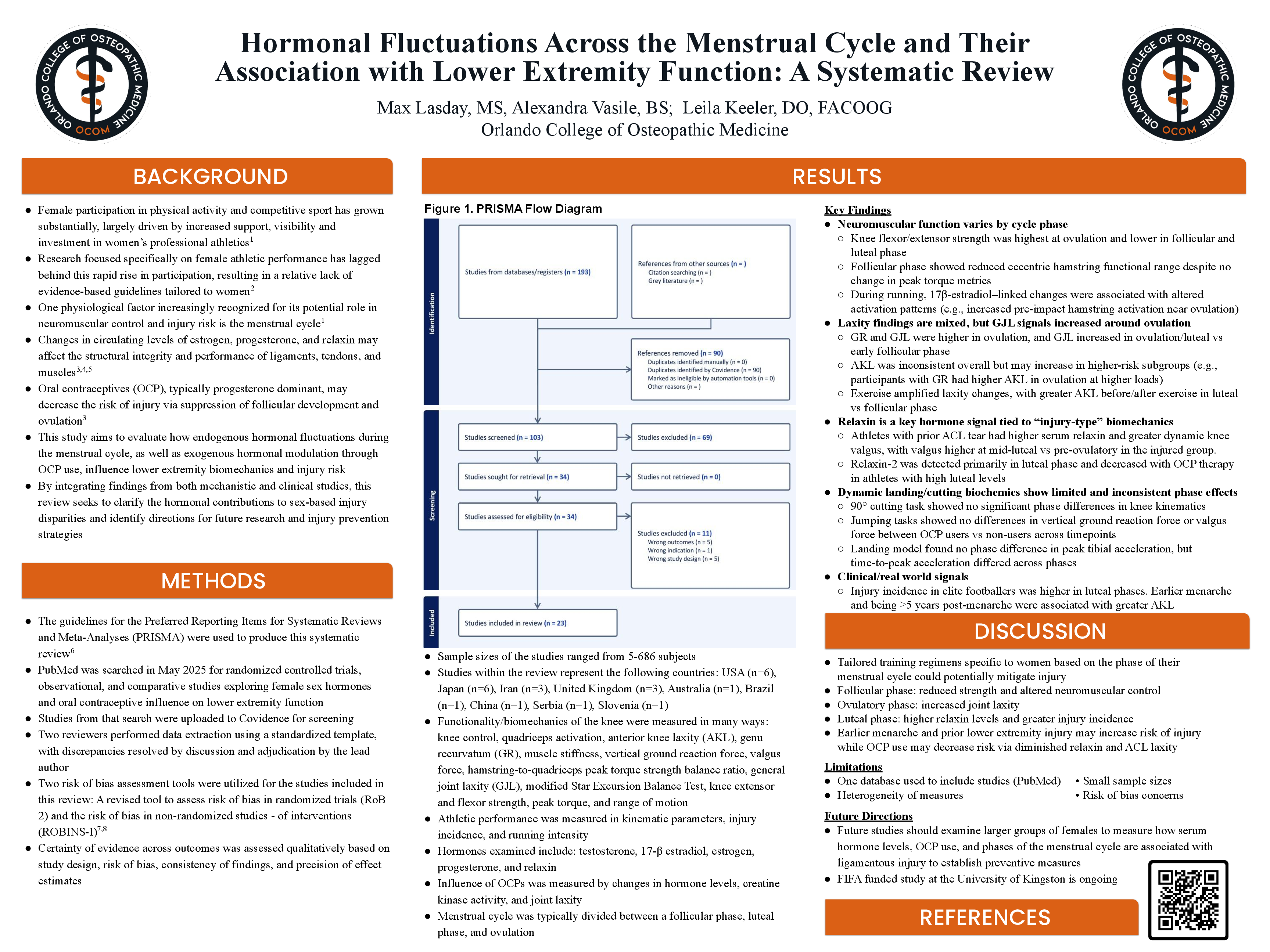
Background: Participation in competitive and recreational sports continues to grow among women. Understanding the role of female sex hormones in musculoskeletal health has become increasingly important. This systematic review aims to evaluate how endogenous hormonal fluctuations during the menstrual cycle, as well as exogenous hormonal modulation through OCP use, influence lower extremity biomechanics and injury risk.
Methods: This PRISMA-guided systematic review searched PubMed in May 2025 for RCTs, observational, and comparative studies exploring female sex hormones and oral contraceptive influence on lower extremity function. Studies were screened in Covidence by two independent reviewers. Risk of bias was assessed using RoB 2 and ROBINS-I tools.
Results: The 23 studies selected for data extraction collectively included 1,259 subjects. Strength and muscle activation were generally reduced in the follicular phase and favored the ovulatory or mid-luteal phases. Altered hamstring–quadriceps coordination and increased injury-risk markers were observed during the follicular phase. Joint laxity findings were mixed, but several studies reported increased anterior knee laxity, genu recurvatum, or generalized joint laxity during ovulation and the luteal phase, particularly after exercise and in women with baseline hypermobility or prior ACL injury. Women with ACL rupture demonstrated lower sex hormone concentrations and higher relaxin levels. OCP use was associated with lower relaxin and reduced ACL laxity, suggesting a protective effect, despite one report of increased post-exercise pain. Other biomechanical, balance, and kinematic outcomes showed minimal or inconsistent phase-related differences. One prospective study reported higher injury incidence during the luteal phase.
Discussion: These findings can help inform decision-making on what preventive protocols may be implemented to reduce risk of lower extremity injury in female athletes. Future studies should examine larger groups of females to measure how serum hormone levels, OCP use, and phases of the menstrual cycle are associated with ligamentous injury to establish preventive measures.