Abstract
Introduction:
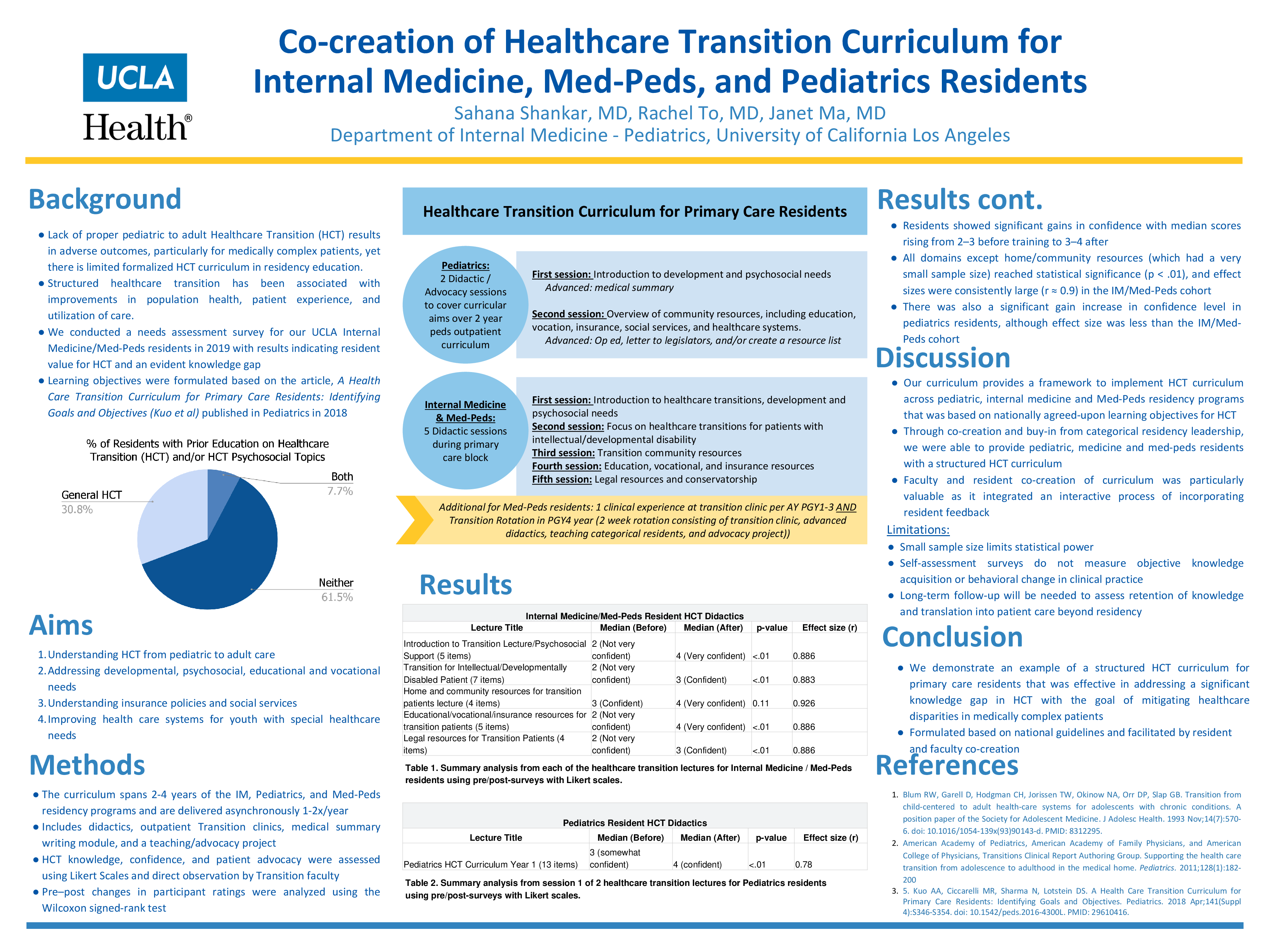
Lack of proper Healthcare Transition (HCT) results in adverse outcomes, particularly for medically complex patients, yet there is limited formalized HCT curriculum in residency education. There remains a significant unmet need for HCT curriculum with only a few published curriculums available. We conducted a needs assessment for our UCLA Med-Peds residents in 2019 that demonstrated 87.5% of residents felt that formal HCT training would be beneficial, yet 50% of residents reported that they had not received training on the core elements of HCT. The results of the needs assessment clearly signify both resident value for HCT and an evident knowledge gap, and therefore a call for formalized HCT in primary care residency programs.
Objective:
Kuo et al. published a list of learning objectives to AAP’s Pediatrics journal with the goal of developing a national HCT residency curriculum. Our proposed HCT curriculum utilizes these key learning objectives to create a standardized curriculum for pediatric, medicine (IM), and Med-Peds residents. The curricular aims include 1) understanding HCT from pediatric to adult health care; 2) addressing developmental, psychosocial, educational, and vocational needs; 3) understanding insurance policies and social services; and 4) improving health care systems for youth with special healthcare needs.
Methods:
We have developed a longitudinal HCT curriculum that is co-designed by faculty and residents. We delivered educational content in 4 – 5 didactic sessions during pediatric and IM/Med-Peds ambulatory didactic sessions. Topics include an introduction to HCT and psychosocial support, transition for patients with intellectual and developmental disabilities, transition community resources, educational/vocational and insurance resources, and legal resources/conservatorship. These sessions are complemented by clinical experiences in our Transition clinic and advocacy projects.
Results:
Multiple didactic sessions were conducted between 2024 - 2025 during scheduled ambulatory blocks for primary care residents. Prior to the first HCT didactic session, the majority (62%) of primary care residents reported that they had never received any formal transition education and had minimal familiarity with healthcare transitions. Analysis of post-intervention surveys revealed that participants had substantial gains in confidence across nearly all HCT topics, with statistically significant improvements (p < 0.01) and consistently large effect sizes (r ≈ 0.88–0.93). The training was particularly impactful for HCT topics where baseline confidence was low (e.g., psychosocial support, educational/vocational/insurance resources), moving participants from “not very confident” to “very confident.” In short, the intervention produced strong, meaningful improvements in resident confidence across multiple areas of transition care knowledge, with the greatest relative gains in areas where participants began least confident.
Conclusion:
In conclusion, our HCT curriculum provides a framework for co-curricular development that addresses an educational gap for physician trainees to optimize the care of Transition patients based on national guidelines on HCT education. Co-curricular development was particularly valuable as it integrated an iterative process of incorporating resident feedback, allowing the HCT medical education team to develop and deliver HCT that was representative of resident knowledge gaps and learning styles.