Abstract
Objective or Purpose of Innovation:
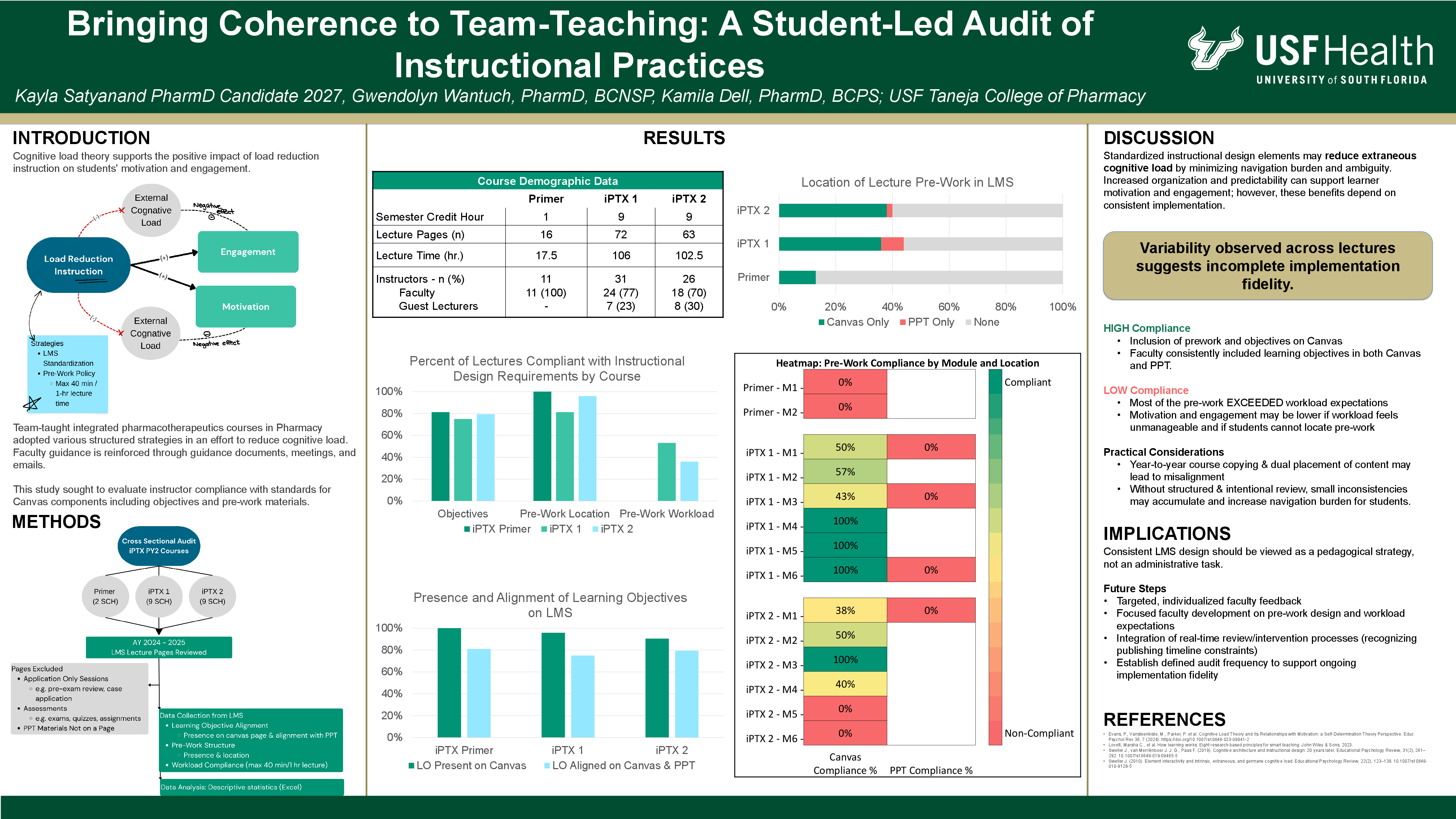
Evaluate instructor compliance with instructional design standards for Canvas components in a team-taught pharmacotherapeutics series.
Background or Theoretical Framework and Importance to the Field:
Consistency in course design and in online learning management systems (LMS) can reduce learners’ cognitive load, by providing clarity and predictability. This can be difficult to achieve in large team-taught courses. The integrated pharmacotherapeutics (iPTX) sequence spans 19 credit hours in year two of the PharmD curriculum and involves 20+ instructors per course. Standardized LMS pages are created for each lecture, and course policies and guidance provided for all course instructors both written, and reiterated in course planning meetings, for uploading materials to the LMS, yet student feedback highlights inconsistencies in presentation of objectives and pre-work. Since coordinators cannot review all pages prospectively, an internal audit was conducted to assess current practices and identify improvement opportunities.
Instructional Methods and Materials Used:
A structured audit of three iPTX courses evaluated LMS content using a rubric. Variables included presence and alignment of learning objectives, and clarity, consistency, and workload of pre-work. This provided a systematic view of adherence to design expectations across a multi-instructor sequence.
Educational Outcomes to Date:
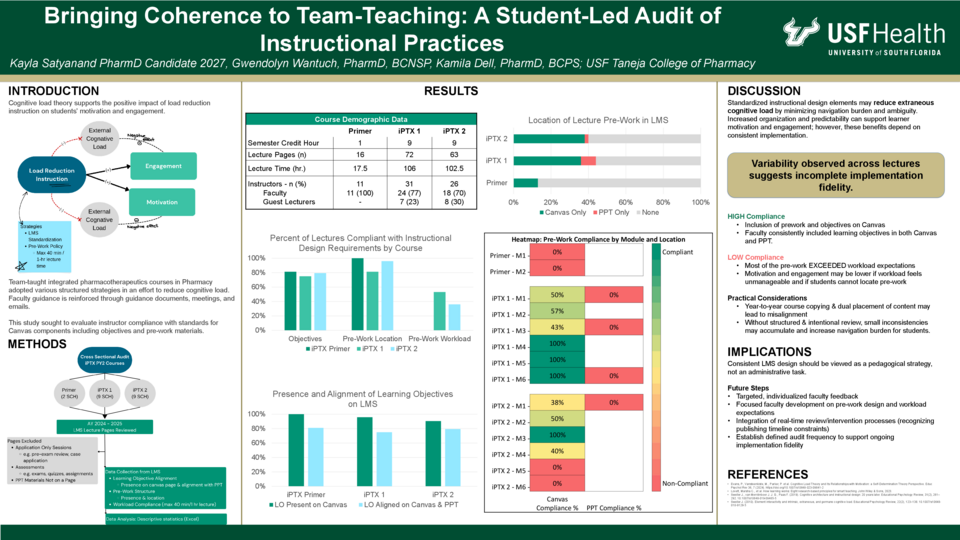
In iPTX 1, 95.8% of the 72 pages listed objectives, but only 78.3% matched learning materials. Pre-work appeared in 36.1% of the pages; 8% listed pre-work only in materials. Nearly half (47%) of the pre-work exceeded workload allocations. Data for iPTX 2 is in progress.
Innovation’s Strengths and Areas for Improvement:
Strengths: structured audit, actionable faculty insights, reinforcement of standardized LMS design. Opportunities: identify prospective non-compliance, increase faculty engagement, and expand to other courses.
Feasibility of Maintaining Program and Transfer to Other Schools/Programs:
Though not intended for annual use, the audit establishes a baseline opportunity for real-time alignment support by academic assistants. Findings inform quality processes, curriculum redesign, and adaptation for other multi-instructor or health professions programs.
References
- Lovett, Marsha C., et al. How learning works: Eight research-based principles for smart teaching. John Wiley & Sons, 2023.
- Sweller J., van Merriënboer J. J. G., Paas F. (2019). Cognitive architecture and instructional design: 20 years later. Educational Psychology Review, 31(2), 261–292. 10.1007/s10648-019-09465-5
- Sweller J. (2010). Element interactivity and intrinsic, extraneous, and germane cognitive load. Educational Psychology Review, 22(2), 123–138. 10.1007/s10648-010-9128-5