Abstract
1. Objective or Purpose of Innovation:
To design and implement a curriculum session introducing medical students to ADA guidelines on building and built-environment accessibility, and to increase students’ awareness of how environmental barriers affect patients.
2. Background or Theoretical Framework and Importance to the Field:
People with disabilities face various environmental barriers that significantly impact their participation in the healthcare system and health outcomes.1 Despite these barriers and health inequities, disability-focused curricula remain limited across medical education.2 In response, disability advocates have emphasized the need for disability-conscious curricula.3
3. Instructional Methods and Materials Used:
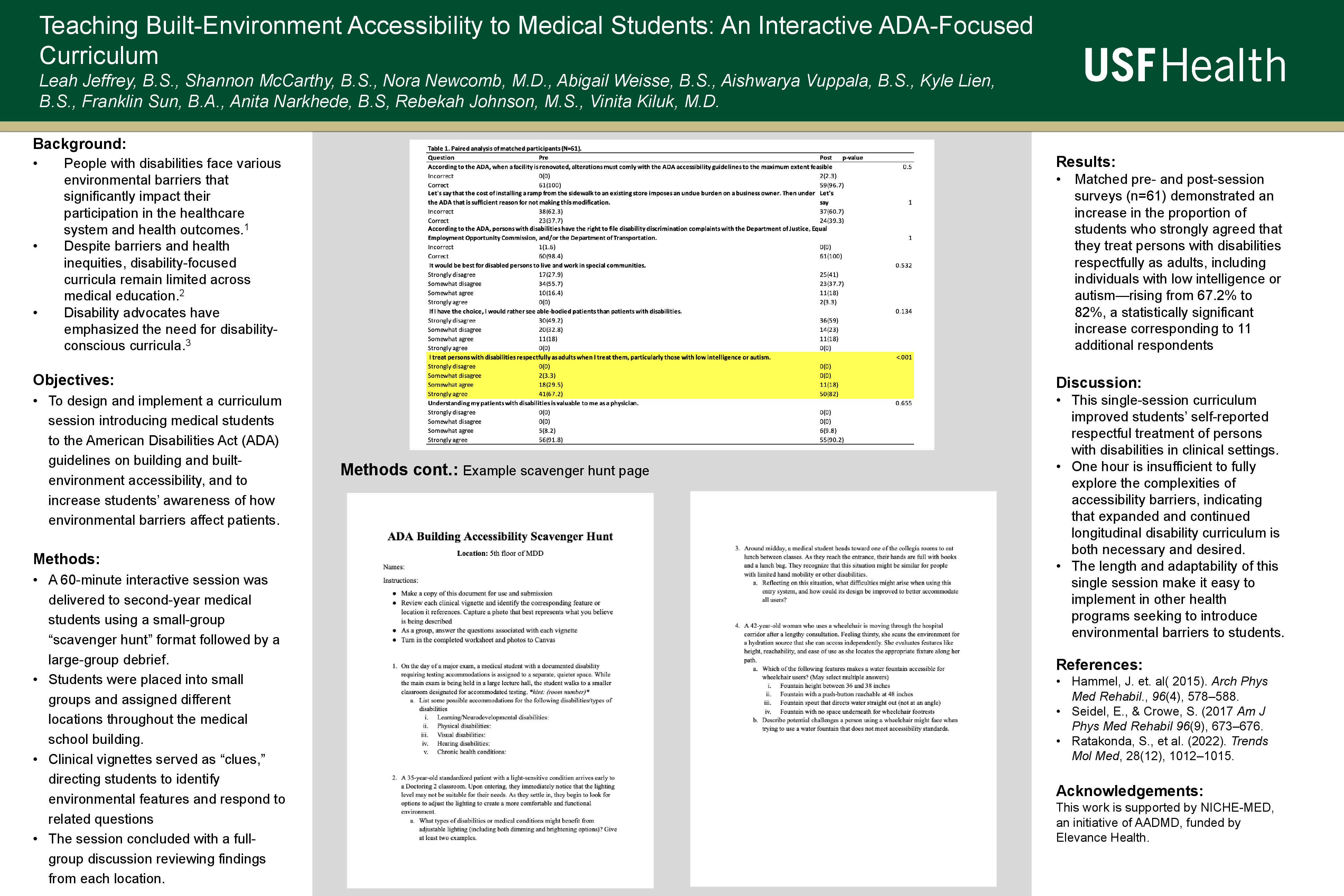
A 60-minute interactive session was delivered to second-year medical students using a small-group “scavenger hunt” format followed by a large-group debrief. Students were placed into small groups and assigned different locations throughout the medical school building. Clinical vignettes served as “clues,” directing students to identify accessible and inaccessible environmental features and respond to related questions. The session concluded with a full-group discussion reviewing findings from each location.
4. Educational Outcomes to Date:
Matched pre- and post-session surveys (n=61) demonstrated an increase in the proportion of students who strongly agreed that they treat persons with disabilities respectfully as adults, including individuals with low intelligence or autism—rising from 67.2% to 82%, a statistically significant increase corresponding to 11 additional respondents. No other measured parameters showed statistically significant change.
5. Innovation’s Strengths and Areas for Improvement:
This single-session curriculum improved students’ self-reported respectful treatment of persons with disabilities in clinical settings. However, one hour is insufficient to fully explore the complexities of accessibility barriers, indicating that expanded and continued longitudinal disability curriculum is both necessary and desired.
6. Feasibility of Maintaining Program and Transfer to Other Schools/Programs:
The length and adaptability of this single session make it easy to implement in other health programs seeking to introduce environmental barriers to students.
7. References:
- Hammel, J., Magasi, S., Heinemann, A., Gray, D. B., Stark, S., Kisala, P., Carlozzi, N. E., Tulsky, D., Garcia, S. F., & Hahn, E. A. (2015). Environmental barriers and supports to everyday participation: a qualitative insider perspective from people with disabilities. Archives of physical medicine and rehabilitation, 96(4), 578–588. https://doi.org/10.1016/j.apmr.2014.12.008
- Seidel, E., & Crowe, S. (2017). The State of Disability Awareness in American Medical Schools. American journal of physical medicine & rehabilitation, 96(9), 673–676. https://doi.org/10.1097/PHM.0000000000000719
- Ratakonda, S., Argersinger, D. P., Auchus, G. C., McGowan, C., Ship, H., Wang, D. R., & McKee, M. M. (2022). A call for disability health curricula in medical schools. Trends in molecular medicine, 28(12), 1012–1015. https://doi.org/10.1016/j.molmed.2022.08.004