Abstract
Objective or Purpose of Innovation:
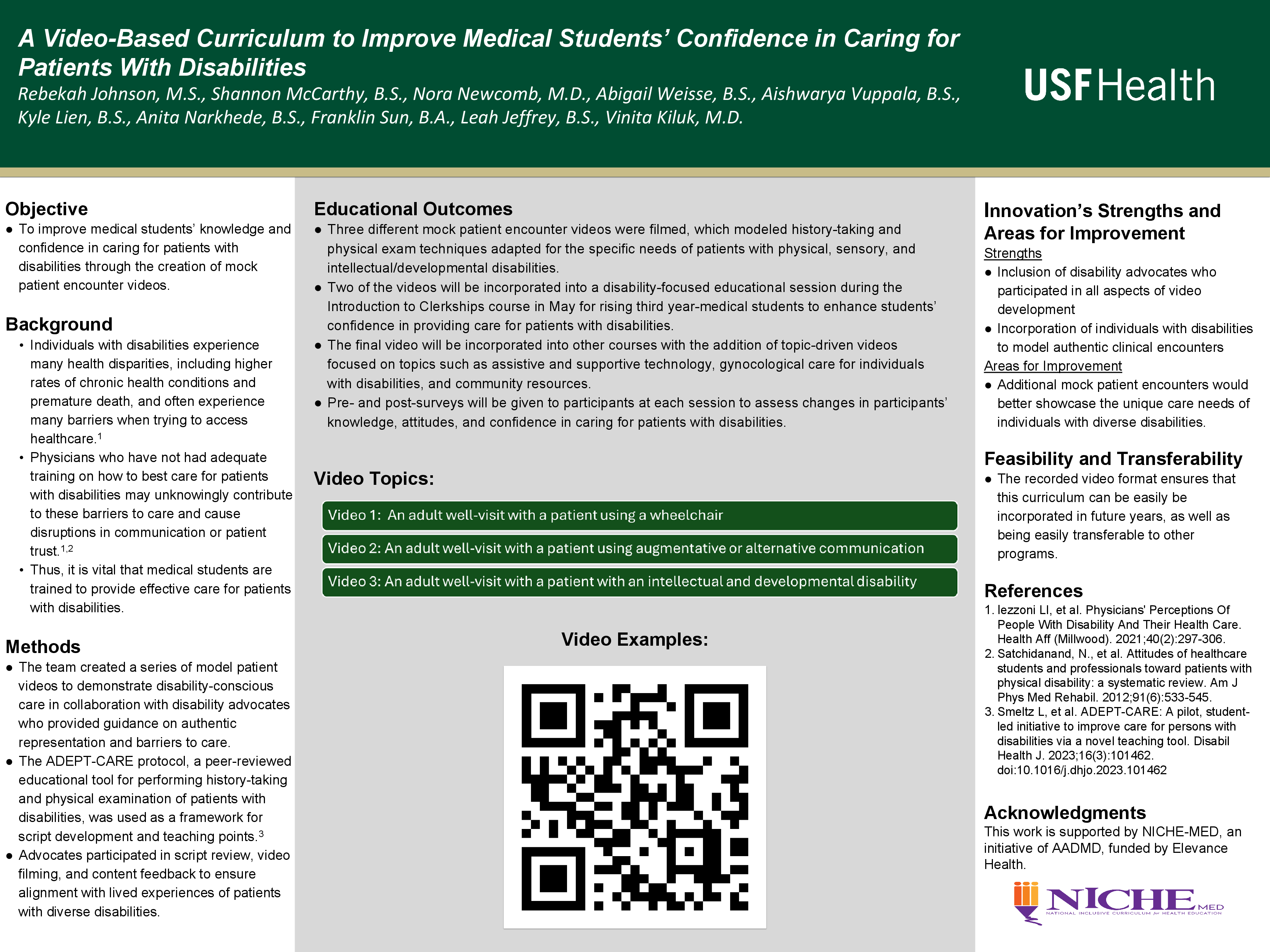
This curriculum aims to improve medical students’ knowledge and confidence in caring for patients with disabilities through the creation of mock patient encounter videos.
Background or Theoretical Framework and Importance to the Field:
Individuals with disabilities often experience many barriers when trying to access healthcare.1 Physicians who have not had adequate training on how to best care for patients with disabilities may unknowingly contribute to these barriers to care and cause disruptions in communication or patient trust.1,2 Thus, it is vital that medical students are trained to provide effective care for patients with disabilities.
Instructional Methods and Materials Used:
The team created a series of model patient videos to demonstrate disability-conscious care in collaboration with disability advocates who provided guidance on authentic representation and barriers to care. The ADEPT-CARE protocol, a peer-reviewed educational tool for performing history-taking and physical examination of patients with disabilities, was used as a framework for script development and teaching points.3 Advocates participated in script review, video filming, and content feedback to ensure alignment with lived experiences of patients with diverse disabilities.
Educational Outcomes to Date:
The model patient videos are ready for integration into the curriculum after undergoing multiple iterative reviews with disability advocates to ensure authentic representation of patient experiences and clinical barriers. The team plans to incorporate videos in multiple courses to enhance students’ confidence in providing disability-inclusive care.
Innovation’s Strengths and Areas for Improvement:
The curriculum’s strengths include the close collaboration with disability advocates and integration of patients with disabilities to model authentic clinical encounters. The curriculum could be refined by adding more mock patient encounters to better showcase the unique care needs of individuals with diverse disabilities.
Feasibility of Maintaining Program and Transfer to Other Schools/Programs:
Due to the recorded video format, this curriculum can continue to be incorporated in future years, as well as being easily transferable to other programs.
References:
- Iezzoni LI, Rao SR, Ressalam J, et al. Physicians' Perceptions Of People With Disability And Their Health Care. Health Aff (Millwood). 2021;40(2):297-306. doi:10.1377/hlthaff.2020.01452
- Satchidanand, N., Gunukula, S. K., Lam, W. Y., McGuigan, D., New, I., Symons, A. B., Withiam-Leitch, M., & Akl, E. A. (2012). Attitudes of healthcare students and professionals toward patients with physical disability: a systematic review. American journal of physical medicine & rehabilitation, 91(6), 533–545. https://doi.org/10.1097/PHM.0b013e3182555ea4
- Smeltz, L., Carpenter, S., Benedetto, L., Newcomb, N., Rubenstein, D., King, T., Lunsford, C., & DeWaters, A. L. (2023). ADEPT-CARE: A pilot, student-led initiative to improve care for persons with disabilities via a novel teaching tool. Disability and health journal, 16(3), 101462. https://doi.org/10.1016/j.dhjo.2023.101462