A Novel Electrophysiological Model Of Chemotherapy-Induced Cognitive Deficits In Mice
Abstract
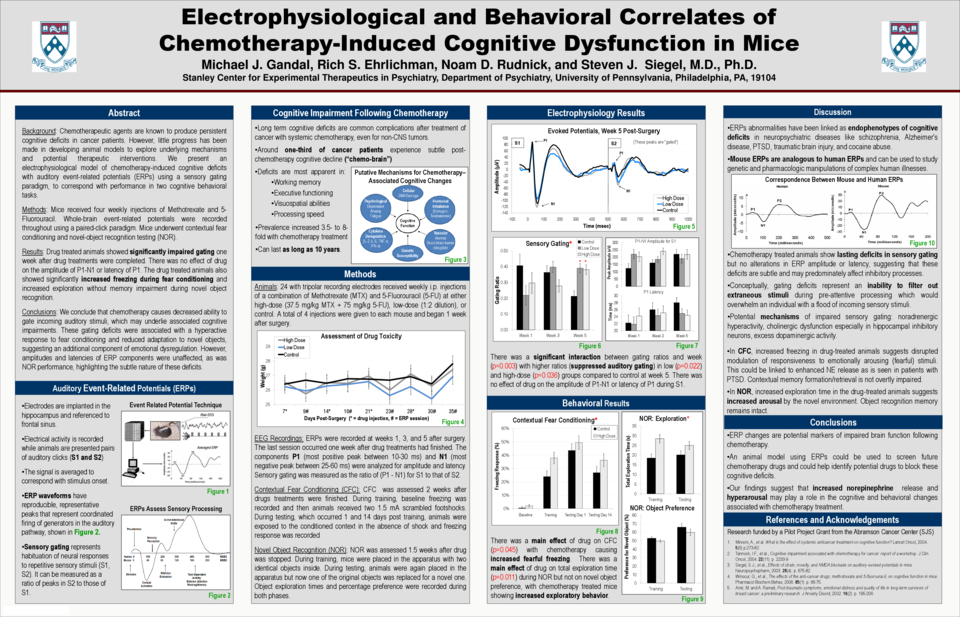
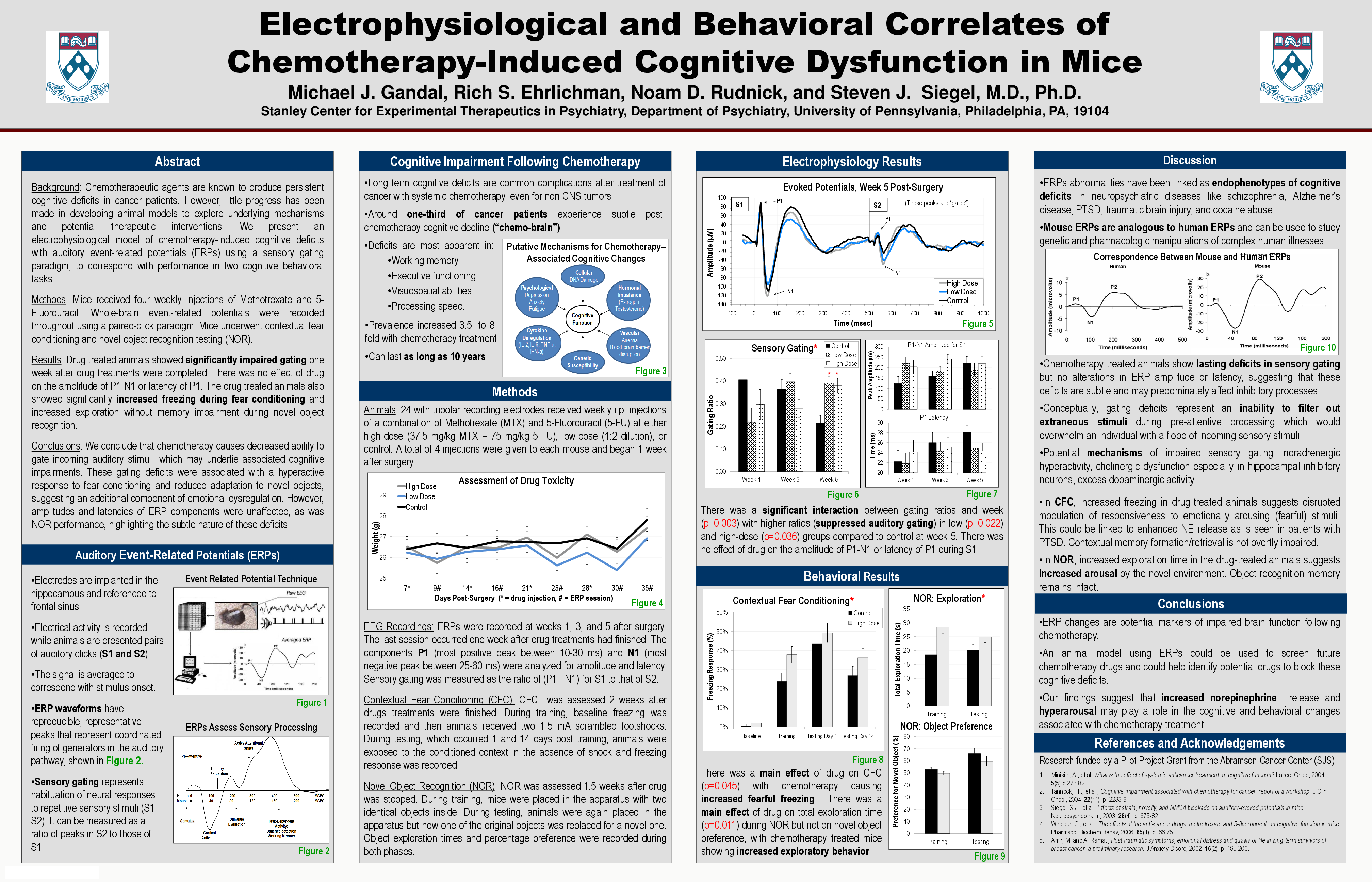
Background – Chemotheraputic agents have been shown to produce moderate, persistent cognitive deficits in cancer patients. However, little progress has been made in developing an animal model to explore underlying mechanisms and potential therapeutic interventions. We present an electrophysiological model of chemotherapy-induced cognitive deficits using a sensory gating paradigm, to correspond with performance in two behavioral tasks.
Methods – Adult mice (n=24) were divided into three groups and received four weekly injections of the common cancer treatment regimen of Methotrexate and 5-Fluorouracil at high dose (37.5mg/kg MTX + 75mg/kg 5-FU), low dose (1:2 dilution), or control. Whole-brain event related potentials (ERPs) were recorded at weeks 1, 3, and 5 with bipolar electrodes using a paired-click paradigm. Mice underwent contextual fear conditioning and novel-object recognition testing to assess hippocampal and limbic system functioning. Data was analyzed using repeated-measures ANOVA.
Results – A significant interaction (p=0.003) was found between gating ratios and week, with higher ratios (suppressed auditory gating) in low (p=0.022) and high-dose (p=0.036) groups compared to control at week 5. There was no effect of drug on the amplitude of the mouse P20-N40 component or latency of P20. The drug treated animals showed significantly increased freezing during fear conditioning (p=0.044) and significantly increased total exploration (p=0.003) during novel-object recognition (NOR), but no difference in preference for the novel object.
Conclusions – Treatment with chronic chemotherapy impairs the basic perceptual process of habituation to repeated incoming auditory stimuli, which may underlie or be a marker of its associated cognitive deficits. These gating deficits were associated with a hyperactive response to fear and increased exploratory behavioral, suggesting an additional component of emotional dysregulation or hyperarousal. However, amplitudes and latencies of ERP components were unaffected, as was NOR preference, indicative of the subtle nature of these deficits.
Related articles