Abstract
Background
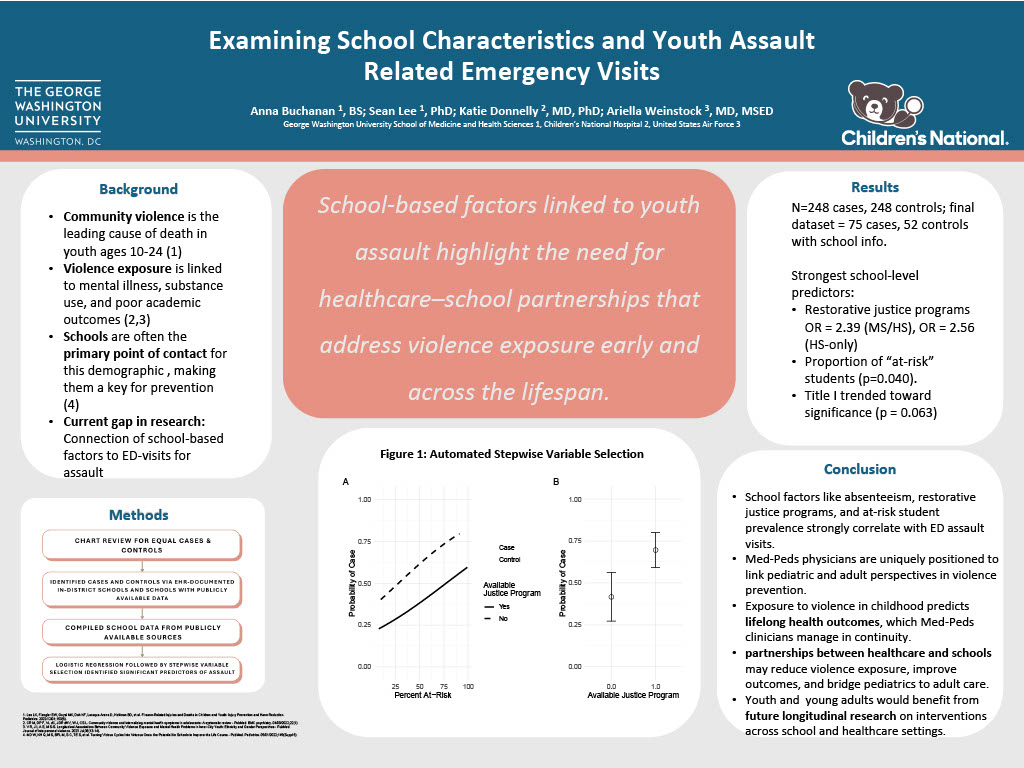
Community violence profoundly affects youth, with homicide the leading cause of death among individuals aged 10-24. Exposure to violence in childhood has been linked to increased rates of mental illness and substance use, as well as poor academic outcomes. Youth have a higher interaction with their schools than with the medical system, making for an optimal location to implement preventative health measures, as well as collect data about a variety of factors. Existing research emphasizes the urgent need to better understand how school-based factors interact with broader social determinants to influence youth involvement in community violence.
Objective
Identify significant school-related factors among patients who present to a pediatric emergency department (ED) for violence-related injury.
Design/Methods
In this retrospective case-control study, patients aged 10-18 presenting to a pediatric ED (January 2022 - February 2023) for gun, knife, or physical injuries were matched by age, sex, and medical complexity. We analyzed cases and controls with electronic health record-documented in-district schools and schools with publicly available data, then used logistic regression followed by stepwise variable selection.
Results
Of 248 cases and 248 controls, 75 cases and 52 controls with documented DC school information were reviewed. Univariate analysis showed that chronic absenteeism, proportion of 'at-risk' students, English Language Arts performance, and presence of a restorative justice program were most strongly associated with assault-related ED visits. Following stepwise variable selection, two variables that contribute to the most parsimonious model were restorative justice program availability (p=0.032), and increased prevalence of students identified as ‘at risk’ (p=0.040).
Conclusions
The most significant factors associated with youth violence and assault were the presence of a restorative justice program and the proportion of students identified as “at risk.” Likely, the association with restorative justice programs is a result of pre-existing violence at these schools, which may have prompted implementation of such a program prior to this study’s timeframe. The correlation with “at-risk” student populations aligns with prior research that indicated that youth violence disproportionately affects communities already burdened by adverse social determinants of health. Limitations include reliance on publicly available data and a limited sample size due to incomplete school enrollment data within the EHR. Future studies may investigate rates of assault before and after implementation of school-based programs, as well as the efficacy of long term, school-based interventions after an assault. This study demonstrates the potential value of partnerships between healthcare and schools to address factors contributing to community violence.