Abstract
Effective self-management of Type II diabetes (T2DM) requires monitoring lifestyle modifications (e.g., diet, exercise, sleep). Shared decision-making (SDM) is when patients and healthcare providers work together to make informed health care decisions that align with the patient’s values, preferences, and clinical situation, aiming for the best possible outcomes. SDM empowers individuals to actively engage in their own care, which can lead to improved health outcomes. To support SDM, health coaching was provided to enhance patient engagement by providing personalized data feedback to patients with T2DM.
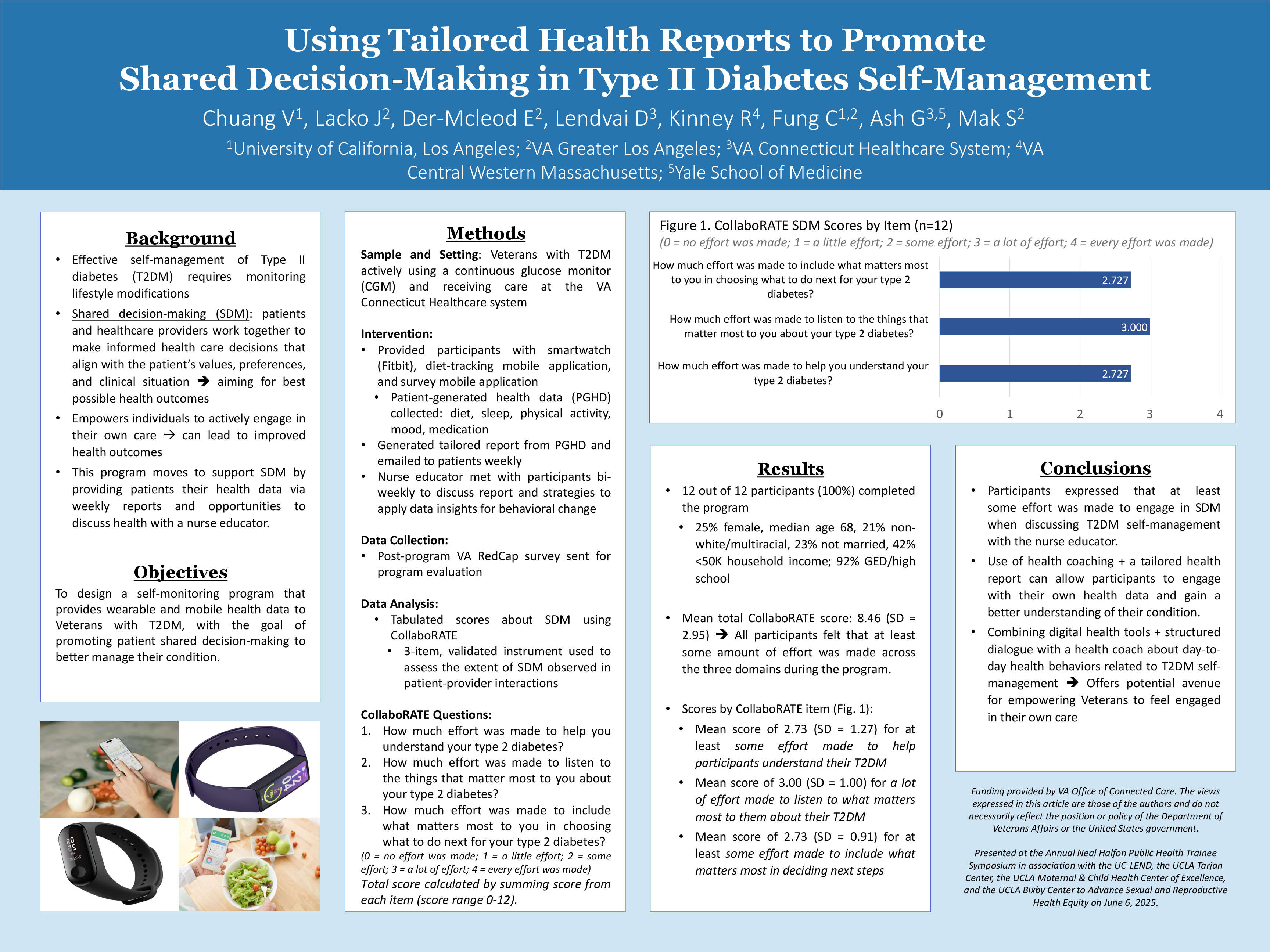
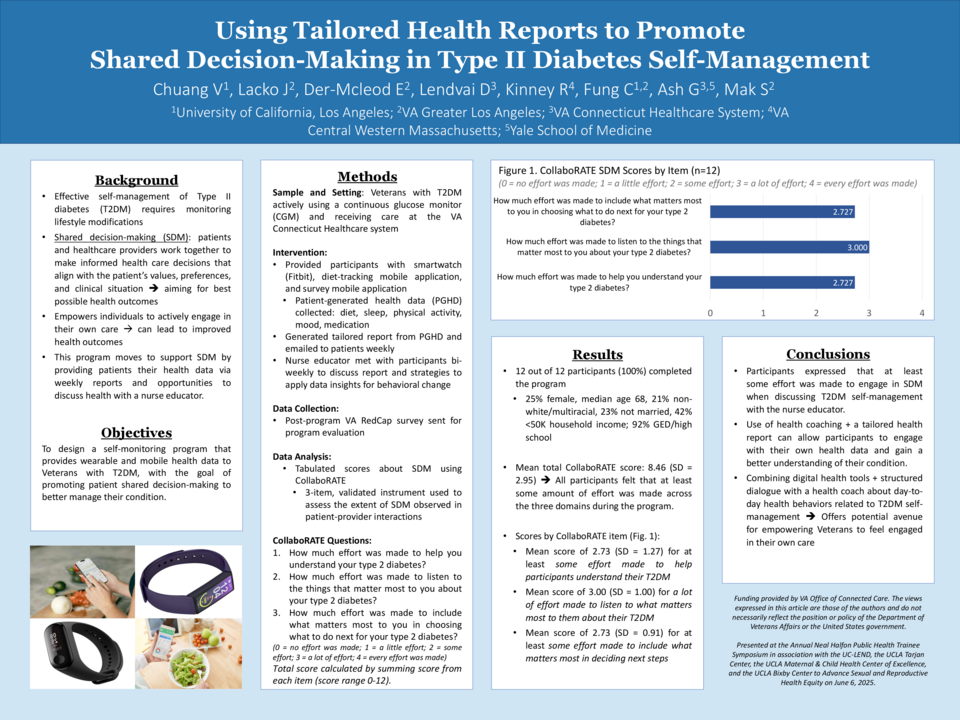
Adults with T2DM who are actively using a continuous glucose monitor (CGM) and receiving care at the VA Connecticut Healthcare system were eligible to participate. Participants were provided with a smartwatch (Fitbit), a diet-tracking mobile application, and a survey mobile application to collect diet, sleep, physical activity, mood and medication data. Participants verbally consented to share data with the project team through a third-party data platform. Participants received a tailored weekly report which visualized collected data points. A nurse educator met with participants at the end of weeks 1 and 3 to help participants interpret their data, set health goals, and develop strategies for self-management. A post-program REDCap survey was sent to participants for program evaluation, which included questions about SDM using CollaboRATE, a validated instrument which assesses the extent of SDM observed in patient-provider interactions using a 3 item Likert scale (where 0=no effort was made, 4=every effort was made), and score range is 0-12.
All 12 participants (25% female, median age 68, 21% non-white/multiracial, 23% not married, 42% <50K household income; 92% GED/high school) completed the program. Average scores for the CollaboRATE items were 2.73 (standard deviation [SD] = 1.27) for effort made to help participants understand their T2DM, 3.00 (SD = 1.00) for effort made to listen to what matters most to them about their T2DM or disease, and 2.73 (SD = 0.91) for effort made to include what matters most in deciding next steps. Collectively, all participants felt that at least some amount of effort was made across the three domains during the program (avg = 8.46, SD = 2.95).
Participant feedback after completing the program expressed that some effort was made in SDM of their T2DM self-management. The use of health coaching and a tailored health report can allow participants to engage with their own health data and gain a better understanding of their condition. This offers a potential avenue for empowering Veterans to feel engaged in their own care by integrating digital health tools with structured dialogue with a health coach about day-to-day health behaviors related to T2DM self-management.