Using Visual Evoked Potentials for the Detection of Amblyopia in Preverbal Children
Abstract
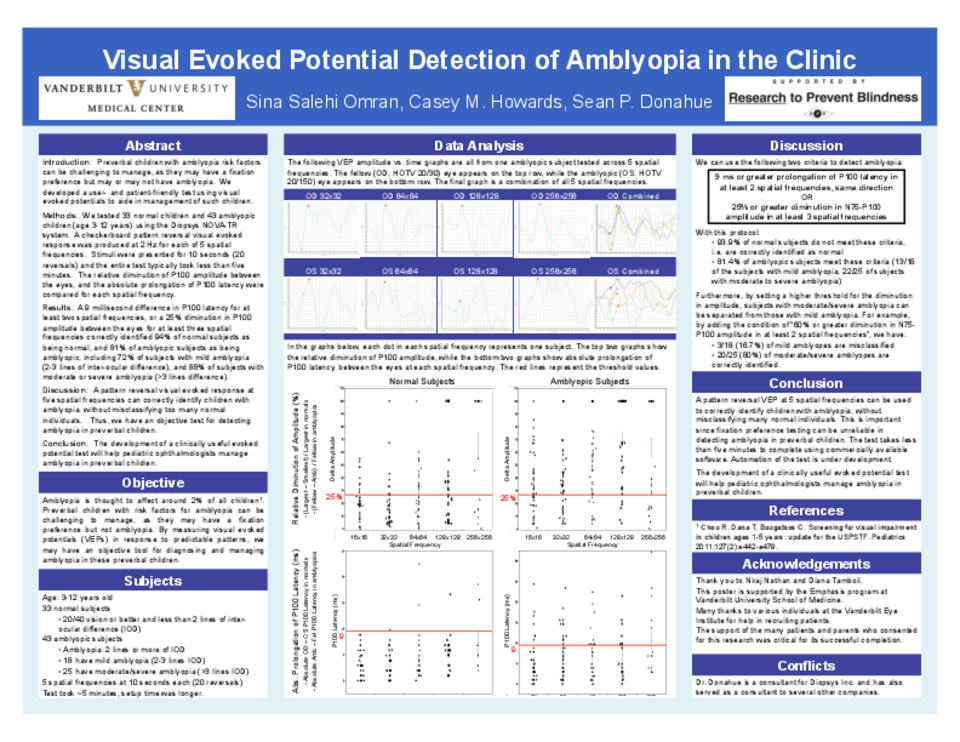
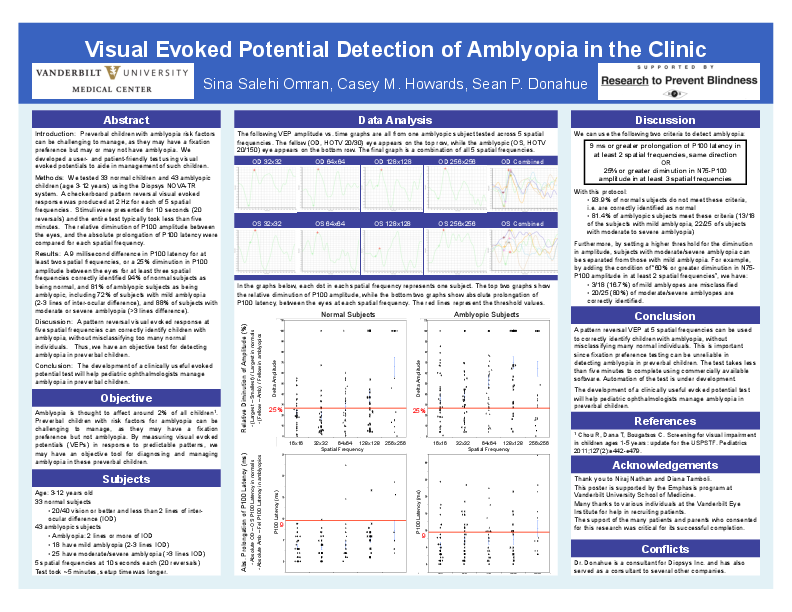
Introduction: Preverbal children with amblyopia risk factors can be challenging to manage, as they may have a fixation preference but may or may not have amblyopia. We developed a user- and patient-friendly test using visual evoked potentials to aide in management of such children.
Methods: We tested 33 normal children and 43 amblyopic children (age 3-12 years) using the Diopsys NOVA-TR system. A checkerboard pattern reversal visual evoked response was produced at 2 Hz for each of 5 spatial frequencies. Stimuli were presented for 10 seconds (20 reversals) and the entire test typically took less than five minutes. The relative diminution of P100 amplitude between the eyes, and the absolute prolongation of P100 latency were compared for each spatial frequency.
Results: A 9 millisecond difference in P100 latency for at least two spatial frequencies, or a 25% diminution in P100 amplitude between the eyes for at least three spatial frequencies correctly identified 94% of normal subjects as being normal, and 81% of amblyopic subjects as being amblyopic, including 72% of subjects with mild amblyopia (2-3 lines of inter-ocular difference), and 88% of subjects with moderate or severe amblyopia (>3 lines difference).
Discussion: A pattern reversal visual evoked response at five spatial frequencies can correctly identify children with amblyopia, without misclassifying too many normal individuals. Thus, we have an objective test for detecting amblyopia in preverbal children.
Conclusion: The development of a clinically useful evoked potential test will help pediatric ophthalmologists manage amblyopia in preverbal children.
Related articles