Abstract
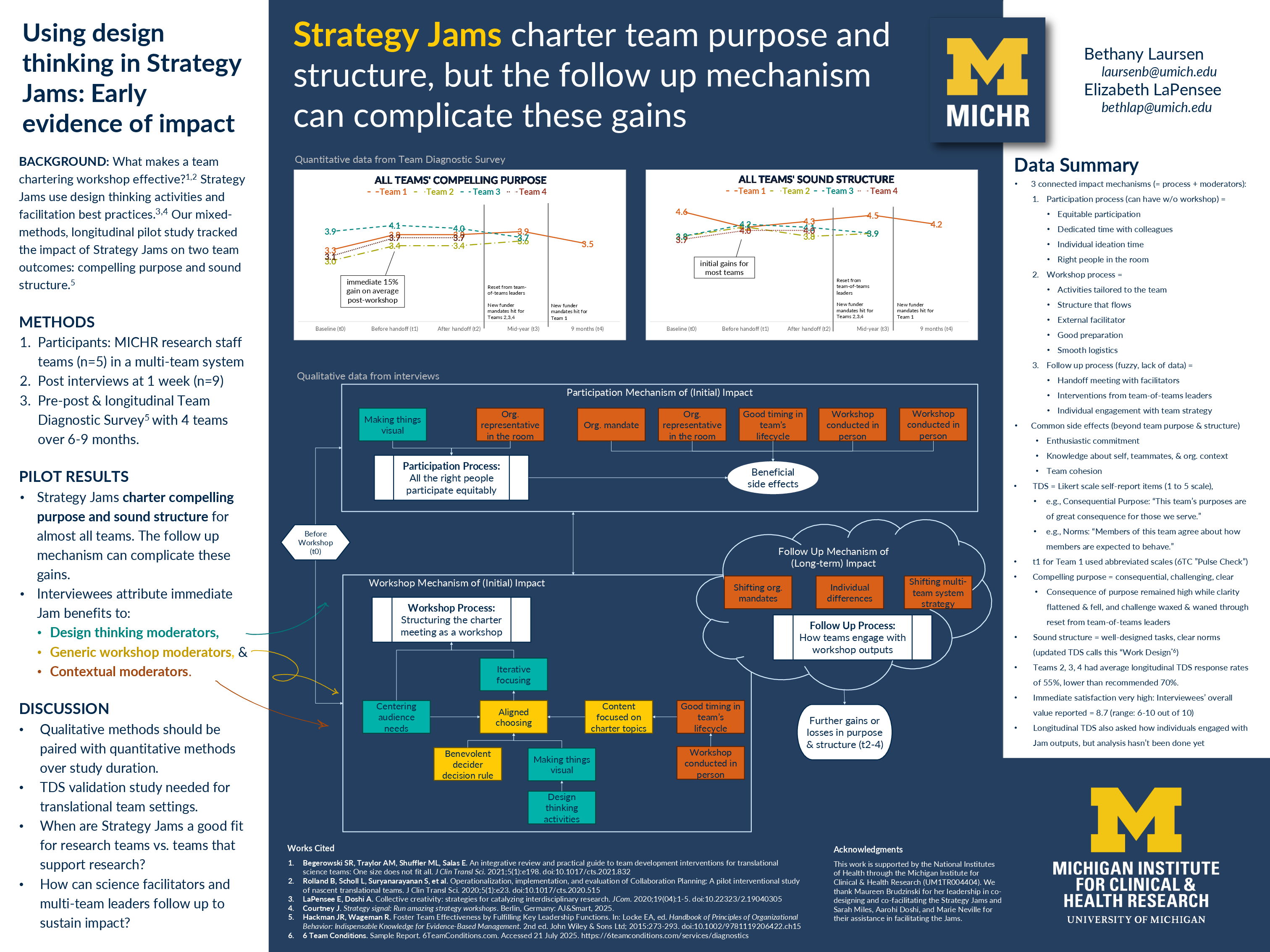
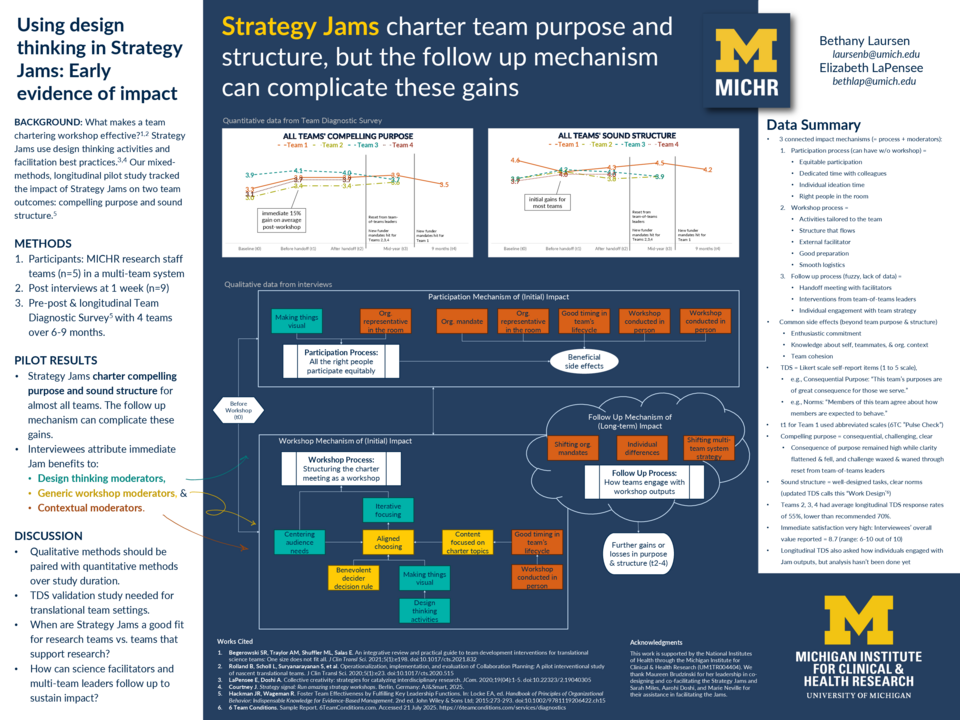
Background: Launching teams with a compelling purpose and sound structure is essential for future team performance [1], and participatory team chartering workshops can accelerate an effective team launch [2,3]. Default charters, such as grant proposals and unit mission statements, often lack the specificity to guide observable tasks and coordinated norms, necessitating additional efforts to crystallize team goals. Our ongoing work at the Michigan Institute for Clinical & Health Research (MICHR) focuses on addressing this need through Strategy Jams that utilize design thinking [4]. Strategy Jams are an innovative workshop model aiming to convert a team’s knowledge of audience needs into actionable purposes, principles, and projects. Strategy Jams uniquely integrate common workshop features (e.g., an external facilitator) and design thinking principles (e.g., empathize, define, ideate, prototype, and test). Design thinking is a human-centered approach to problem-solving and innovating [5]. It encourages teams to involve everyone in iteratively designing solutions to meet stakeholder needs. We posit that this approach can accelerate research team development and effectiveness [6].
Method: Building on last year’s work, we now report the outcomes of four Strategy Jam pilots—two more than previously reported—along with more longitudinal results. This ongoing mixed-method study triangulates qualitative insights from participant interviews with longitudinal quantitative data collected through the Team Diagnostic Survey [7]. This robust methodology allows us to capture a comprehensive view of the impact of our Strategy Jams over time.
Findings: ...
To read the full abstract, visit https://julnet.swoogo.com/scits25/poster-abstracts
References
- Hackman JR, Wageman R. Foster team effectiveness by fulfilling key leadership functions. In: Locke EA, ed. Handbook of Principles of Organizational Behavior. 2nd ed. John Wiley & Sons Ltd; 2015:273-293. doi:10.1002/9781119206422.ch15
- Begerowski SR, Traylor AM, Shuffler ML, Salas E. An integrative review and practical guide to team development interventions for translational science teams: One size does not fit all. J Clin Transl Sci. 2021;5(1):e198. doi:10.1017/cts.2021.832
- Ericksen J, Dyer L. Right from the start: Exploring the effects of early team events on subsequent project team development and performance. Adm Sci Q. 2004;49(3):438-471. doi:10.2307/4131442
- Brudzinski M, Laursen B. Strategy Jams: Using design thinking to charter teams with compelling purpose and sound structure. Poster presented at: Science of Team Science Conference; July 30, 2024. https://www.cureus.com/posters/2823-strategy-jams-using-design-thinking-to-charter-teams-with-compelling-purpose-and-sound-structure
- Micheli P, Wilner SJS, Bhatti SH, Mura M, Beverland MB. Doing design thinking: Conceptual review, synthesis, and research agenda. J Prod Innov Manag. 2019;36(2):124-148. doi:10.1111/jpim.12466
- LaPensee E, Doshi A. Collective creativity: Strategies for catalyzing interdisciplinary research. JCom. 2020;19(04):1-5. doi:10.22323/2.19040305
- Wageman R, Hackman JR, Lehman E. Team Diagnostic Survey: Development of an instrument. J Appl Behav Sci. 2005;41(4):373-398. doi:10.1177/0021886305281984