Abstract
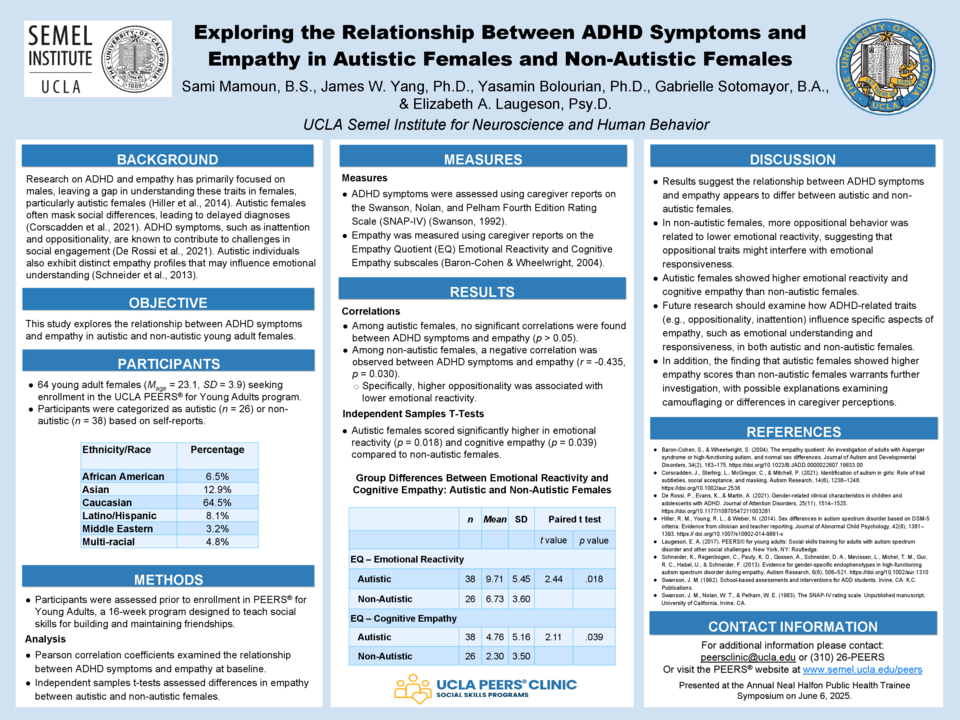
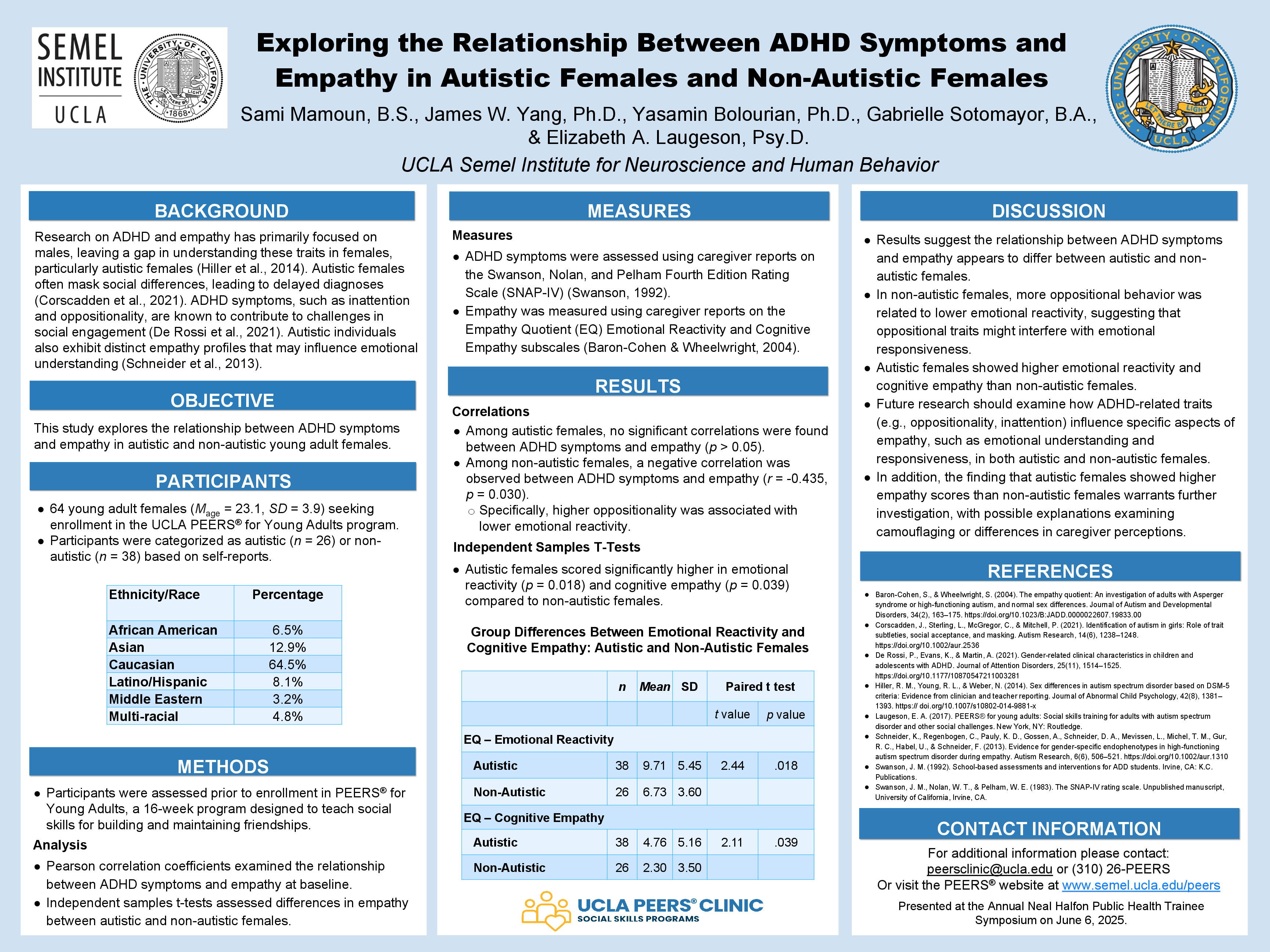
Background: Research on ADHD and empathy has primarily focused on males (Hiller et al., 2014), leaving a gap in understanding these traits in females, particularly autistic females who often mask social differences, which may lead to delayed diagnosis (Corscadden et al., 2021). ADHD symptoms, including inattention and oppositionality, can impact social engagement (De Rossi et al., 2021). Additionally, autistic individuals often exhibit distinct empathy profiles that affect emotional understanding (Schneider et al., 2013), which may influence levels of social engagement. Given the social challenges associated with both ADHD and autism, examining how ADHD symptoms relate to empathy in autistic and non-autistic females can provide valuable insights into their social-emotional functioning.
Objectives: This study explores the relationship between ADHD symptoms and empathy in autistic and non-autistic young adult females.
Methods: Participants included 64 young adult females (Mage = 23.1, SD = 3.9) enrolled in the UCLA PEERS® for Young Adults program, an evidence-based social skills intervention for neurodivergent adults (Laugeson et al., 2015). Participants were categorized as autistic (n = 26) or non-autistic (n = 38) based on self-reports. ADHD symptoms were assessed using the caregiver-reported Swanson, Nolan, and Pelham Rating Scale (SNAP-IV; Swanson, 1992), while empathy was measured using the caregiver-reported emotional reactivity and cognitive empathy subscales of the Empathy Quotient (EQ; Baron-Cohen & Wheelwright, 2004). Pearson correlation coefficients examined the relationship between ADHD symptoms and empathy, and independent sample t-tests assessed differences between groups.
Results: For autistic females, no significant correlations were found between ADHD symptoms and empathy. In non-autistic females, a significant negative correlation was found between the SNAP-IV oppositionality subscale and the EQ emotional reactivity subscale (r = -0.435, p = 0.030). Independent samples t-tests revealed a significant difference on the Emotional Reactivity subscale of the EQ between autistic and non-autistic females, t(62) = 2.44, p = .018, with a mean difference of 2.97 (95% CI [0.53, 5.42]). A significant difference was also observed on the Cognitive Empathy subscale of the EQ, t(62) = 2.11, p = .039, with a mean difference of 2.45 (95% CI [0.13, 4.78]). However, no significant differences were found between autistic and non-autistic females on all subscales of the SNAP-IV based on caregiver reports prior to attending PEERS®.
Conclusion: The findings suggest the relationship between ADHD symptoms and empathy are different in autistic and non-autistic females, with non-autistic females showing a significant negative correlation between ADHD oppositionality and emotional reactivity. For non-autistic females, more oppositional behaviors were related to less emotional reactivity. Additionally, non-autistic females demonstrated higher levels of emotional reactivity and cognitive empathy compared to autistic females based on caregiver reports. These results underscore the need for tailored supports addressing the unique social-emotional challenges in autistic females, particularly those with co-occurring ADHD. Future research should investigate specific interactions between ADHD symptoms, such as oppositional behavior, and different aspects of empathy, like emotional understanding or responsiveness, in both autistic and non-autistic females.