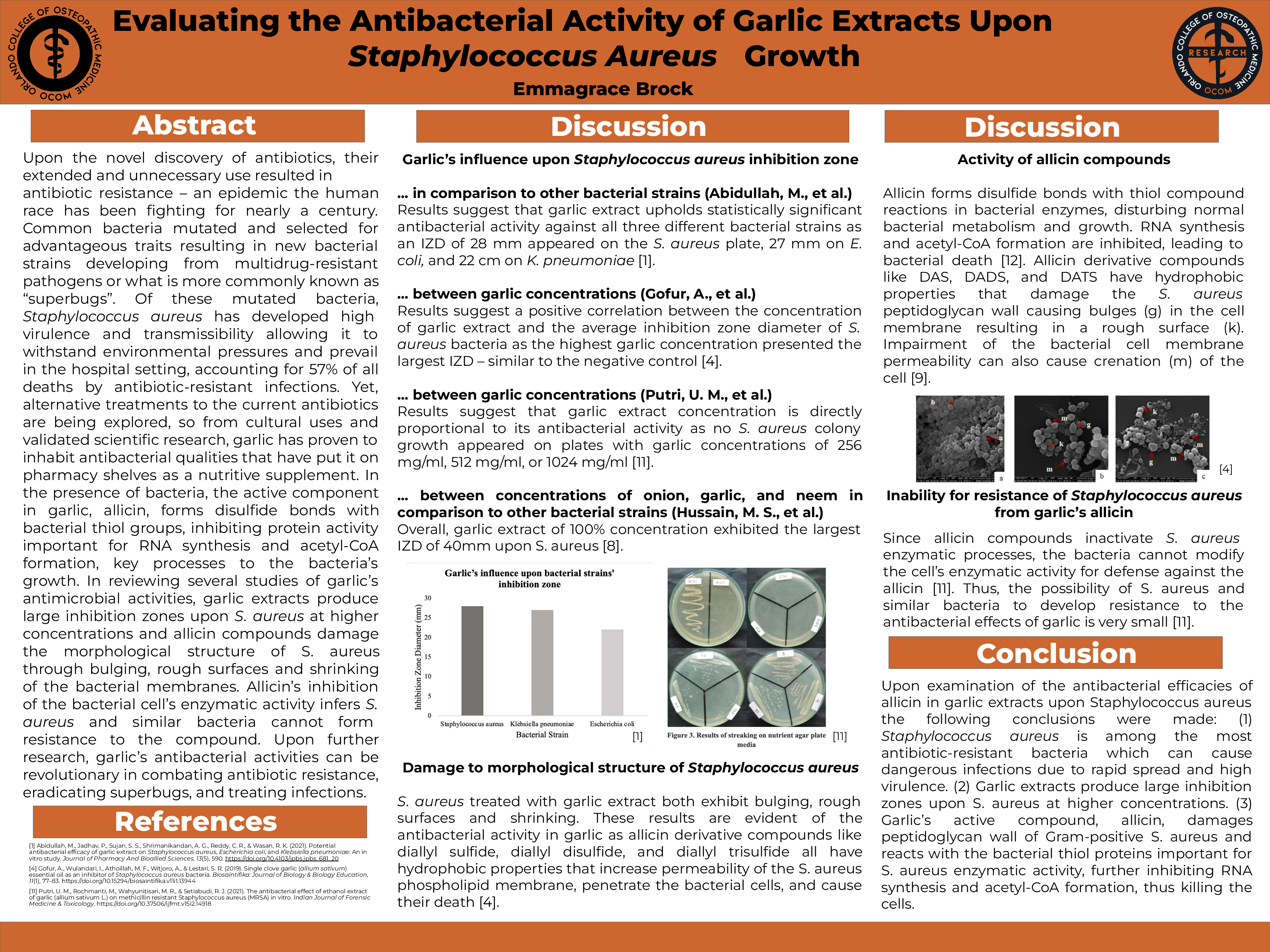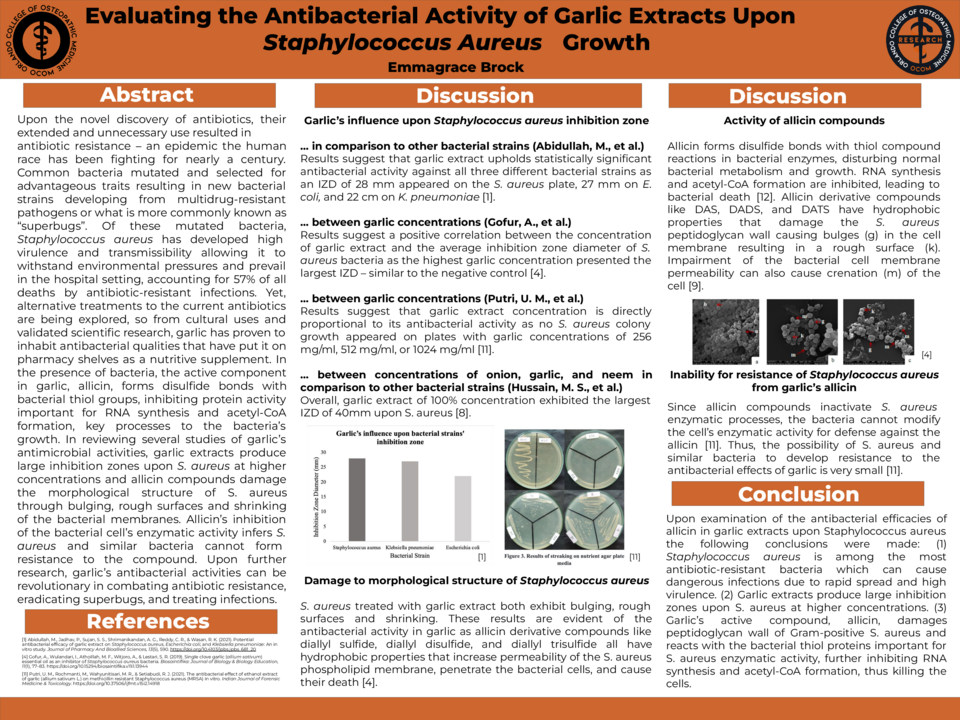
Abstract
Background & Introduction
Due to overuse of the novel antibiotics, rapid accumulation of favored mutations is responsible for the high virulence and transmissibility of superbugs. The most severe antibiotic-resistant infections contract in the hospital setting, causing over 2.8 million cases and more than 35,000 deaths in the US each year [2]. Methicillin-resistant Staphylococcus aureus (MRSA) is identified as a very prevalent strain of S. aureus that has acquired resistance to all beta-lactam antibiotics like penicillins, cephalosporins, carbapenems, and monobactams [3]. MRSA and other virulent bacteria have evolved to form beta-lactamases – enzymes that deactivate the beta-lactam ring of the antibiotic in order to develop resistance [3]. The first known medicinal uses of garlic were practiced more than 4000 years ago in traditional Chinese medicine and centuries later in Egyptian medicine both for ”flu-like” symptoms. Allicin, a major organosulfur compound in garlic, is the component responsible for garlic’s antimicrobial activities. When a garlic clove is crushed, the two compounds alliin and alliinase combine to form allicin [6]. In this review, we evaluate the antibacterial activity of garlic extracts upon Staphylococcus aureus bacterial growth. Factors to be discussed are garlic’s influence upon the inhibition zone of S. aureus, allicin activity, garlic’s effects onto the morphological structure of S. aureus, and the inability of S. aureus to develop resistance to garlic’s active components.
Objective
To evaluate the antibacterial activity of garlic extracts upon Staphylococcus aureus bacterial growth. - Garlic’s antibacterial influence upon S. aureus inhibition zone - Garlic’s antibacterial damage to morphological structure of Staphylococcus aureus - Activity of Allicin Compounds - Inability for resistance of Staphylococcus aureus from garlic’s allicin.
Methods
14 sources were collected from Google Scholar via the mentioned key words. Journals were chosen based upon sufficient background and relevant methodology to approach the mentioned objectives.
Results
Results suggest that garlic extract upholds statistically significant antibacterial activity against all three different bacterial strains as an IZD of 28 mm appeared on the S. aureus plate, 27 mm on E. coli, and 22 cm on K. pneumoniae [1]. Results suggest a positive correlation between the concentration of garlic extract and the average inhibition zone diameter of S. aureus bacteria as the highest garlic concentration presented the largest IZD – similar to the negative control [4]. Results suggest that garlic extract concentration is directly proportional to its antibacterial activity as no S. aureus colony growth appeared on plates with garlic concentrations of 256 mg/ml, 512 mg/ml, or 1024 mg/ml [11]. Overall, garlic extract of 100% concentration exhibited the largest IZD of 40mm upon S. aureus [8]. S. aureus treated with garlic extract both exhibit bulging, rough surfaces and shrinking. These results are evident of the antibacterial activity in garlic as allicin derivative compounds like diallyl sulfide, diallyl disulfide, and diallyl trisulfide all have hydrophobic properties that increase permeability of the S. aureus phospholipid membrane, penetrate the bacterial cells, and cause their death [4]. Allicin forms disulfide bonds with thiol compound reactions in bacterial enzymes, disturbing normal bacterial metabolism and growth.