Abstract
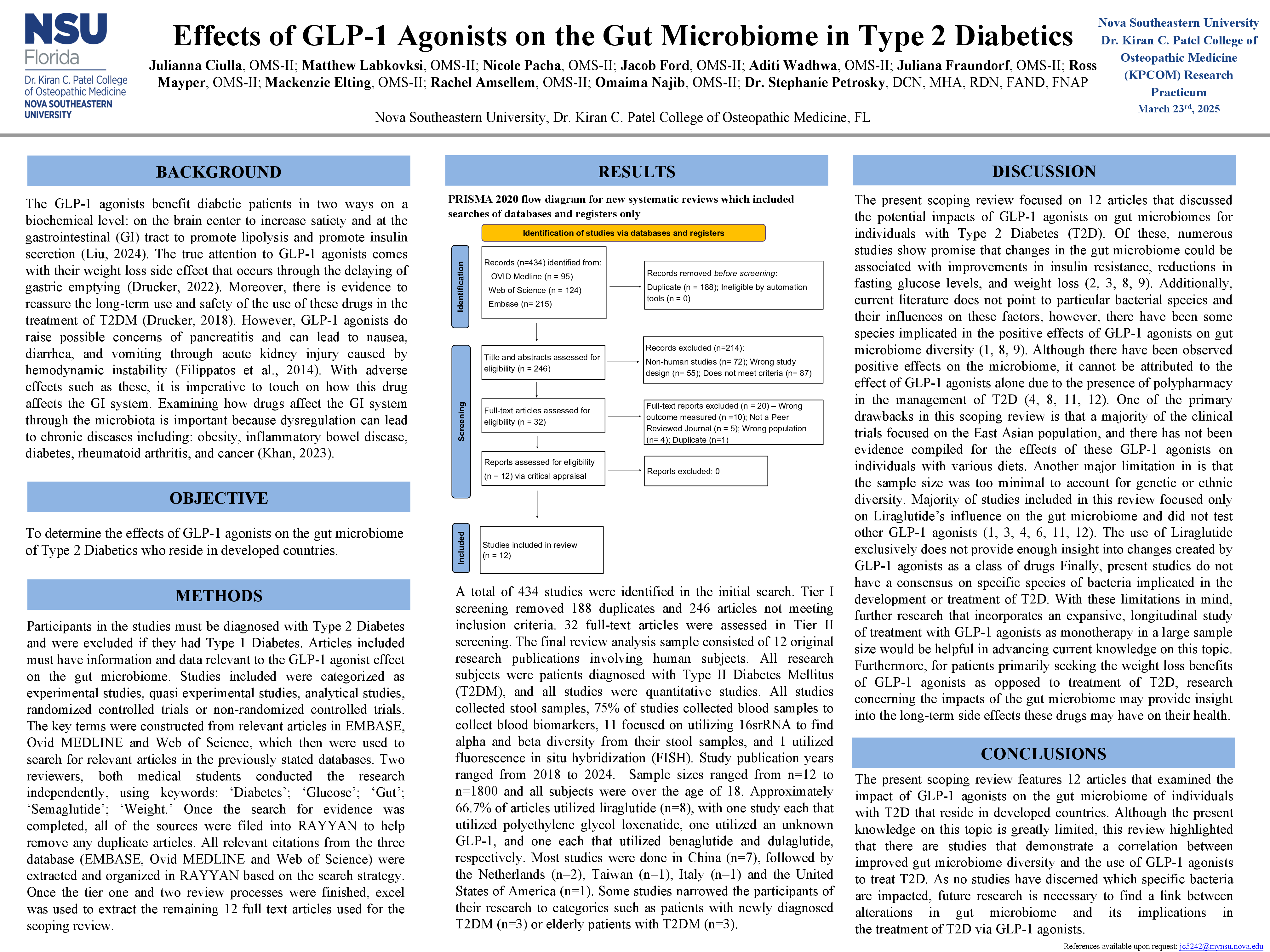
Background: Glucagon-like peptide 1 (GLP-1) agonists are a medication that have gained recent increased popularity to treat Type 2 Diabetes (T2D) through their stimulation of insulin secretion, reduction of glucagon, and suppression of appetite. The gut microbiome is the collection of microorganisms that reside in the gastrointestinal tract which have been recently implicated in their potential role for influencing insulin resistance.
Objective: To determine the effects of GLP-1 agonists on the gut microbiome of Type 2 Diabetics who reside in developed countries.
Methods: This scoping review utilized articles from three databases: Embase, OVID, and Web of Science. From these, 434 articles were gathered that were pertinent to the initial search terms ‘Diabetes’, ‘Glucose’, ‘Gut’, ‘Semaglutide’, and ‘Weight.’ Of these, 188 duplicates were removed, and 246 moved onto the first phase of article review. For this, 10 reviewers screened each article’s title and abstract, and the final decision belonged to two of these reviewers. The inclusion criteria for this stage were that the articles had to be human studies, randomized controlled trials, and strictly focus on Type 2 Diabetes. After this, 32 articles moved onto the Tier II phase. During Tier II Review, 2 reviewers read the full-text articles and determined if they still adhered to the inclusion criteria aforementioned. Following this process, 12 articles were included in this scoping review via critical appraisal.
Results: The twelve articles included discussed the effects of GLP-1 agonists on gut microbiomes of individuals with T2D. It was shown that the gut microbiome shift after taking a GLP-1 agonist has impacts on insulin resistance, blood glucose levels, and weight loss potential. However, current literature does not describe particular species of bacteria associated with the studied effect on T2D. Additionally, the positive effects that have been seen in the gut microbiome have not shown causation between the use of GLP-1 agonists and these changes.
Conclusion: Although the present knowledge on this topic is greatly limited, this review highlights that there are studies that demonstrate a correlation between improved gut microbiome diversity and the use of GLP-1 agonists to treat T2D. As no studies have discerned which specific bacteria are impacted, future research is necessary to find a link between alterations in gut microbiome and its implications in the treatment of T2D via GLP-1 agonists.