Abstract
Introduction:
Electronic health record (EHR) free text notes generated by clinicians are vital for clinical research, as they often contain details not found elsewhere in the EHR. Due to limited resources, a University of Michigan (UM) research support team asked us for guidance on which types of notes are most used, so they could prioritize notes for de-identification. At UM we provide researchers with access to EMERSE, a tool for searching fully identified free text notes, and optionally viewing notes within the tool. The EMERE audit logs contain details about whether the use was for research, what users searched for, and what specific notes a user manually opened/reviewed.
Methods:
We queried the EMERSE audit logs for a 43-month period (Jan 01, 2021 – Aug 01, 2024). Frequency counts and note metadata were obtained and summarized. Ages of notes viewed for research were also summarized and compared to non-research use. During this time, there were approximately 2.5 to 3 million patients and 250-300 million notes indexed within the system. Only notes that were fully opened by the user within EMERSE were counted.
Results:
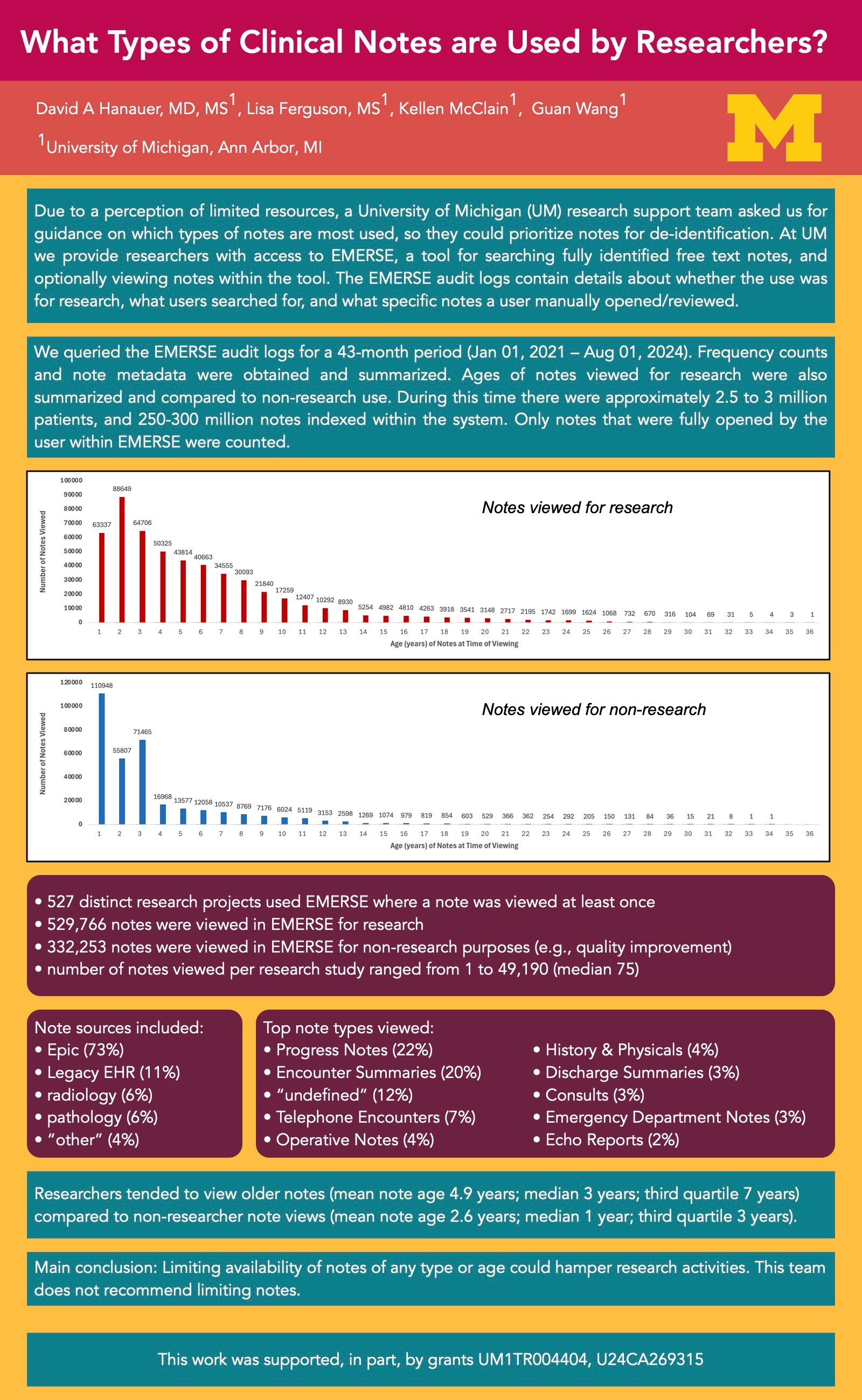
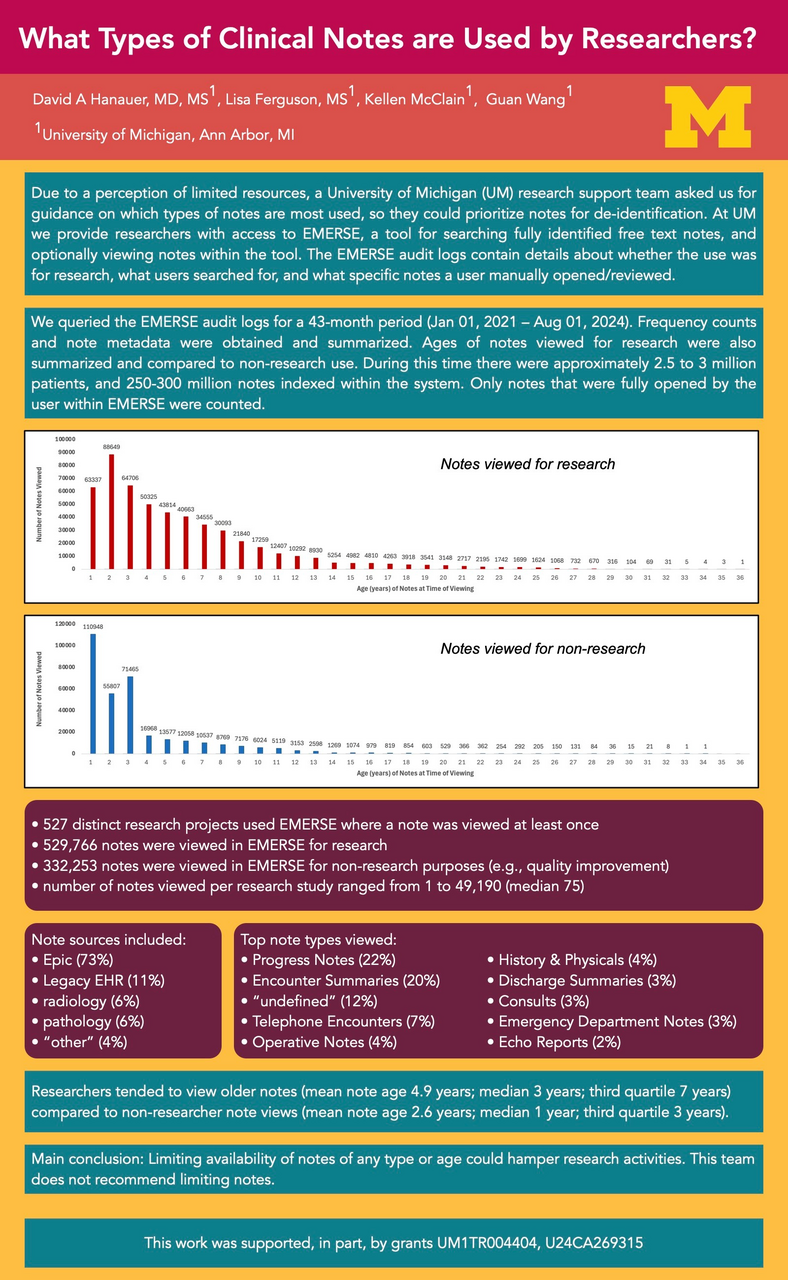
During the 43-month study period, there were 527 distinct research projects using EMERSE where a note was viewed at least once, with 529,766 total notes opened. During this time period, 332,253 notes were also viewed in EMERSE for non-research purposes (e.g., quality improvement). The number of notes viewed per research study ranged from 1 to 49,190 (median 75). The most common sources for notes included Epic (73%), CareWeb, our homegrown EHR decommissioned in 2014 (11%), Radiology (6%), Pathology (6%), and “other” (4%). Among 208 distinct note types viewed, the top 10 (representing nearly 80% of all notes viewed) were Progress Notes (22%), Encounter Summaries (20%), “undefined” (12%), Telephone Encounters (7%), Operative Notes (4%), History & Physicals (4%), Discharge Summaries, Consults (3%), Emergency Department Notes (3%), and Echo Reports (2%). The age of the notes (i.e., how old the notes were at the time of viewing) opened for research were compared to the age of notes for non-research use (Figure). Researchers tended to view older notes (mean note age 4.9 years; median 3 years; third quartile 7 years) compared to non-researcher note views (mean note age 2.6 years; median 1 year; third quartile 3 years).
Discussion and Conclusion:
Researchers use a variety of note sources and types and viewed older notes compared to non-researchers. Limiting access to notes of any type or age could harm research activities. Audit logs are useful for understanding what notes are viewed in clinical systems,1 and a strength of our study was our ability to focus on notes viewed specifically for research, which is often impossible in common EHR systems that typically do not record reason for use. Limitations of our analysis were that the proportion of notes could be influenced by the kinds of studies using EMERSE, and we only had log data linking research use to note viewing within EMERSE--we do not have similar Epic logs, even though researchers also use that system. Future work should include incorporating log data from other clinical systems.
References:
1. Nestor JG, Fedotov A, Fasel D, et al. An electronic health record (EHR) log analysis shows limited clinician engagement with unsolicited genetic test results. JAMIA Open. 2021 Mar 1;4(1):ooab014. doi: 10.1093/jamiaopen/ooab014. PMID: 33709066; PMCID: PMC7935499