Biomechanical Comparison of Two Meniscal Repair Devices with Standard Inside-Out Meniscal Repair Technique in a Porcine Model
Abstract
Surgical repair of injured menisci has traditionally been done using an inside-out suturing technique. Recently, all-inside meniscal repair devices have been developed which allow repairs to be made through arthroscopic portals. Popular all-inside meniscal repair devices include the Ultra FasT-Fix Mensical Repair System by Smith & Nephew®, and the Meniscal Cinch by Arthrex®. Few studies have compared biomechanical properties of these devices to inside-out controls.
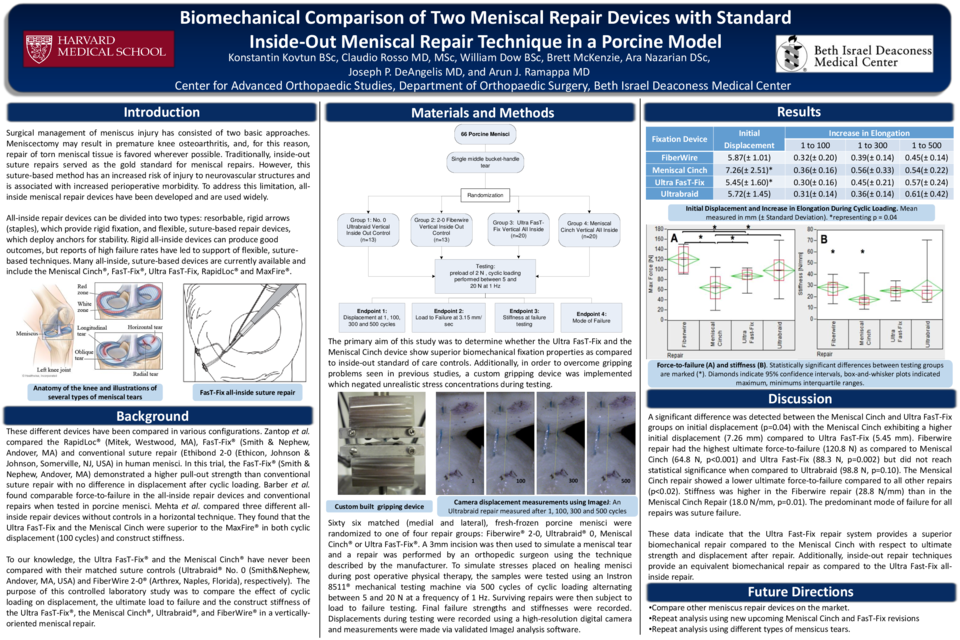
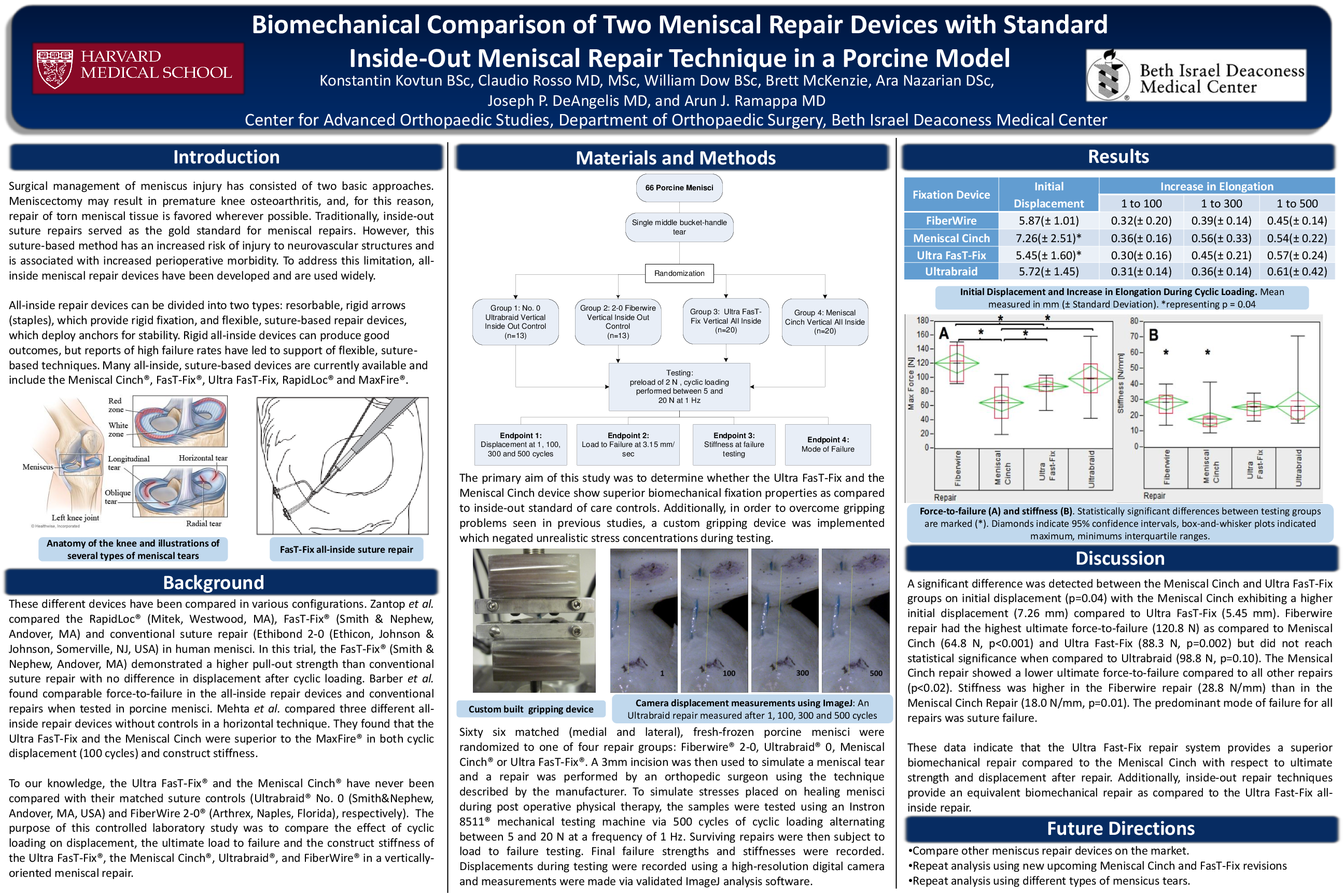
The primary aim of this study was to determine whether the Ultra FasT-Fix and the Meniscal Cinch device show superior biomechanical fixation properties as compared to inside-out standard of care controls. Additionally, in order to overcome gripping problems seen in previous studies, a custom gripping device was implemented which negated unrealistic stress concentrations during testing.
Sixty six matched (medial and lateral), fresh-frozen porcine menisci were randomized to one of four repair groups: Fiberwire® 2-0, Ethibond® 2-0, Meniscal Cinch® or Ultra FasT-Fix®. A 3mm incision was then used to simulate a meniscal tear and a repair was performed by an orthopedic surgeon using the technique described by the manufacturer. To simulate stresses placed on healing menisci during post operative physical therapy, the samples were tested using an Instron 8511® mechanical testing machine via 500 cycles of cyclic loading alternating between 5 and 20 N at a frequency of 1 Hz. Surviving repairs were then subject to load to failure testing. Final failure strengths and stiffnesses were recorded. Displacements during testing were recorded using a high-resolution digital camera and measurements were made via validated ImageJ analysis software.
A significant difference was detected between the Meniscal Cinch and Ultra FasT-Fix groups on initial displacement (p=0.04) with the Meniscal Cinch exhibiting a higher initial displacement (7.26 mm) compared to Ultra FasT-Fix (5.45 mm). Fiberwire repair had the highest ultimate force-to-failure (120.8 N) as compared to Meniscal Cinch (64.8 N, p<0.001) and Ultra Fast-Fix (88.3 N, p=0.002) but did not reach statistical significance when compared to Ultrabraid (98.8 N, p=0.10). The Mensical Cinch repair showed a lower ultimate force-to-failure compared to all other repairs (p<0.02). Stiffness was higher in the Fiberwire repair (28.8 N/mm) than in the Meniscal Cinch Repair (18.0 N/mm, p=0.01). The predominant mode of failure for all repairs was suture failure.
These data indicate that the Ultra Fast-Fix repair system provides a superior biomechanical repair compared to the Meniscal Cinch with respect to ultimate strength and displacement after repair. Additionally, inside-out repair techniques provide an equivalent biomechanical repair as compared to the Ultra Fast-Fix all-inside repair.
Related articles