Abstract
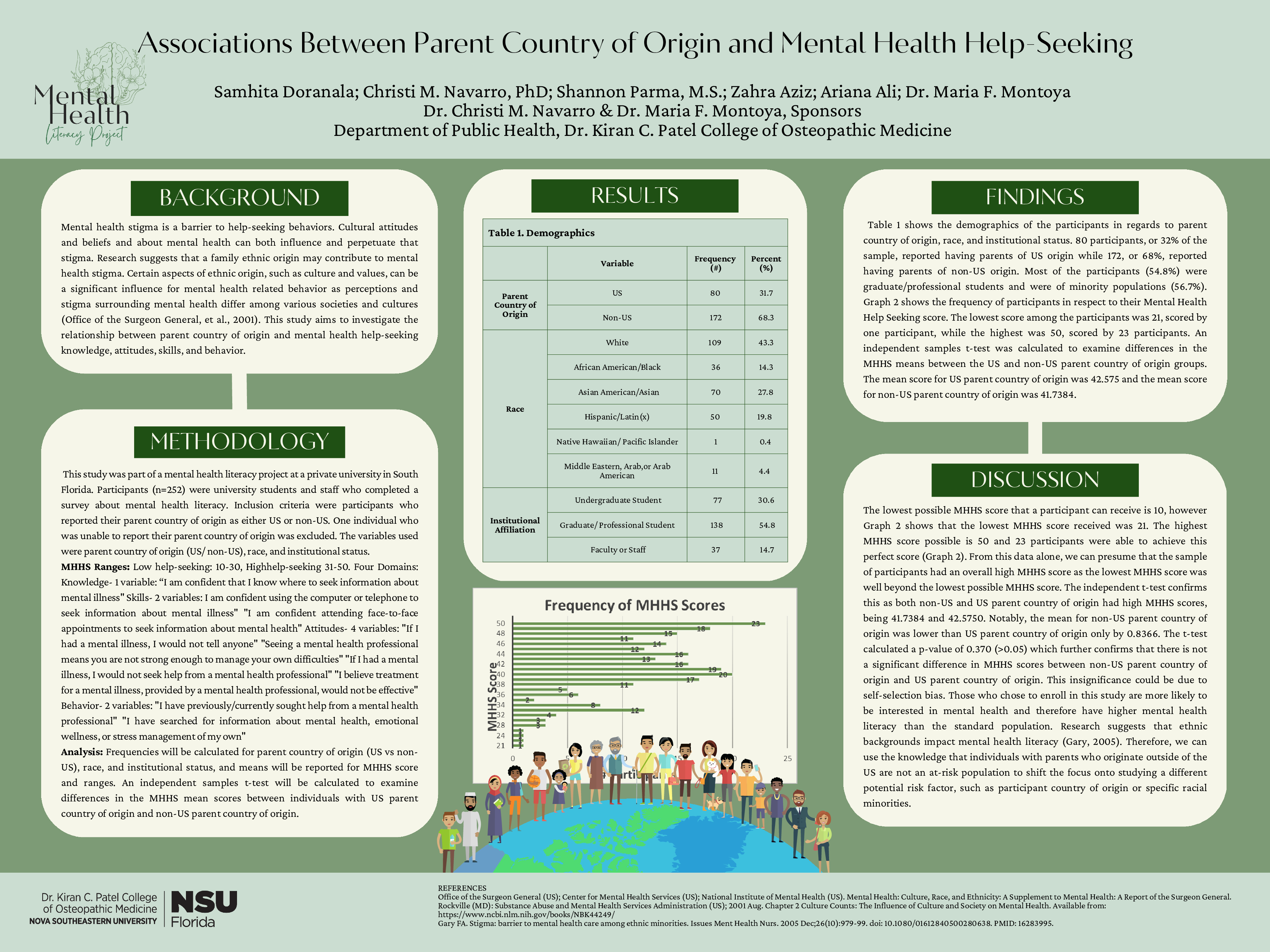
Mental health stigma is a barrier to help-seeking behaviors. Cultural attitudes and beliefs and about mental health can both influence and perpetuate that stigma. Research suggests that a family ethnic origin may contribute to mental health stigma. This study aims to investigate the relationship between parent country of origin and mental health help-seeking knowledge, attitudes, skills, and behavior.
A cross-sectional study was conducted as part of a mental health literacy pilot project at private university in South Florida. Parent country of origin (U.S. vs. non-U.S.) was used to examine the likelihood of participants (n=252) to report on seven attributes related to help-seeking: knowledge (“Know where to seek information about mental illness”), skills (“Confident using technology to seek information;” “Confident attending face-to-face appointments to seek information”), attitudes (“If I had a mental illness, I would not seek help from a mental health professional;” “If I had a mental illness I would not tell anyone”), and behaviors (“Searched for information about mental health on my own;” “Previously/currently sought help from a mental health professional”).
An independent samples t-test was calculated to examine differences in the MHHS means between the US and non-US parent country of origin groups. The mean score for US parent country of origin was 42.575 and the mean score for non-US parent country of origin was 41.7384. A p-value of 0.370 (>0.05) showed no significant difference in MHHS scores between non-US parent country of origin and US parent country of origin. Results from this study can be used to inform public health approaches to mental health literacy in targeting different potential risk factors, such as participant country of origin or specific racial minorities, rather than second-generation individuals, to improve knowledge, skills, and attitudes about help-seeking behaviors.