Abstract
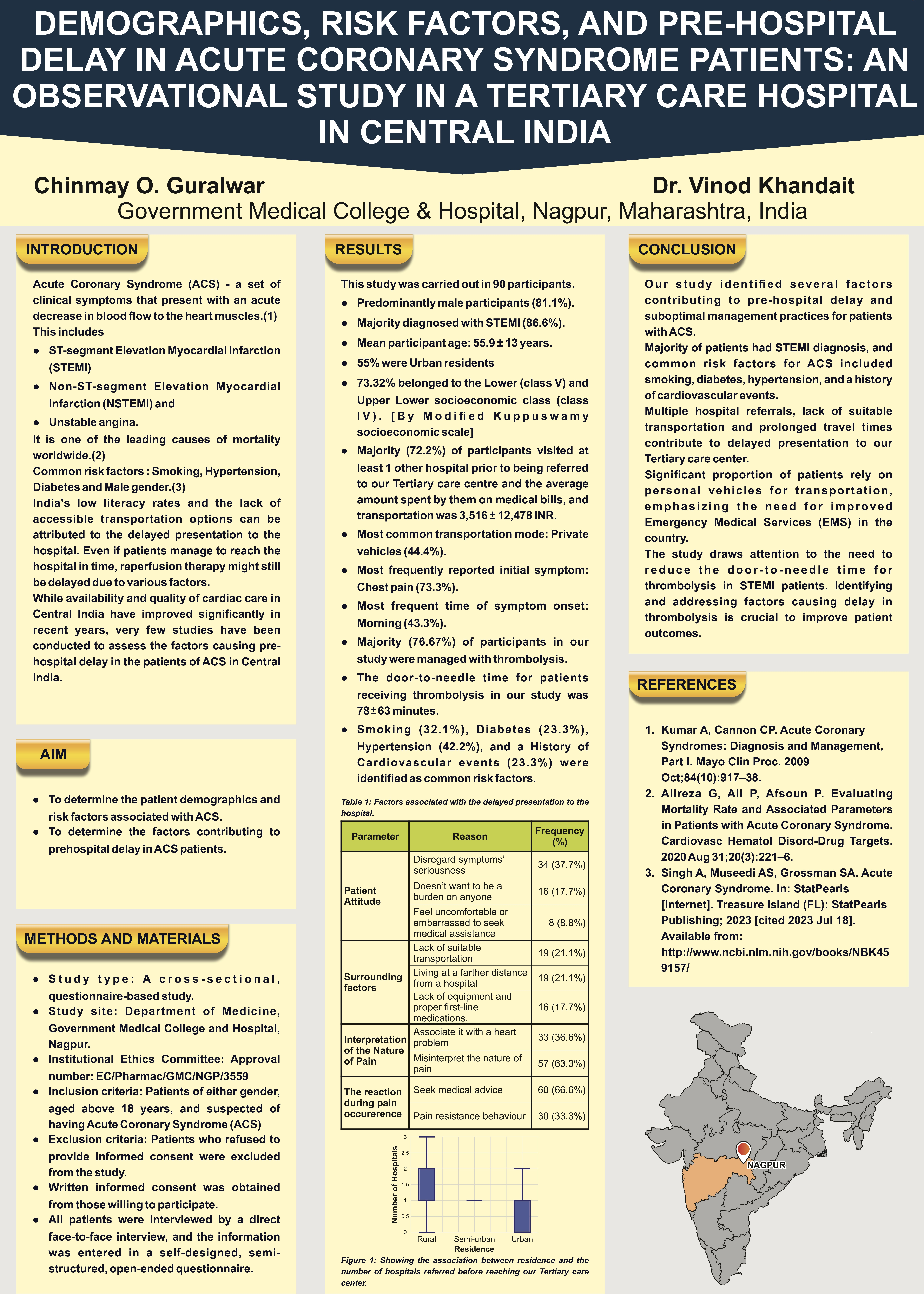
Background: Acute Coronary Syndrome (ACS) is one of the leading causes of mortality worldwide. No accurate estimates are available; however, over three million cases of ACS may occur in India every year. Thus, this study was planned to determine the patient demographics and risk factors associated with ACS and determine the factors causing the prehospital delay.
Methods: The study was conducted using a cross-sectional design and a questionnaire-based approach at the Department of Medicine, Government Medical College and Hospital, Nagpur. The study population consisted of patients who were hospitalized due to ACS. All patients were interviewed face-to-face using a self-designed, semi-structured, open-ended questionnaire.
Results: The sample consisted of 73 males (81.1%) and 17 females (18.9%), with the participants comprising 86.6% STEMI (n=78), 10% NSTEMI (n=9), and 3.33% Unstable Angina (n=3). Smoking, diabetes, hypertension, and a history of cardiovascular events were identified as common risk factors for ACS. The most cited reason (n=34, 37.7%) for the delay in seeking medical treatment was not considering presenting symptoms to be serious. Chest pain (73.3%) was the most commonly reported first symptom by patients, with Morning (43.3%) being the most frequent time of symptom onset. Males were more likely to have an anterior wall MI, while females were more likely to have an inferior wall MI and a posterior wall MI. Patients who were referred to more hospitals tended to use ambulances to reach the Tertiary care hospital, while patients who were referred to fewer hospitals tended to use private vehicles or friend’s/relative's vehicles. Individuals from rural areas had to go to at least one more hospital before arriving at our Tertiary care center. The majority (76.67%) of participants in our study were managed with thrombolysis. The door-to-needle time for patients receiving thrombolysis in our study was 78+63 minutes.
Conclusion: Patients faced significant economic burdens and delays in seeking medical help, with rural residents having to visit more hospitals before arriving at a Tertiary care center. The study draws attention to the need for reducing the door-to-needle time for thrombolysis in STEMI patients to improve treatment outcomes and the need for improved Emergency Medical Services (EMS) in the country.
References:
1. Kumar A, Cannon CP. Acute Coronary Syndromes: Diagnosis and Management, Part I. Mayo Clin Proc. 2009 Oct;84(10):917–38.
2. Alireza G, Ali P, Afsoun P. Evaluating Mortality Rate and Associated Parameters in Patients with Acute Coronary Syndrome. Cardiovasc Hematol Disord-Drug Targets. 2020 Aug 31;20(3):221–6.
3. Singh A, Museedi AS, Grossman SA. Acute Coronary Syndrome. In: StatPearls [Internet]. Treasure Island (FL): StatPearls Publishing; 2023 [cited 2023 Jul 18]. Available from: http://www.ncbi.nlm.nih.gov/books/NBK459157/