Abstract
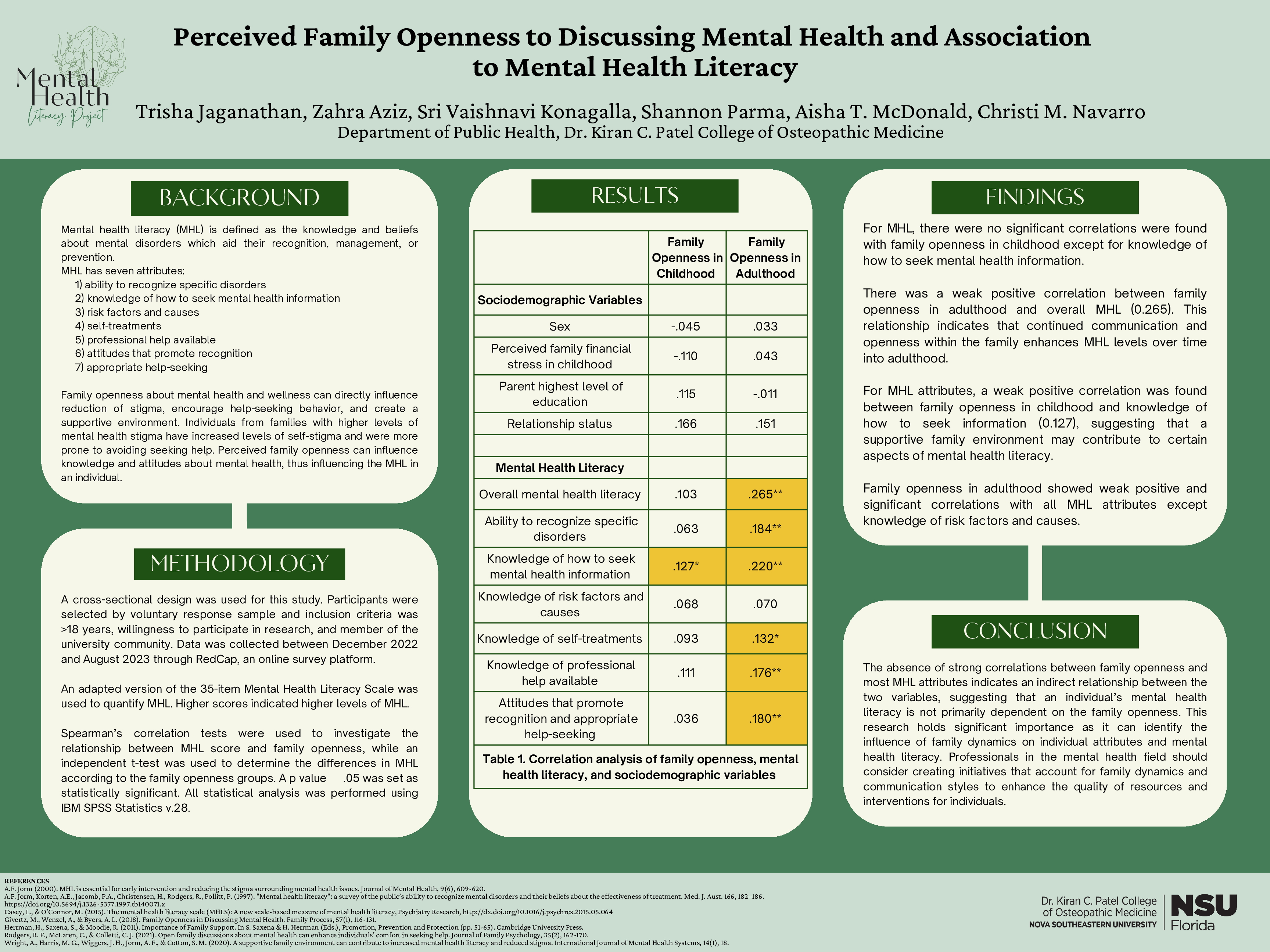
Mental health literacy (MHL) is defined as the knowledge and beliefs about mental disorders which aid their recognition, management, or prevention. MHL has seven attributes: 1) ability to recognize specific disorders, knowledge of 2) how to seek mental health information, 3) risk factors and causes, 4) self-treatments, 5) professional help available, and 6) attitudes that promote recognition and 7) appropriate help-seeking.
Family openness about mental health and wellness can directly influence reduction of stigma, encourage help-seeking behavior and create a supportive environment. Conversely, individuals from families with higher levels of mental health stigma have increased levels of self-stigma and were more prone to avoiding seeking help. Perceived family openness can influence knowledge and attitudes about mental health, thus influencing the MHL in an individual. The objective of this study is to examine the relationship between MHL and perceived family openness in a university community.
A cross-sectional design was used for this study. Participants were selected by voluntary response sample and inclusion criteria was >18 years, willingness to participate in research, and member of the university community. Data was collected between December 2022 and August 2023 through RedCap, an online survey platform.
An adapted version of the 35-item Mental Health Literacy Scale was used to quantify MHL. Higher scores indicated higher levels of MHL. Two questions were asked in relation to participants’ perceptions of family openness to discussions about mental health-related issues during childhood (“growing up”) and currently in adulthood.
Spearman’s correlation tests were used to investigate the relationship between MHL score and family openness, while an independent t-test was used to determine the differences in MHL according to the family openness groups. A p value ≤ .05 was set as statistically significant. All statistical analysis was performed using IBM SPSS Statistics v.28.
For MHL, there were no significant correlations found with the family openness in childhood, however, there was weak positive correlation between family openness in adulthood and MHL. This relationship indicates that continued communication and openness within the family enhances MHL levels over time into adulthood.
For MHL attributes, a weak positive correlation was found between family openness in childhood and knowledge of how to seek information, suggesting that a supportive family environment may contribute to certain aspects of mental health literacy. Family openness in adulthood showed weak positive and significant correlations with all MHL attributes except knowledge of risk factors and causes.
The absence of strong correlations between family openness and most MHL attributes indicates an indirect relationship between the two variables, suggesting that an individual’s mental health literacy is not primarily dependent on the family openness. This research holds significant importance as it can identify the influence of family dynamics on individual attributes and mental health literacy. Professionals in the mental health field should consider creating initiatives that account for family dynamics and communication styles to enhance the quality of resources and interventions for individuals.