Abstract
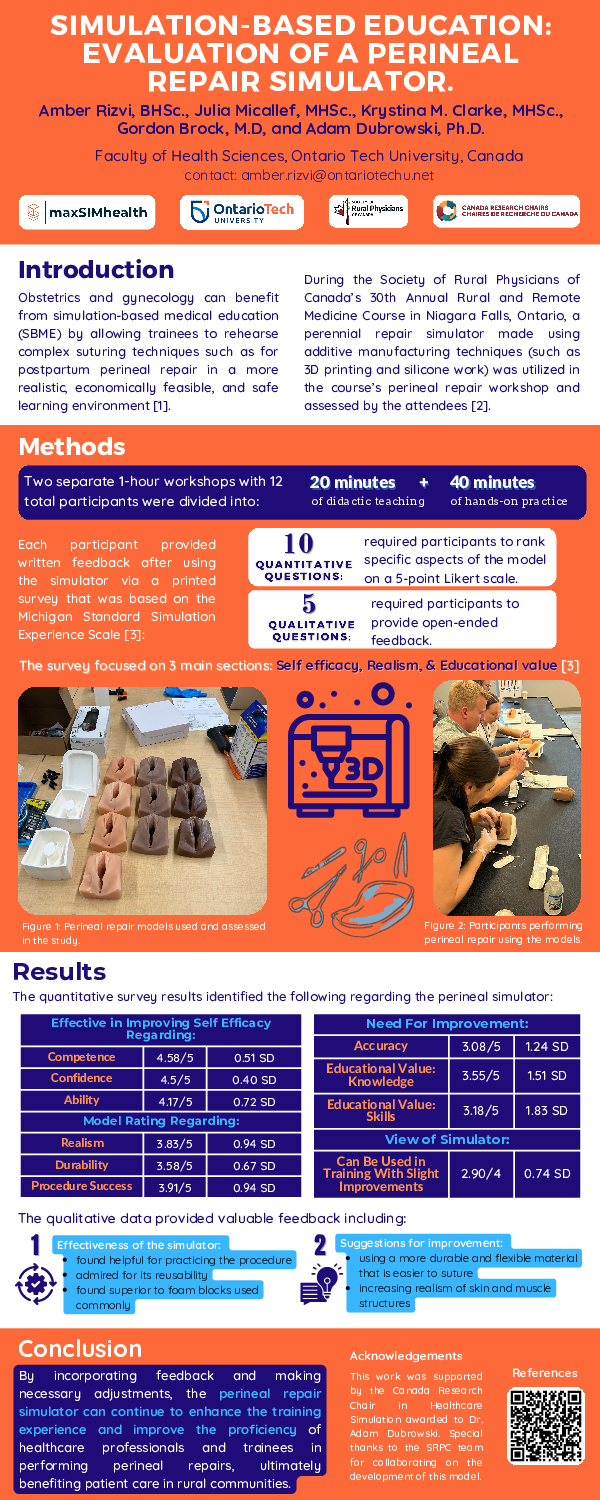
Introduction: Obstetrics and gynecology can benefit from simulation-based medical education (SBME) by allowing trainees to rehearse complex suturing techniques such as postpartum perineal repair in a more realistic, economically feasible, and safe learning environment. During the Society of Rural Physicians of Canada (SRPC)’s 30th Annual Rural and Remote Medicine Course in Niagara Falls, Ontario, a previously developed perennial repair simulator was utilized in the perineal repair workshop and assessed by the attendees. The simulator was made using additive manufacturing (AM) techniques such as 3D printing and silicone work. The assessment of the perineal repair model used during the perineal repair workshop is described in this study.
Methods: The participants involved in this study were 12 attendees who registered for the medicine course and expressed interest in participating. Two separate 1-hour workshops were divided into 20 minutes of didactic teaching followed by 40 minutes of hands-on practice using the silicone models. Each participant provided feedback after using the stimulator in the form of a paper survey based on the Michigan Standard Simulation Experience Scale. The 10 quantitative questions required participants to rank specific aspects of the model on a 5-point Likert scale and the 5 qualitative questions were to provide open-ended feedback. The quantitative data was analyzed as frequencies, means, and standard deviations (SD). Anything that had a mean above 3.5/5 (70%) and an SD below one was considered acceptable. The qualitative data was thematically analyzed and triangulated between the survey data and field notes.
Results: Regarding the quantitative survey question results, the perineal simulator was found to be effective in improving self-efficacy concerning; competence (4.58/5, 0.51 SD), confidence (4.5/5, 0.40 SD), and ability (4.17/5, 0.72 SD) in performing the procedure. The realism of the model was rated highly for having realistic features (3.83/5, 0.94 SD), being durable (3.58/5, 0.67 SD), and being able to successfully perform the procedure (3.91/5, 0.94 SD). However, there is a need for improvement with respect to the simulator feeling more accurate (3.08/5, 1.24 SD). The educational value of this simulator was an area needing improvement with respect to learning the knowledge (3.55/5, 1.51 SD) and skills (3.18/5, 1.83 SD) related to performing perineal repairs. Despite this, the majority of participants indicated that this simulator can be used in training but should be improved slightly (2.90/4, 0.74 SD). The main themes emerging from the qualitative data are; 1) the effectiveness of the simulator, 2) challenges with the simulator, 3) improving the realism of anatomical features, and 4) a comparison to other simulators.
Discussion: The assessment of the perineal repair simulator suggests that the 3D-printed perineal repair simulator has the potential to enhance training and skill development in perineal repair procedures. The positive impact on self-efficacy, realistic features, and overall satisfaction among participants demonstrates the value of utilizing SBME in rural areas to overcome the limitations imposed by limited hands-on experience. The feedback provided by participants offers valuable insights to further improve the simulator, such as enhancing the accuracy of anatomical features and addressing material durability and flexibility, to continue to enhance the training experience.