Abstract
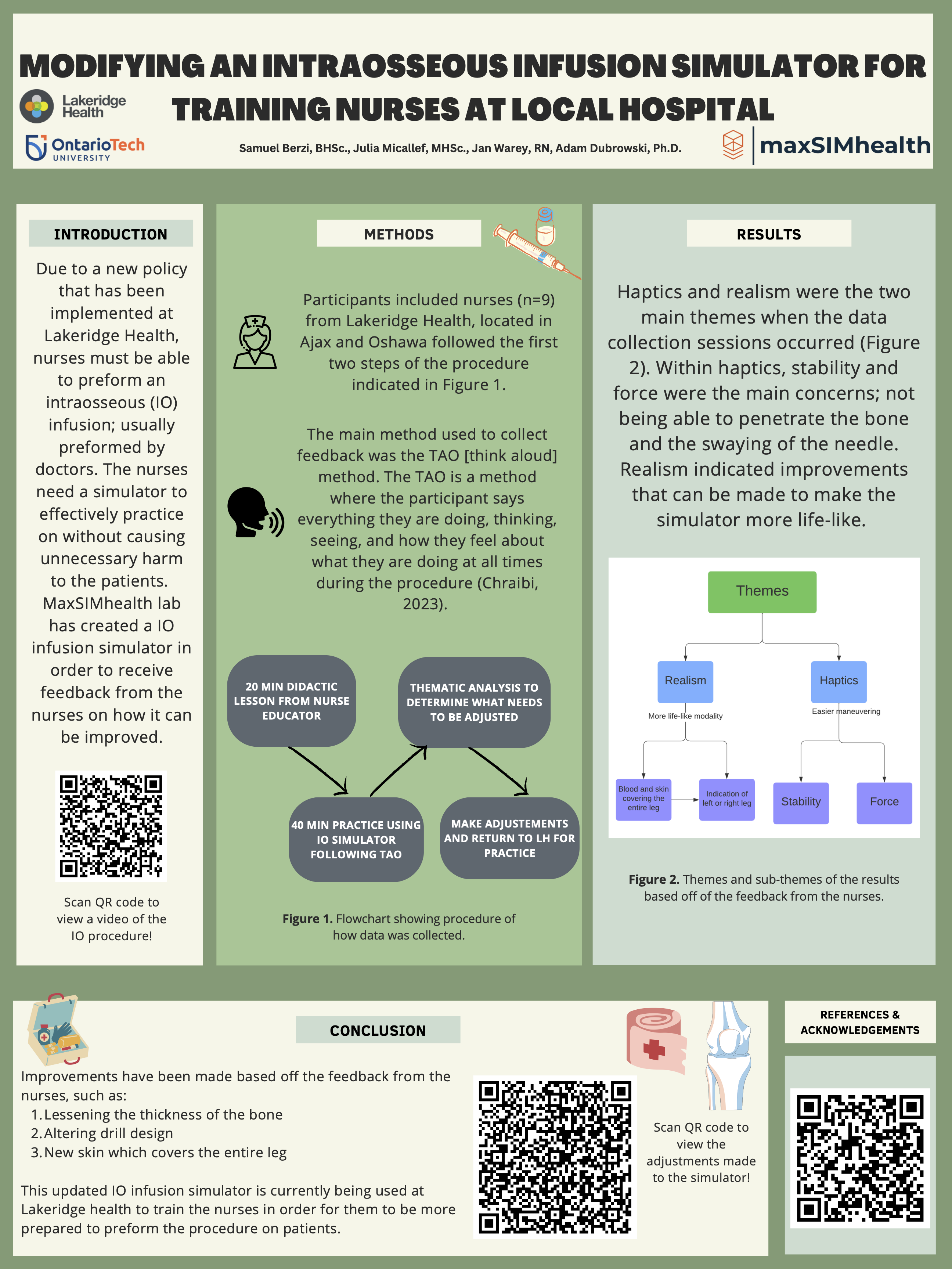
A policy has been implemented at Lakeridge Health that requires nurses to perform an intraosseous (IO) infusion, which is usually performed by doctors or paramedics, and involves drilling a hole into the patient's bone to administer medication when venous access is not possible (Jousi et al., 2019). An effective way that nurses can practice the procedure is through simulation (Kothari et al., 2017). Simulation-based health professional education uses simulation experience to allow healthcare professionals to practice their clinical skills without causing harm to patients (Kothari et al., 2017). Therefore, the objective of this work was to obtain feedback on a previously developed IO infusion simulator made for paramedics and make the needed adjustments using additive manufacturing techniques, such as 3D printing and silicon, to create a cost-effective and customizable IO simulator to fit the needs of the nurses.
The outcomes of this work have informed the design of the IO infusion simulator for the procedure to be implemented at Lakeridge Health for IO training for nurses. Specifically, this feedback was used to make the adjustments to the IO simulator, such as lessening the thickness of the bone and altering the design of the drill bit so it is more stable and requires less effort to push the needle. Additionally, a new skin layer was made so that the entire leg was covered and was more secure. This updated IO infusion simulator is currently being used at Lakeridge Health to train nurses on this procedure so that they are prepared to perform this skill on patients.