Abstract
Introduction: Lingual thyroid, a rare condition where thyroid tissue is ectopically located in the tongue, poses a diagnostic and therapeutic challenge due to its infrequency. Its prevalence is estimated to be around 1 in 100,000 individuals, predominantly affecting females. The condition often remains asymptomatic but can lead to complications such as dysphagia, dysphonia, and airway obstruction, necessitating timely intervention. There is a dearth of information in the literature regarding the ideal therapeutic strategy for treating ectopic thyroid, particularly when oral submucous fibrosis complicates matters.
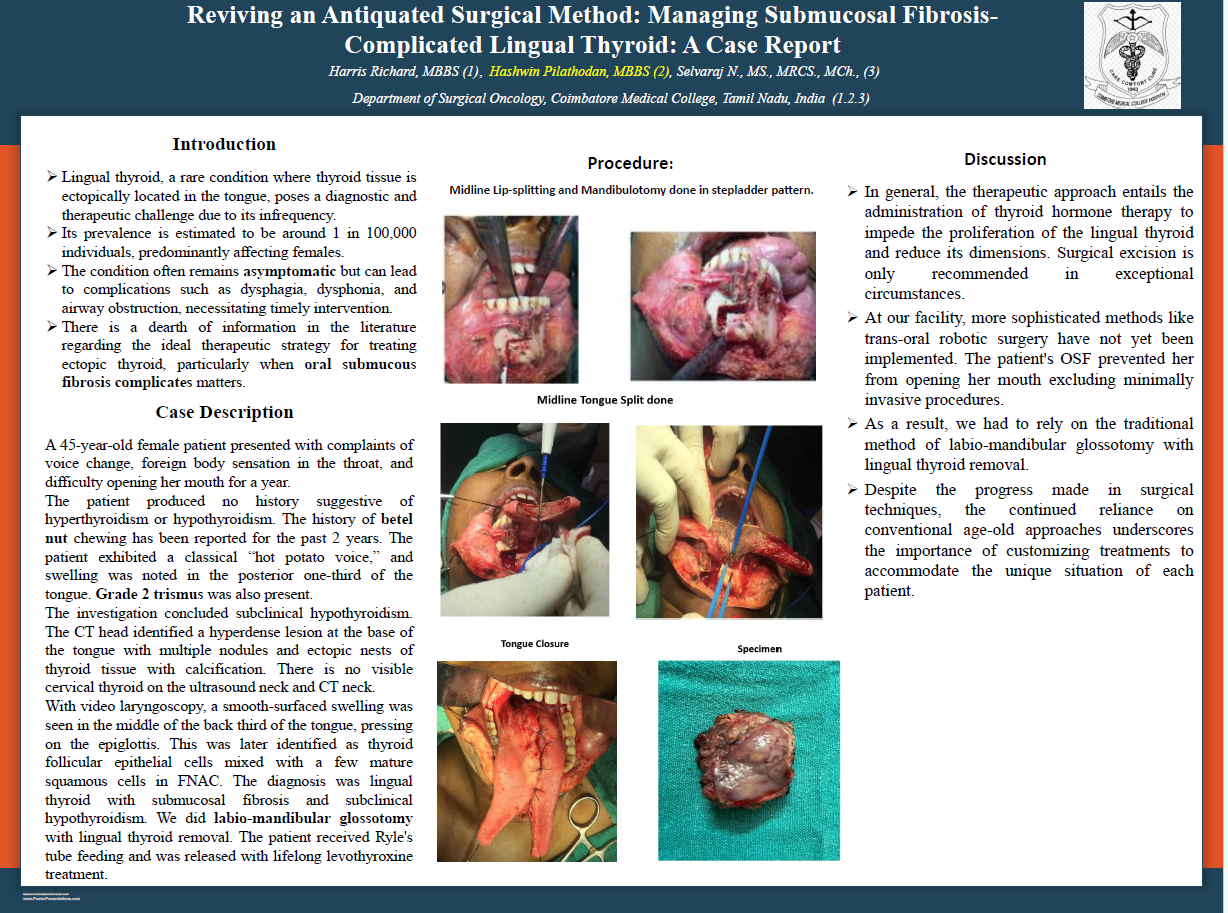
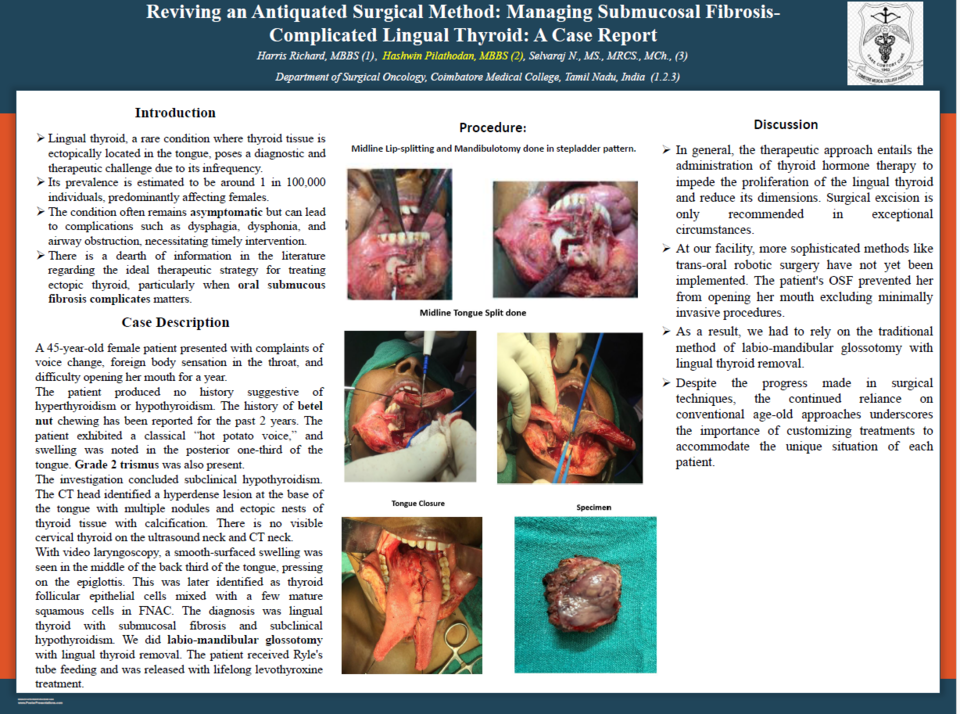
Case: A 45-year-old female patient presented with complaints of voice change, foreign body sensation in the throat, and difficulty opening her mouth for a year. The patient produced no history suggestive of hyperthyroidism or hypothyroidism. The history of betel nut chewing has been reported for the past 2 years. The patient exhibited a classical “hot potato voice,” and swelling was noted in the posterior one-third of the tongue. Grade 2 trismus was also present. The investigation concluded subclinical hypothyroidism. The CT head identified a hyperdense lesion at the base of the tongue with multiple nodules and ectopic nests of thyroid tissue with calcification. There is no visible cervical thyroid on the ultrasound neck or CT neck. With video laryngoscopy, a smooth-surfaced swelling was seen in the middle of the back third of the tongue, pressing on the epiglottis. This was later identified as thyroid follicular epithelial cells mixed with a few mature squamous cells in FNAC. The diagnosis was lingual thyroid with submucosal fibrosis and subclinical hypothyroidism. We did labiomandibular glossotomy and lingual thyroid removal. The patient received Ryle's tube feeding and was released with lifelong levothyroxine treatment.
Discussion: In general, the therapeutic approach entails the administration of thyroid hormone therapy to impede the proliferation of the lingual thyroid and reduce its dimensions. Surgical excision is only recommended in exceptional circumstances. At our facility, we were unable to use more sophisticated methods like trans-oral robotic surgery because the patient's OSF prevented her from opening her mouth. As a result, we had to rely on the traditional method of labio-mandibular glossotomy. Despite the progress made in surgical techniques, the continued reliance on conventional approaches underscores the importance of customizing treatments to accommodate the unique situation of each patient.