Abstract
Introduction: Pyomyositis is an uncommon and clinically significant manifestation of deep-seated soft tissue infections. Although less common than superficial skin and soft tissue infections, its occurrence can lead to severe morbidity and occasionally mortality if not promptly diagnosed and appropriately managed.
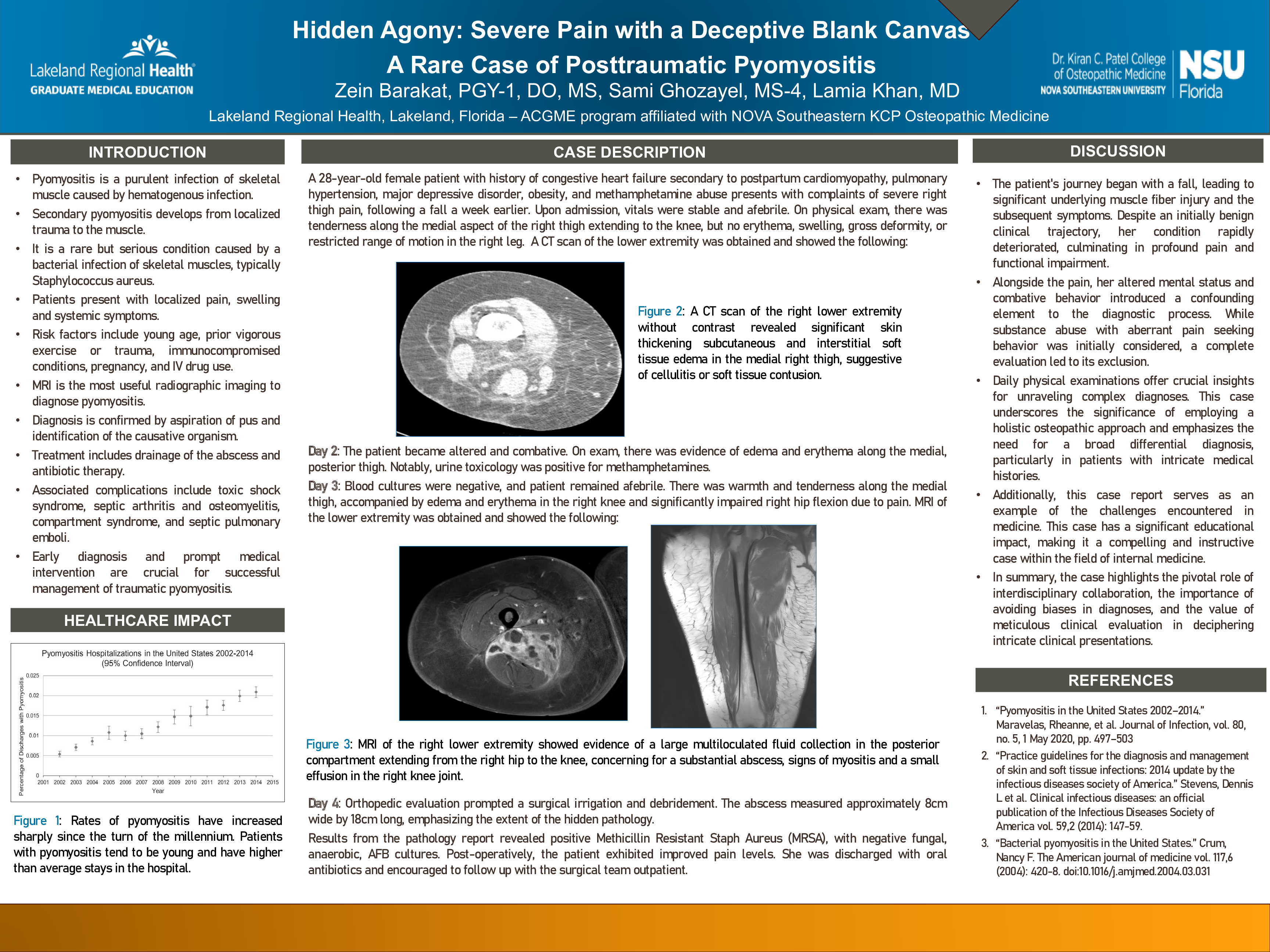
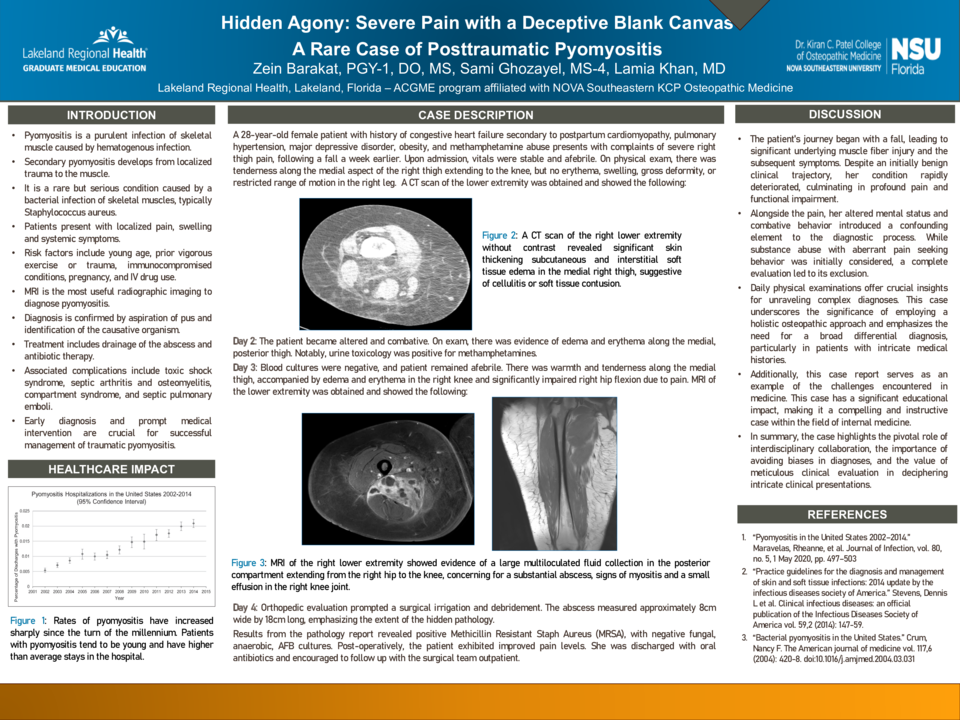
Case: A 28-year-old female patient with history of congestive heart failure secondary to postpartum cardiomyopathy, pulmonary hypertension, major depressive disorder, obesity, and methamphetamine abuse presents with complaints of severe right thigh pain, following a fall a week earlier. Upon examination, her vitals were stable and afebrile. The finding was tenderness along the medial aspect of the right thigh extending to the knee. There was no erythema, swelling, gross deformity, or restricted range of motion in the right leg. A CT scan of the lower extremity without contrast revealed significant skin thickening subcutaneous and interstitial soft tissue edema in the medial right thigh, suggestive of cellulitis or soft tissue contusion. No fracture or joint effusion was detected, but reactive right groin lymph nodes were noted. The patient was initially treated with vancomycin and piperacillin-tazobactam. Urine toxicology returned positive for methamphetamines. On the next day, the patient became altered and combative. On exam, there was evidence of edema and erythema along the medial, posterior thigh. Her kidney function was deteriorating; thus, vancomycin was replaced with daptomycin. On the third day, there was notable warmth and tenderness along the medial thigh, accompanied by edema and erythema in the right knee. There was no evidence of bacteremia, based on blood cultures and the patient remained afebrile. As the kidney function improved, magnetic resonance imaging (MRI) of the right lower extremity was taken revealing a large multiloculated fluid collection in the posterior compartment extending from the right hip to the knee, concerning for a substantial abscess. There were signs of mild myositis in the distal vastus lateralis and vastus medialis muscles, along with a small effusion in the right knee joint. Orthopedic evaluation prompted surgical irrigation and debridement. The abscess measured approximately 8cm wide by 18cm long, emphasizing the extent of the hidden pathology. Results from the pathology report revealed positive Methicillin Resistant Staph Aureus (MRSA), with negative fungal, anaerobic, AFB cultures. Post-operatively, the patient exhibited improved pain levels. She was discharged on doxycycline for three weeks and encouraged to follow up with the surgical team outpatient.
Discussion: The patient's journey began with a fall, leading to significant underlying muscle fiber injury and the subsequent symptoms. Despite an initially benign clinical trajectory, her condition rapidly deteriorated, culminating in profound pain and functional impairment. Alongside the pain, her altered mental status and combative behavior introduced a confounding element to the diagnostic process. While substance abuse with aberrant pain seeking behavior was initially considered, a complete evaluation led to its exclusion. Daily physical examinations offer crucial insights for understanding and unraveling complex diagnoses. This case underscores the significance of employing a holistic osteopathic approach and emphasizes the need for a broad differential diagnosis, particularly in patients with intricate medical histories.