Abstract
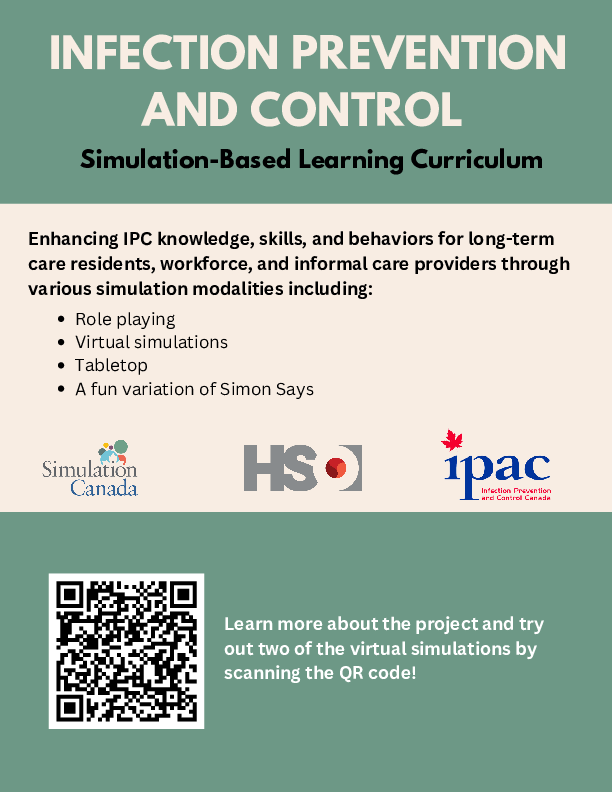
Rationale: COVID-19 highlighted gaps in knowledge in Infection, Prevention and Control (IPC) competencies – particularly in Long-Term Care (LTC) homes across Canada. There is a need for continuous and accessible capacity-building opportunities focused on IPC for care providers (including the workforce and informal care providers), residents, and residents’ families. Simulation provides opportunities to engage the workforce, residents, and residents’ families in relevant, culturally responsive practice-based learning.
Project Objective: Funded by Health Canada, Health Standards Organization and Simulation Canada partnered with system colleagues to collaboratively co-design, prototype, and test an accessible hybrid simulation-based IPC Practices curriculum aimed at improving knowledge and behaviors in 15 LTC homes across Canada. The development of the simulation-based IPC Practices curriculum was informed by a needs assessment, and co-designed with people with lived experiences in LTC, IPC experts, and simulation experts.
Description of the Innovation: A simulation-based IPC Practices curriculum focused on hand hygiene, respiratory etiquette, personal protective equipment, and a culture/environment that supports positive IPC behaviours. Comprised of four simulation scenarios, using a hybrid approach of in-person and online modalities, the curriculum provides cognitive and hands-on opportunities to enhance IPC practices. A train-the-trainer toolkit that facilitator practitioners from each LTC home used to implement and scale the simulation activities in their organizations, including adapting scenarios to better reflect their local population, culture, and environment. This toolkit included briefing and debriefing guides for every simulation scenario, monitoring and evaluation tools, and additional supporting documents. A learning collaborative encompassing weekly drop-in sessions that allowed the 15 participating LTC homes to troubleshoot issues, and share lessons learned and best practices with each other.
Summary of usage/evaluation: The project time period was April 2021 to March 2023. Evaluation survey data and participants’ interviews show positive feedback for the simulation-based IPC practices curriculum by the 15 LTC homes. Outcomes included:
- Increased IPC knowledge among all population groups, particularly the workforce
- Positive changes in IPC behaviours among all population groups
- Improved organizational competency in IPC practices
- Significant engagement and participation from residents and residents’ families