Abstract
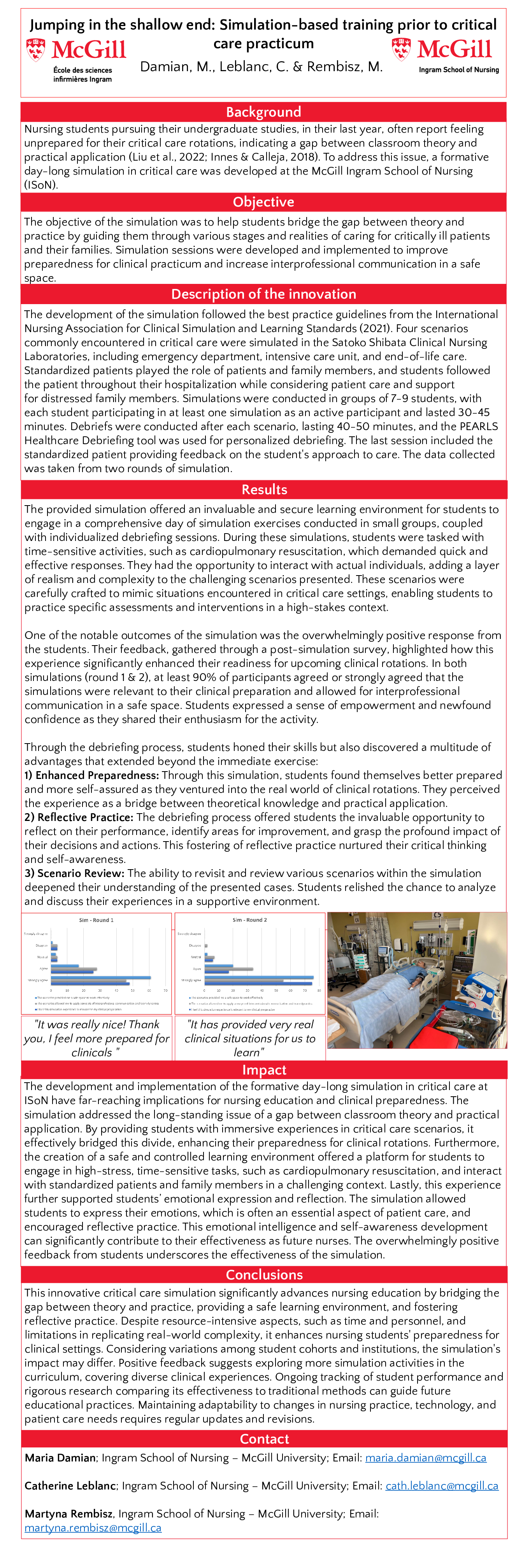
Background: Bachelor of Science in Nursing students in their last year often report feeling unprepared for their critical care rotations, indicating a gap between classroom theory and practical application. To address this issue, a formative day-long simulation in critical care was developed at the McGill Ingram School of Nursing (ISoN).
Objective: The objective of the simulation was to help students bridge the gap between theory and practice by guiding them through various stages and realities of caring for critically ill patients and their families, and to improve their preparedness for clinical practicum.
Description: The development of the simulation followed the best practice guidelines from the International Nursing Association for Clinical Simulation and Learning Standards (2022). Four scenarios commonly encountered in critical care were simulated in the Satoko Shibata Clinical Nursing Laboratories, including emergency department, intensive care unit, and end-of-life care. Standardized patients played the role of patients and family members, and students followed the patient throughout their hospitalization while considering patient care and support for distressed family members. Simulations were conducted in groups of 7-9 students, with each student participating in at least one simulation as an active participant and lasted 30-45 minutes. Debriefs were conducted after each scenario, lasting 40-50 minutes, and the PEARLS Healthcare Debriefing tool was used for personalized debriefing. The last session included the standardized patient providing feedback on the students' approach to care.
Impact: The simulation provided a safe learning environment for students to experience a full day of simulation in small groups, along with personalized debriefing. Students performed time-sensitive tasks such as cardiopulmonary resuscitation, interacted with real humans in a challenging context, and conducted specific assessments in a critical care context. The post-simulation survey showed that the simulation enhanced students' preparedness for their clinical rotation, as they expressed their positive feedback about the activity. Students appreciated the simulation's ability to allow them to express their emotions, reflect on their practice, review scenarios, and feel better equipped for clinical practicum. The success of this simulation suggests the potential for more simulation activities in the future to enhance students' learning experiences.