Abstract
Purpose:
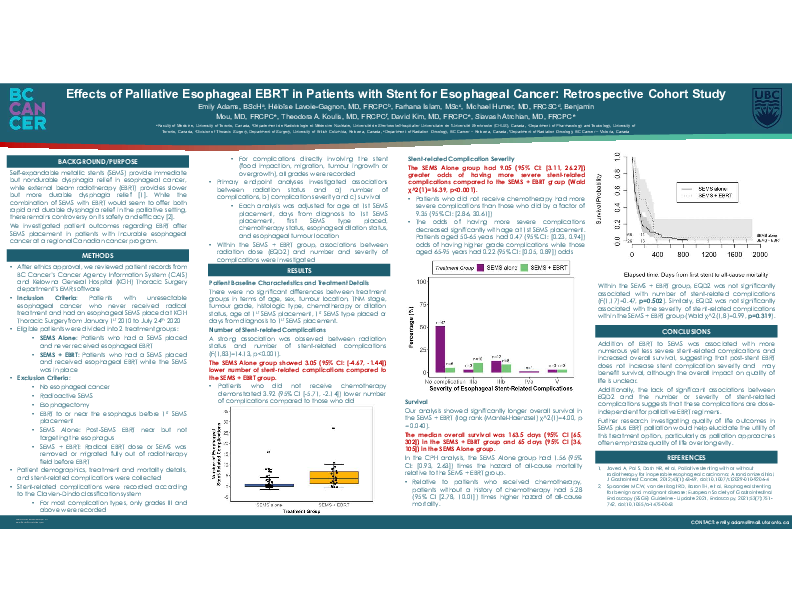
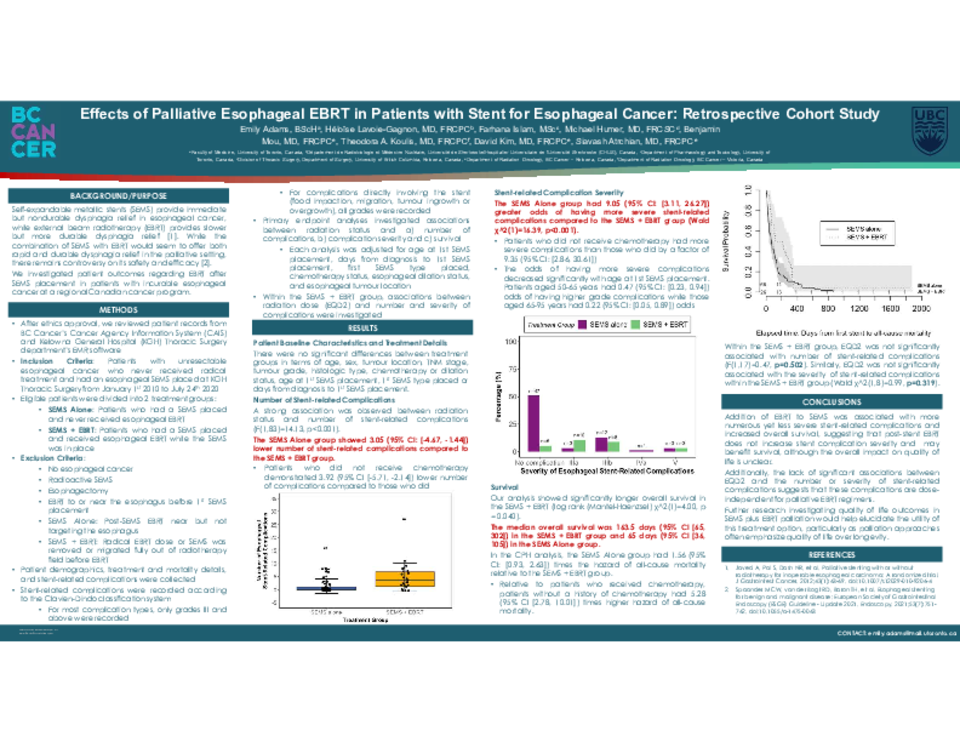
Self-expandable metallic stents (SEMS) provide immediate but nondurable dysphagia relief in esophageal cancer, while external beam radiotherapy (EBRT) provides slower but more durable dysphagia relief. While the combination of SEMS with EBRT would seem to offer both rapid and durable dysphagia relief in the palliative setting, there remains controversy on its safety and efficacy. We investigated patient outcomes regarding EBRT after SEMS placement in patients with incurable esophageal cancer at a regional Canadian cancer program.
Methods:
We conducted a single-centre retrospective chart review from January 2010 to July 2020 to compare stent-related complications and survival in patients with incurable esophageal cancer treated with SEMS alone or SEMS + EBRT at Kelowna General Hospital (KGH). KGH provides centralized thoracic surgery services for the entire Interior and Northern regions of British Columbia.
Results:
66 patients were included in the SEMS alone group and 26 in the SEMS + EBRT group. Patients treated with SEMS alone showed 3.05 (95% CI [-4.67, -1.44]) fewer stent-related complications and 9.05 (95% CI [3.11, 26.27]) greater odds of experiencing more severe complications compared to patients who received SEMS + EBRT. Patients in the SEMS + EBRT group survived significantly longer than those treated with SEMS alone, with a median overall survival of 163.5 days (95% CI [65, 302]) and 65 days (95% CI [36, 105]), respectively.
Conclusions:
SEMS monotherapy was associated with fewer yet more severe stent-related complications compared to palliative EBRT after SEMS placement. SEMS + EBRT treatment was associated with prolonged survival compared to SEMS alone. Prospective studies are needed to confirm these findings.