Abstract
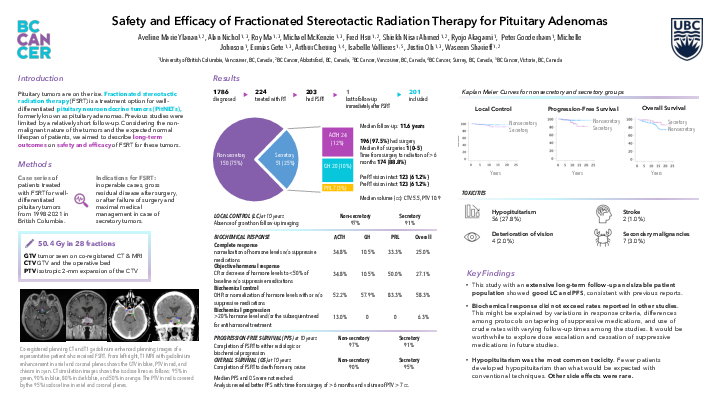
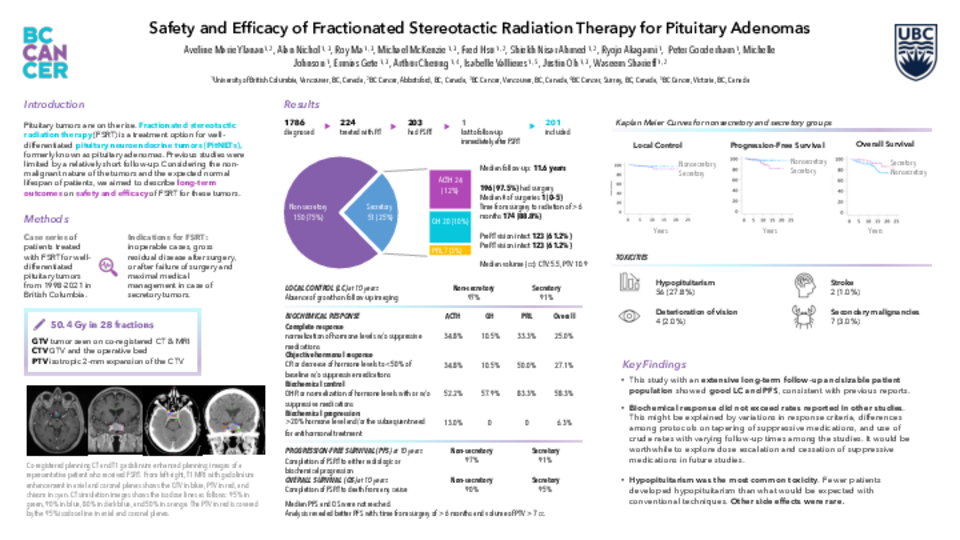
Purpose: To determine the safety and efficacy of fractionated stereotactic radiation therapy (FSRT) in the treatment of patients with pituitary adenomas.
Methods: This is a retrospective case series of patients treated for pituitary adenoma with FSRT between January 1, 1998 and December 31, 2021. Patient charts and radiation treatment plans were reviewed to abstract information on patient and disease characteristics, treatment details, and follow-up. Efficacy measures included local control for alltumors, and complete response, objective hormonal response, biochemical control and biochemical progression for functioning tumors. Local control was defined as the absence of growth on follow-up imaging. Complete response was defined as normalization of elevated hormone levels without suppressive medications. Objective hormonal response was defined as complete response or decrease in hormone levels by 50% or more without suppressive medications. Biochemical control was defined as objective hormonal response or normalization of hormone levels with or without medications. Biochemical progression was defined as >20% hormonal secretion level and/or the subsequent need for medications. Data were analyzed with descriptive statistics, linear regression models and Kaplan Meier curves.
Results: Of 201 patients treated with FSRT, 51 (25%) had functioning tumors. Median dose was 50.4 Gy in 1.8 Gy daily fractions. At a median follow-up of 11.6 years, local control was 96%. Of 51 patients with functioning tumors, 48 (94%) had rising hormone levels at baseline. Of these, 25% achieved complete response, 27% achieved objective hormonal response, 58% achieved biochemical control, 35% stabilized, and 6% continued to progress. Out of 29 deaths, one was due to tumor progression, and none due to treatment related complications. Late effects included hypopituitarism (28%), decline in vision (2%), and second malignancy (3%). No patient developed radionecrosis following FSRT.
Conclusion: Our experience suggests that FSRT is a safe and effective treatment for pituitary adenomas.