
Abstract
Introduction
The pancreas is an organ that lies around the epigastric region that functions primarily to help the body digest food. Pancreatitis is a condition where the pancreas gets inflamed. Inflammation of the pancreas can occur through several etiologies, such as heavy alcohol use, gallstones, post-surgical, hypertriglyceridemia, and autoimmune. Although rare, pancreatitis can be induced by various drugs, one of which is propofol. Propofol is considered as being in class II of the drugs that cause acute pancreatitis. A recent systematic review specified the propofol-pancreatitis relationship as probable. A potential mechanism in which this happens may be from propofol's propensity to induce hypertriglyceridemia, a traditional etiology for acute pancreatitis.
Case Description
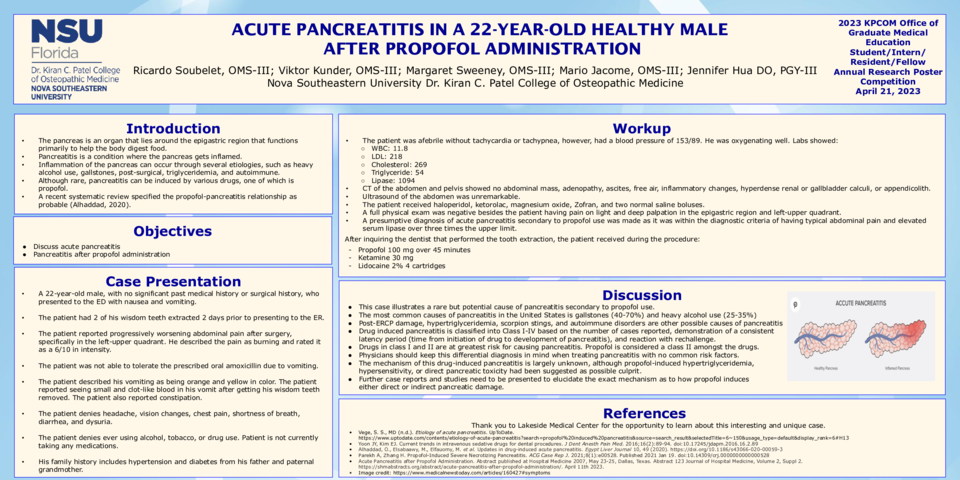
We present a case of a 22-year-old male with no significant past medical history, who presents to the ED with nausea and vomiting. The patient received propofol the day before when he had his wisdom teeth extracted. The patient reported progressively worsening abdominal pain after surgery, specifically in the left-upper quadrant. He described the pain as burning and rated it as a 6/10 in intensity. The patient was not able to tolerate the prescribed oral amoxicillin due to vomiting. The patient describes his vomiting as being orange and yellow in color. The patient reported seeing small and clot-like blood in his vomit after getting his wisdom teeth removed. The patient also reported constipation. The patient denies headache, vision changes, chest pain, shortness of breath, diarrhea, and dysuria. He has never had any major surgeries and is not currently taking any medications. The patient denies ever using alcohol, tobacco, or drug use. His family history includes hypertension and diabetes from his father and paternal grandmother. The patient was afebrile without tachycardia or tachypnea, however, had a blood pressure of 153/89. He was oxygenating well. Labs showed a WBC count of 11.8, LDL of 218, cholesterol of 269, triglyceride of 54, and lipase of 1094. CT of the abdomen and pelvis showed no abdominal mass, adenopathy, ascites, free air, inflammatory changes, hyperdense renal or gallbladder calculi, or appendicolith. Ultrasound of the abdomen was unremarkable. The patient received haloperidol, ketorolac, magnesium oxide, Zofran, and two normal saline boluses. A full physical exam was negative besides the patient having pain on light and deep palpation in the epigastric region and left-upper quadrant. The diagnosis of acute pancreatitis secondary to propofol use was made as it was within the diagnostic criteria of having typical abdominal pain and elevated serum lipase over three times the upper limit.
Discussion
This case illustrates a rare but potential cause of pancreatitis secondary to propofol use. The most common causes of pancreatitis involve heavy alcohol use, gallstones, post-surgical, hypertriglyceridemia, and autoimmune disorders. Drug induced pancreatitis is rare, and Propofol is considered as being in class II amongst the drugs. Physicians need to be more aware about drug-induced pancreatitis as it is often overlooked. Pancreatitis can happen in young individuals without risk factors. Although the etiology isn’t clear, the proposed mechanism through how propofol can induce pancreatitis involves a rise in triglycerides.




