Abstract
Introduction:
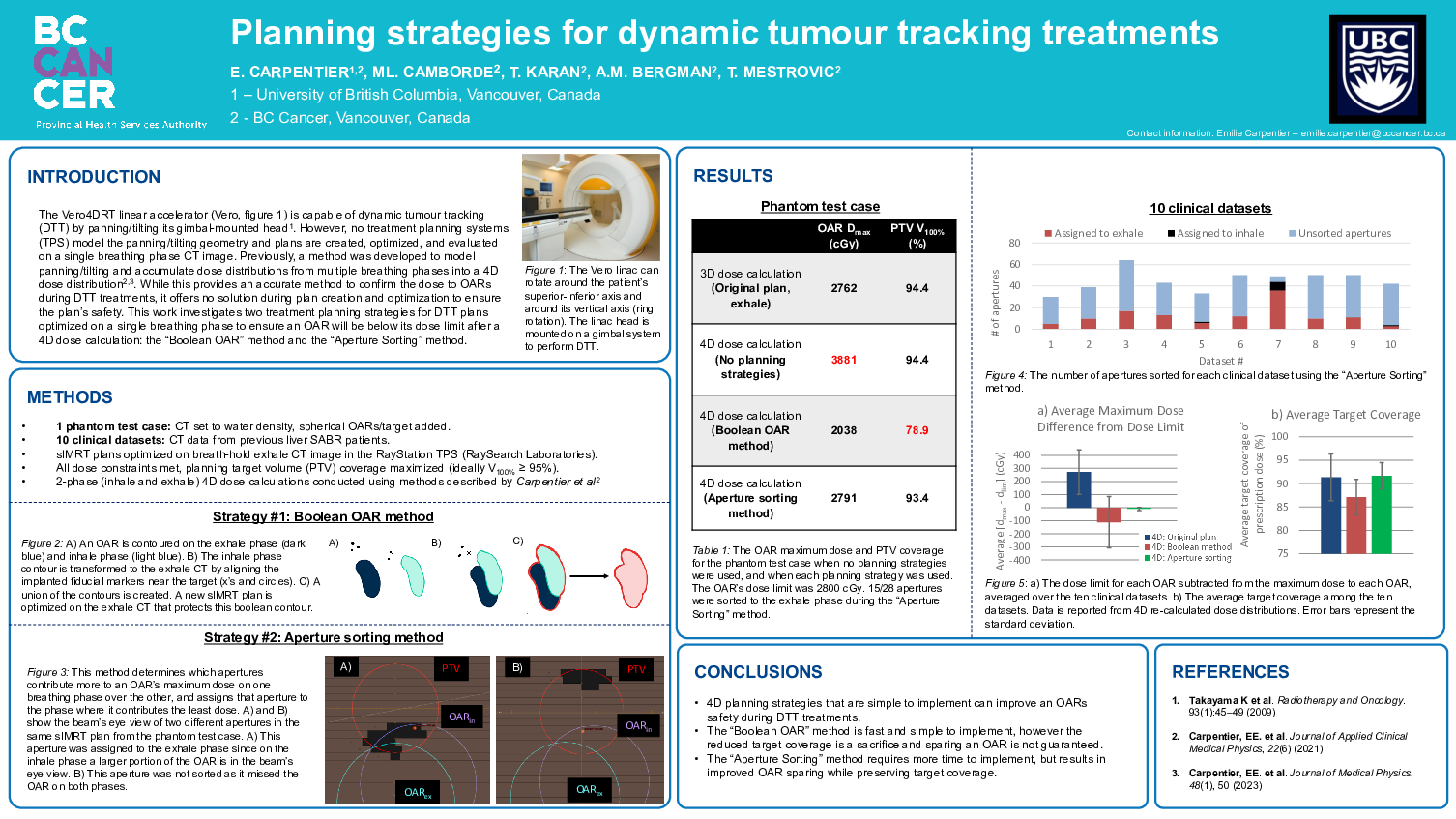
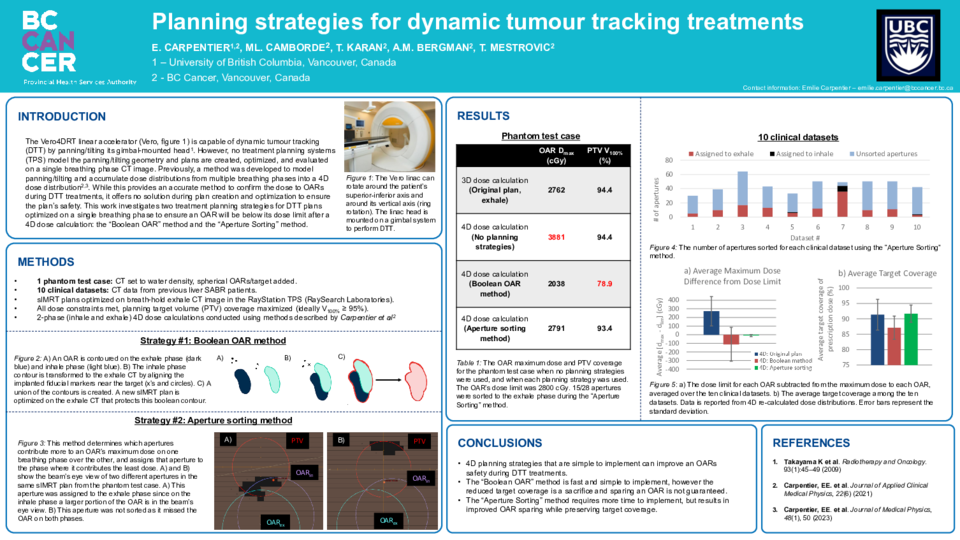
Dynamic tumour tracking (DTT) is a motion management technique where a radiation beam follows a moving tumour in real time. Improperly modelling DTT beam motion leaves an organ at risk (OAR) vulnerable to exceeding its dose limit. This work investigates two planning strategies for DTT plans optimized on a single breathing phase, the “Boolean OAR Method” and the “Aperture Sorting Method,” to determine if they can successfully spare an OAR while maintaining sufficient target coverage.
Materials and methods:
A step-and-shoot intensity modulated radiation therapy (sIMRT) treatment plan was optimized on the exhale phase for ten previously treated liver stereotactic ablative radiotherapy patients. The “Boolean OAR Method” creates a union of an OAR’s contours from two breathing phases (exhale and inhale) on the exhale phase and protects this boolean OAR during plan optimization. The “Aperture Sorting Method” assigns apertures to the breathing phase where it contributes the least to an OAR’s maximum dose. These strategies were compared to determine which is more effective at sparing an OAR while maintaining target coverage.
Results and discussions:
All ten OARs exceeded their dose limits on the original plan 4D dose distributions and average target coverage was V100% = 91.3%±2.9% (ranging from 85.1% to 94.8%). The “Boolean OAR Method” was unable to spare three of the ten OARs, and mean target coverage decreased to V100% = 87.1%±3.8% (ranging from 80.7% to 93.7%). The “Aperture Sorting Method” failed to spare one OAR. The mean target coverage remained high at V100% = 91.7%±2.8% (ranging from 84.9% to 94.5%).
Conclusions:
4D planning strategies are simple to implement and can improve OAR sparing during DTT treatments. The “Boolean OAR Method” is quick but comes at the cost of reduced target coverage and OAR sparing is not guaranteed. The “Aperture Sorting Method” requires more time to implement, however it results in improved OAR sparing and target coverage.