Abstract
Purpose:
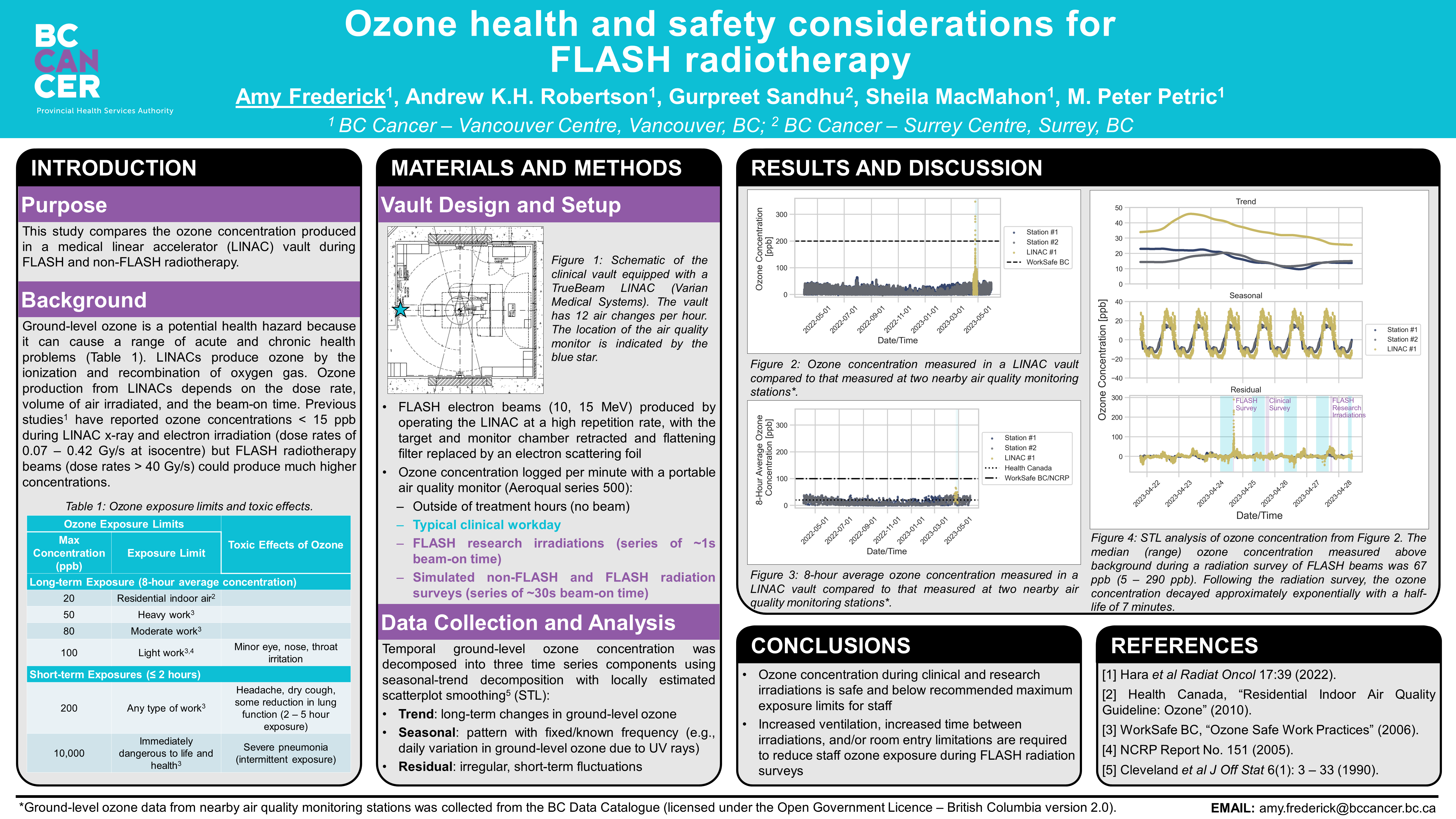
Medical linear accelerators (LINACs) can produce ozone by the ionization and subsequent recombination of oxygen gas. Ozone is a potential health hazard for staff and patients because it can cause a range of acute and chronic health problems depending on the concentration and duration of exposure. Previous studies have reported ozone concentrations < 15 ppb during LINAC x-ray and electron irradiation but FLASH radiotherapy beams could yield higher concentrations. The purpose of this study was to compare ozone concentrations produced in the LINAC vault during non-FLASH and FLASH radiotherapy.
Materials and methods:
All measurements were performed in a vault equipped with a TrueBeam LINAC (Varian Medical Systems). The vault dimensions are 6.50 x 6.43 x 2.77 m3 and the air exchange rate is approximately 12 air changes per hour. A portable air quality monitor (Aeroqual series 500) was used to measure ozone concentration (detectable range: 1 – 500 ppb, sampling frequency: 60 s) near the vault entrance. To produce FLASH electron beams, the LINAC was operated in photon mode with the target and ion chamber retracted and the flattening filter replaced with an electron scattering foil. Ozone concentrations were measured for 10 and 15 MeV FLASH electron beams as well as 10 MV flattening filter-free and 15 MV non-FLASH photon beams and a 12 MeV non-FLASH electron beam. Measured ozone concentrations were compared with the ground-level ozone concentrations recorded at two nearby air quality monitoring stations. Seasonal-trend decomposition using locally estimated scatterplot smoothing was used to decompose the ozone concentration into three components: the long-term trend, daily periodic variation, and residual short-term fluctuations.
Results:
Ozone concentrations measured for dose levels relevant to clinical treatments or research irradiations (< 50 Gy) did not exceed background levels for all beams tested. The median (range) ozone concentration measured above background during a radiation survey of FLASH electron beams was 67 parts per billion (5 – 290 parts per billion). Following the radiation survey, the ozone concentration decayed approximately exponentially with a half-life of 7 minutes for an air exchange rate of 12 air changes per hour.
Conclusions:
Ozone concentrations during clinical non-FLASH irradiations and FLASH research irradiations were safe and below recommended maximum exposure limits for staff. Increased ventilation, increased time between irradiations, and/or room entry limitations are required to reduce staff ozone exposure during FLASH radiation surveys.