
Abstract
Automated HDR QA tests using an organic plastic scintillator with OpenCV
Richard Lee1, David Sasaki1,3, Niranjan Venugopal1,2,3, Swapanpreet Kaur1and J. E. Alpuche Aviles1,2,3
1Department of Medical Physics, CancerCare Manitoba, Winnipeg, Manitoba, Canada
2Department of Physics and Astronomy, University of Manitoba, Winnipeg, Manitoba, Canada
3Department of Radiology, University of Manitoba, Winnipeg, Manitoba, Canada
Purpose:
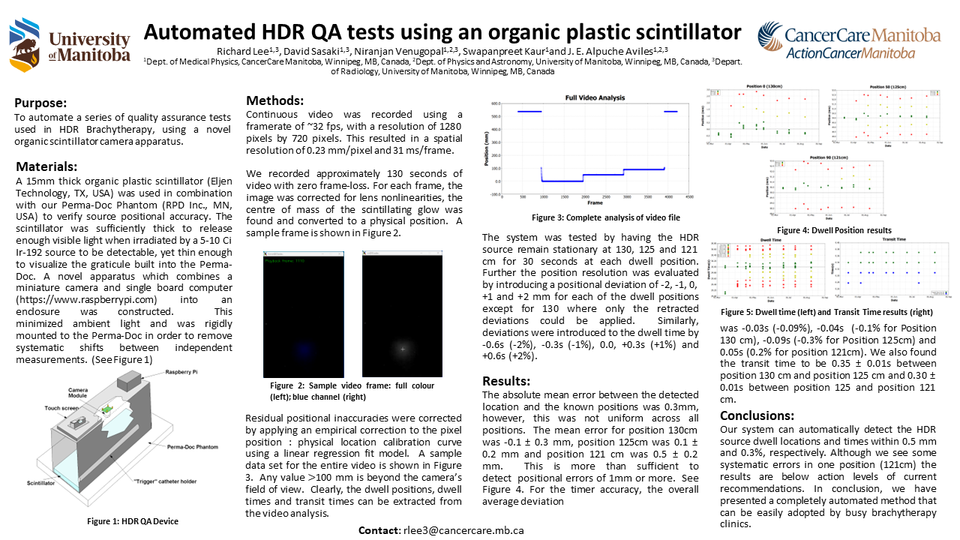
To automate a series of quality assurance tests used in HDR Brachytherapy, using a novel organic scintillator camera apparatus supported by OpenCV.
Materials and Methods:
A 15mm thick organic plastic scintillator (OPS) (Eljen Technology, TX, USA) was used in combination with our Perma-Doc Phantom (RPD Inc., MN, USA) to verify source positional accuracy. The OPS was sufficiently thick, to release enough visible light when irradiated by a 5-10 Ci Ir-192 source, yet thin enough to visualize the graticule built into the Perma-Doc. A novel apparatus which combines a miniature camera and computer (https://www.raspberrypi.com) was constructed to minimize ambient light, and rigidly mounted to remove systematic offsets between independent measurements. Continuous video was recorded using a framerate = 32 fps, with a resolution of 1280 pixels by 720 pixels. This resulted in a spatial resolution of 0.23 mm/pixel and 31 ms/frame. We recorded approximately 90 seconds of video with zero frame-loss. The optimization of lighting and acquisition parameters was needed to assist our technique for automatic localization. Each frame was corrected for lens distortion, however, the optical effects of the scintillator itself was corrected by applying an empirical calibration curve measured at large distances (10cm) using a linear regression fit model. The system was tested by having the HDR source remain stationary at 130, 125 and 129 cm for 15 seconds at each dwell position. Further the position resolution was evaluated by introducing a positional deviation of -2, -1, 0, +1 and +2mm for each of the dwell positions except for 130 where only the retracted deviations could be applied. Similarly, deviations were introduced to the dwell time by -0.3 (-2%), -0.1(-0.7%), 0.0, +0.1(+0.7%) and +0.3 (+2%) s.
Results
The calibration correction was applied and resulted in source positions corrections of 0.81 mm at 130 cm and 0.32 mm at 120 cm. The mean correction was 0.55 mm. The mean agreement between the known source positions and those calculated was 0.2 mm with a standard deviation of 0.3 mm. The disagreement exceeded 0.5 mm twice and the maximum was 0.8 mm. In terms of timer accuracy, the average deviation between calculated and programmed dwell time was 0.4 % (of the programmed dwell time) with a standard deviation of 0.44 %. The maximum timer disagreement was less than 1%.
Conclusions
Our novel system has demonstrated that we can automatically determine source location using light generated from OPS materials. The system can automatically calculate source dwell positions within 0.8 mm and dwell time within 1%. Furthermore, we can detect deviations exceeding action levels based on current quality assurance recommendations, making it a viable solution for routine QA tests. In conclusion, we have presented a completely automated method that can be easily adopted by brachytherapy clinics.


