Abstract
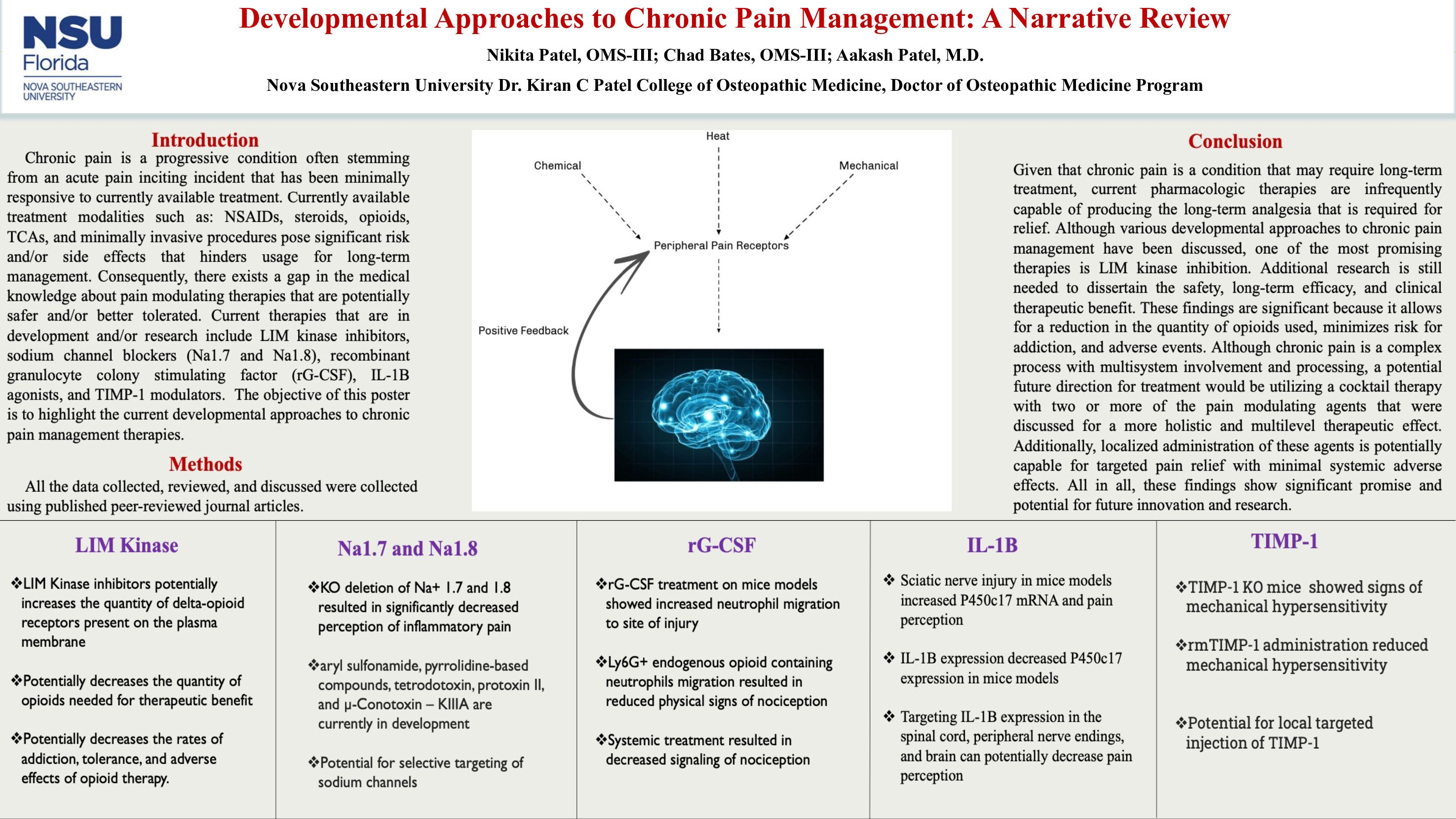
Background: Chronic pain, defined as intractable pain persisting for greater than three months with minimal relief from current analgesic treatment available. Current treatment available for chronic pain includes but is not limited to NSAIDs, opioids, tricyclic antidepressants (TCAs), steroids, and minimally invasive procedures. However, these treatment options have the potential to carry significant risks and therefore there exists a gap in the current medical knowledge about alternative pain management strategies.
Objective: To discuss developmental approaches to chronic pain management.
Methods: All the data collected, reviewed, and discussed were collected using published peer-reviewed journal articles. The keywords used to search for appropriate articles included, “Alternative Approaches to Pain Management,” “Developmental approaches to opioid induced analgesia,” “Preclinical trials of opioid receptor agonists,” “Clinical trials of opioid receptor agonists,” “Delta-Opioid Receptor Agonist,” “Interleukin 1βR Modulation,” “Granulocyte-colony stimulating factors,” “TIMP-1 and MMP modulation,” “sodium channel modulation."
Results: LIM Kinase inhibition can potentially increase delta-opioid receptors (DORs) trafficking to the plasma membrane. Mice models with Na1.7 and Na1.8 knock-out (KO) showed significantly decreased perception of inflammatory pain. Mice models treated with rG-CSF showed increased neutrophil migration to site of injury and subsequent release of neutrophil synthesized endogenous opioids. Additionally, mice models with peripheral sciatic nerve injury showed that IL-1B expression decreased generation of pain inducing P450c17 protein. Lastly, rmTIMP-1 administration was shown in mice models to reduce mechanical hypersensitivity.
Conclusion: Alternative therapies to chronic pain management is a new and developing field of research that holds promise for the treatment of chronic pain. As presented in this poster, these alternative approaches aim to reduce the requirements for opioid usage while still delivering opioid-like analgesia. Given that these treatment options are still in development, additional research is still needed to further discertain their safety and long-term efficacy.