Abstract
Purpose
In many Canadian medical school curricula, radiation oncology (RO) topics are limited, often mentioned as an adjunct to surgery or chemotherapy. Furthermore, RO exposure in clerkship is frequently limited to elective rotations. Thus, leaners receive scant exposure to RO, possibly impacting global oncology awareness, access, and interest. To address this, the RO interest group (ROIG) was founded by medical students in December 2020. The ROIG facilitates a range of events, including didactic lectures on introductory RO topics, technical medical physics workshops, panel discussions, and departmental tours with equipment demos . With growing interest, we hypothesized that the ROIG had an impact on both strengthening pre-existing interest and on fostering new interest in RO.
Materials and Methods
To evaluate the impact of the ROIG, a survey was distributed to attendees via e-mail and social media. Ten quantitative five-point Likert-scale questions addressed the following: the role of the ROIG as a facilitator or barrier to accessing RO, a change in interest in RO, the impact on interest in comparison to medical school curricula, changes in participants’ desire to pursue electives or residency in RO, and likelihood to recommend the group to peers. Qualitative free-form questions recorded favourite and least favourite events, and suggestions. A long-term follow-up survey, consisting of five quantitative Likert-scale questions and three qualitative multiple-choice questions on match data, assessed ROIG’s impact on graduating trainees.
Results
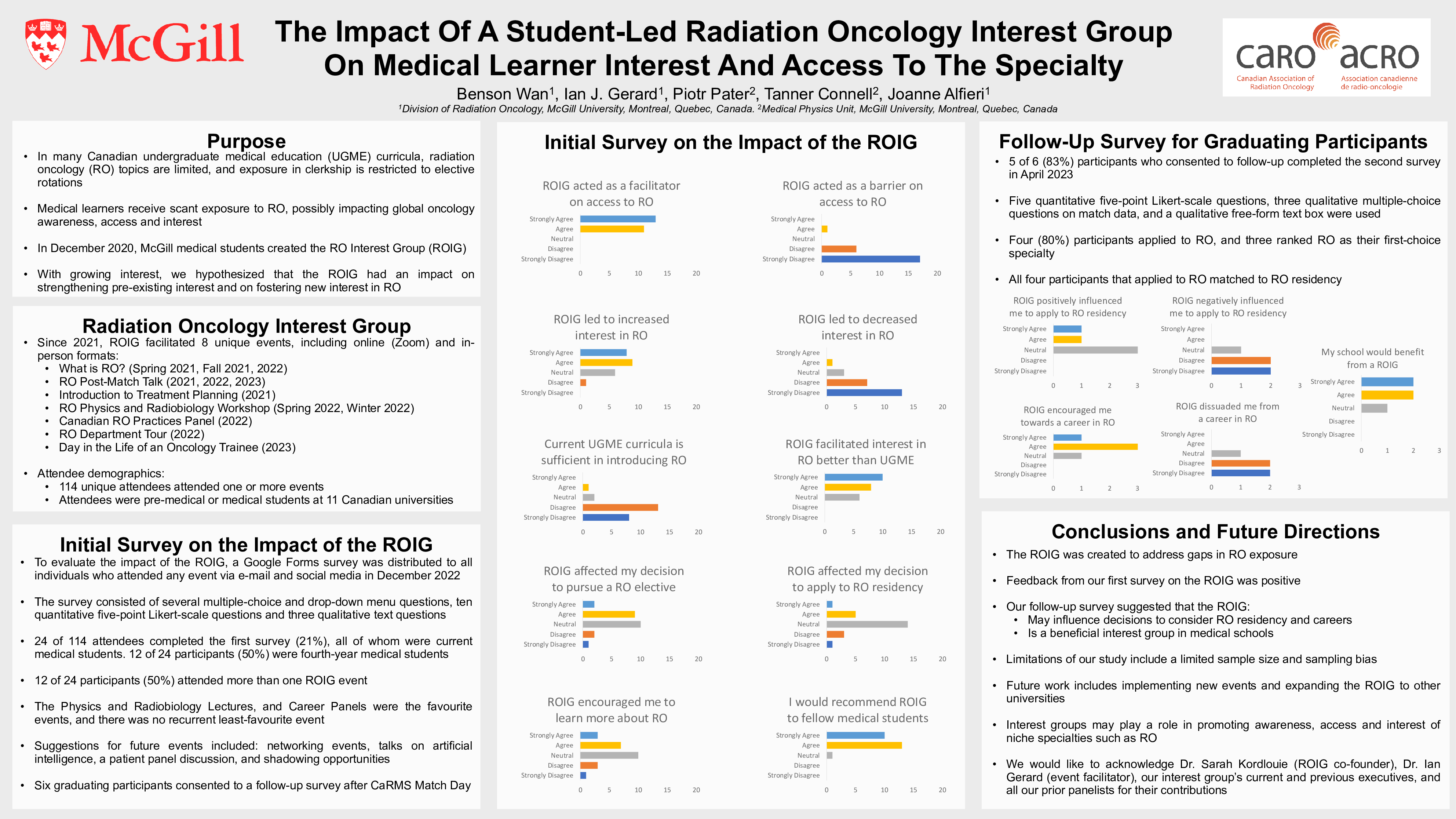
24 of 114 attendees completed the survey (21%) . All participants stated that the ROIG was a facilitator to accessing RO (100%), and most disagreed on ROIG being a barrier (96%). Participants indicated that the ROIG increased their interest in RO (71%) and did not decrease their interest (83%). 96% of participants would recommend the ROIG to peers. Most respondents stated that the ROIG facilitated interest better than current medical school curricula (75%), which was felt to be insufficient in introducing RO (88%). ROIG had no clear impact on students’ likelihood to pursue RO electives, to apply to RO residency, or to contact faculty to learn more. The physics lectures and career panels were the favourite events, and there was no common least favourite event. Suggestions for future events included networking events, a lecture on artificial intelligence, patient panel discussion, and formal shadowing.
5 of 6 (83%) participants who consented to follow-up completed the second survey. Four participants applied to RO, three of whom ranked RO as their first-choice specialty. All four of these participants matched to RO residency. 80% of respondents stated that RO encouraged them towards a career in RO, and 80% stated that their medical school would benefit from a ROIG.
Conclusions
The ROIG was founded to address gaps in RO exposure in medical school. Feedback from our initial survey was overall positive. Our follow-up survey suggested that the ROIG is a beneficial interest group and may influence decisions to consider training or careers in RO. Limitations of our study include sampling bias and a limited sample size. Future work includes implementing new events, expanding the ROIG to other universities, and analyzing long-term post-match data. Moving forward, interest groups may play an important role in promoting awareness, access, and interest of niche specialties such as RO.