Abstract
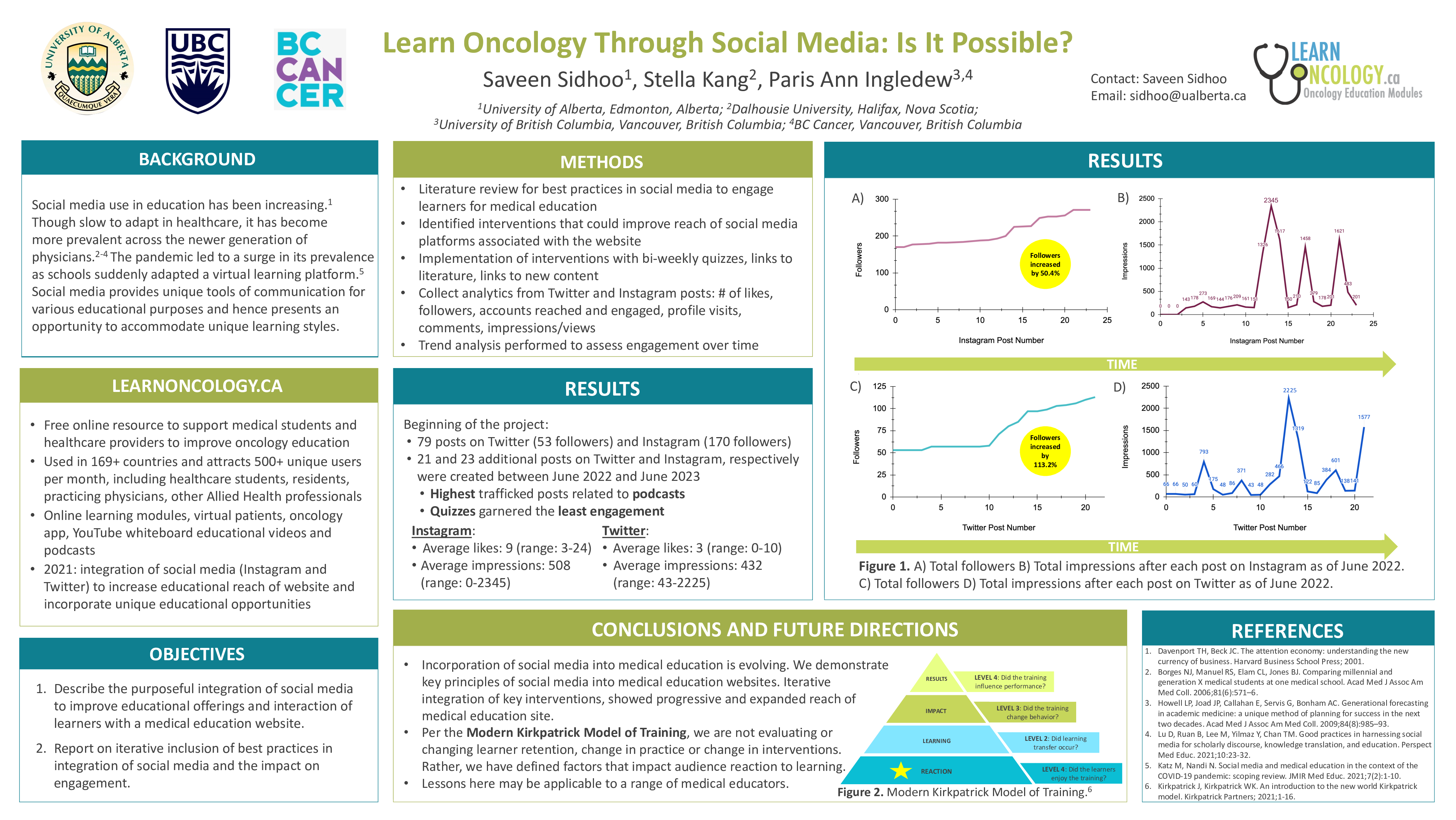
Purpose: Social media (SM) use has increased within education, allowing for global transfer of knowledge within the reach of a button. While slow to adapt in healthcare, this trend has become more prevalent as a generation of physicians enter practice who grew up with SM. This is especially highlighted during the pandemic, where medical schools suddenly adapted a virtual learning platform to uphold training requirements but follow social distancing. Platforms such as Twitter (Twttr), Instagram (IG), podcasts and YouTube (YT), offer unique communication tools for various educational purposes; thus presenting a moment for educators to accommodate many learning styles.
LearnOncology (LO) is a free e-resource intended to support students and healthcare providers to improve oncology education. The website is currently used in 169+ countries and attracts 500 users/month including students, residents, physicians, and other allied health. The site consists of online modules, virtual patients, an oncology app, YT videos and most recently, podcasts. In 2021, we integrated IG and Twttr into the LO offerings with the aim to increase educational reach of the site and incorporate unique educational opportunities.
Here, we describe the purposeful integration of SM to improve educational offerings and interaction of learners with a medical education (MedEd) website. We report on the iterative inclusion of best practices in integration of SM and impact on engagement.
Materials and Methods: Review of literature identified a number of studies analyzing best practices in SM to engage learners for MedEd. A variety of interventions were identified to improve the reach of SM platforms. Iteratively, these interventions were implemented including daily quizzes, and links to literature or new online content. Analytics from the platforms were collected. The number of likes, followers, accounts reached and engaged, and impressions/views were recorded from June 2022 to February 2023. Trend analysis assessed engagement over time.
Results: At the start of the project, there were 79 posts on both Twttr and IG. 14 additional posts were produced. With interventions incorporated, followers on IG increased 32.4% from 170 to 225, and 83.0% on Twttr from 53 to 97. On IG, number of likes averaged at 7 (range: 3-15), and number of impressions 492 (range: 0-2345). On Twttr, number of likes were 3 (range: 0-10), and number of impressions 431 (range: 50-2225). Highest trafficked posts related to podcasts. Posts with collaborators garnered the most traffic.
Conclusions: Incorporation of SM into MedEd is evolving. Here, we identified key principles to incorporate SM into MedEd websites. With integration of these principles, we demonstrate a progressive and expanded reach of this MedEd site. Lessons here may be applied to a range of medical educators as they develop new online learning tools.