A Preliminary Study To Investigate The Risk For Development Of Diabetes Among Young Mauritians
Abstract
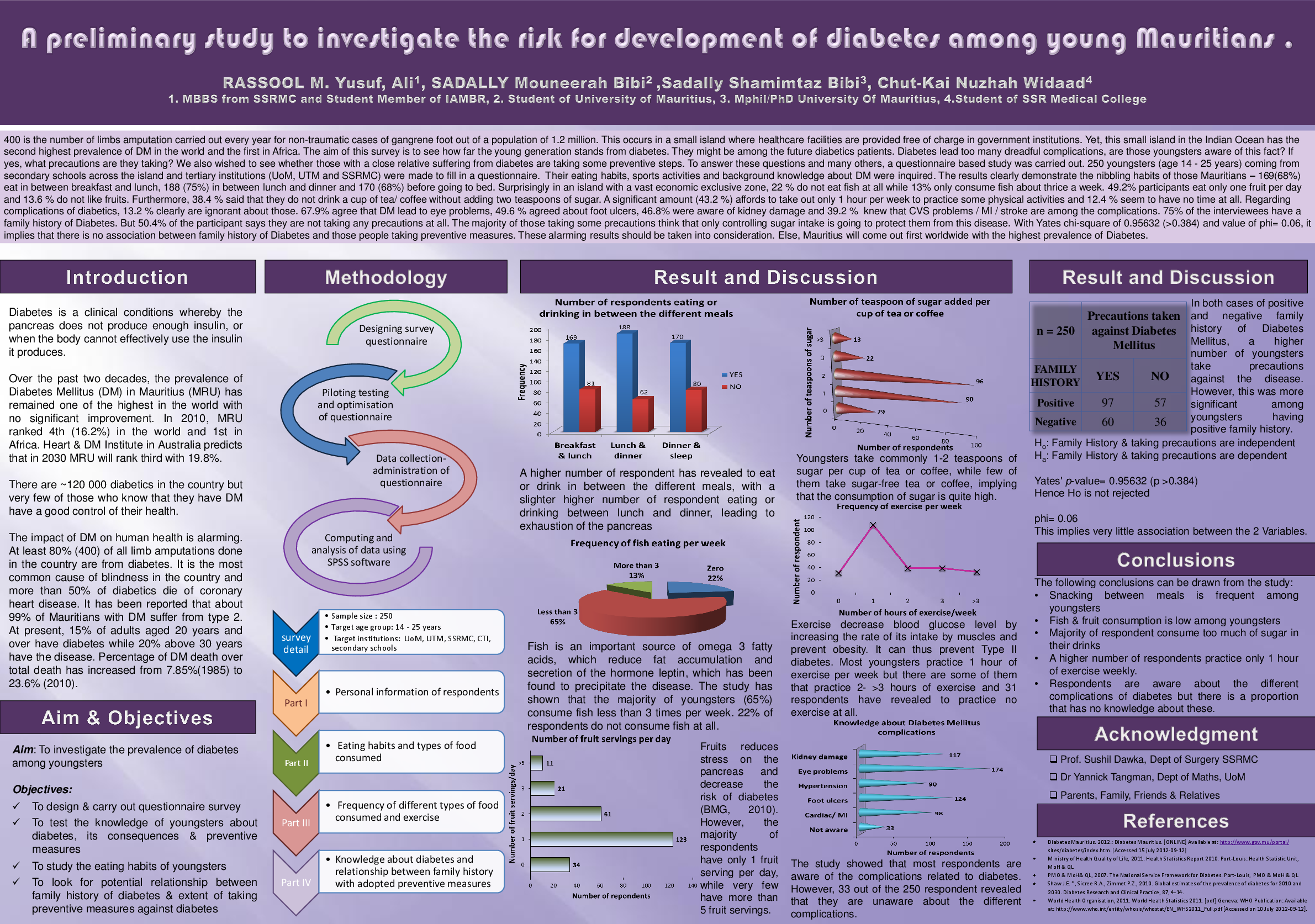
400 is the number of limbs amputation carried out every year for non-traumatic cases of gangrene foot out of a population of 1.2 million. This occurs in a small island where healthcare facilities are provided free of charge in government institutions. Yet, this small island in the Indian Ocean has the second highest prevalence of DM in the world and the first in Africa. The aim of this survey is to see how far the young generation stands from diabetes. They might be among the future diabetics patients. Diabetes lead too many dreadful complications, are those youngsters aware of this fact? If yes, what precautions are they taking? We also wished to see whether those with a close relative suffering from diabetes are taking some preventive steps. To answer these questions and many others, a questionnaire based study was carried out. 250 youngsters (age 14 - 25 years) coming from secondary schools across the island and tertiary institutions (UoM, UTM and SSRMC) were made to fill in a questionnaire. Their eating habits, sports activities and background knowledge about DM were inquired. The results clearly demonstrate the nibbling habits of those Mauritians – 169(68%) eat in between breakfast and lunch, 188 (75%) in between lunch and dinner and 170 (68%) before going to bed. Surprisingly in an island with a vast economic exclusive zone, 22 % do not eat fish at all while 13% only consume fish about thrice a week. 49.2% participants eat only one fruit per day and 13.6 % do not like fruits. Furthermore, 38.4 % said that they do not drink a cup of tea/ coffee without adding two teaspoons of sugar. A significant amount (43.2 %) affords to take out only 1 hour per week to practice some physical activities and 12.4 % seem to have no time at all. Regarding complications of diabetics, 13.2 % clearly are ignorant about those. 67.9% agree that DM lead to eye problems, 49.6 % agreed about foot ulcers, 46.8% were aware of kidney damage and 39.2 % knew that CVS problems / MI / stroke are among the complications. 75% of the interviewees have a family history of Diabetes. But 50.4% of the participant says they are not taking any precautions at all. The majority of those taking some precautions think that only controlling sugar intake is going to protect them from this disease. With Yates chi-square of 0.95632 (>0.384) and value of phi= 0.06, it implies that there is no association between family history of Diabetes and those people taking preventive measures. These alarming results should be taken into consideration. Else, Mauritius will come out first worldwide with the highest prevalence of Diabetes.
Related articles