The Beneficial Effects of N-acetylcysteine Supplementation on the Underlying Inflammatory Etiology of Polycystic Ovarian Syndrome: A Scoping Review


Abstract

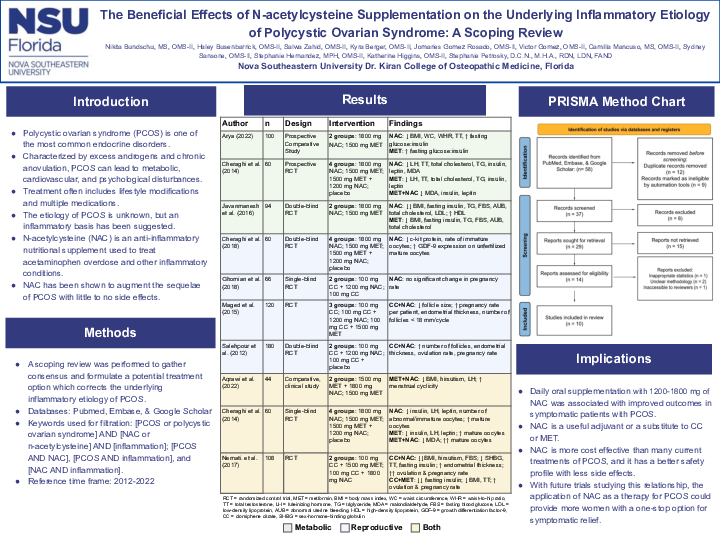
Background: Polycystic ovarian syndrome (PCOS) is characterized by hyperandrogenism leading to reproductive and metabolic abnormalities. The etiology is poorly understood, but an inflammatory basis has been suggested. Current treatment is targeted at the symptoms, rather than the underlying cause. N-acetylcysteine (NAC) is an anti-inflammatory supplement with potential to improve PCOS symptoms.

Objective: Investigate existing literature on the effects of NAC supplementation in women with PCOS to better treatment recommendations.

Methods: Pubmed, Embase, and Google Scholar were searched for randomized control trials and clinical trials between 2012 and 2022 using the terms “PCOS”, “NAC” and “inflammation”.

Results: Six out of 10 articles demonstrated metabolic improvements using 1800 mg/day of NAC. Multiple studies showed the combination of NAC (1200-1800 mg/day) with metformin (1500 mg/day) improved reproductive hormone levels, menstrual regularity, and oocyte quality and quantity. Alone, NAC yielded enhanced oocyte quality compared to placebo. One publication described improved growth factors involved in oogenesis in women treated with the same dose of NAC. NAC with 100 mg/day of clomiphene citrate (CC) reported higher pregnancy rates and increased endometrial thickness in PCOS patients. 

Conclusions: Daily oral supplementation with 1200-1800 mg of NAC was associated with improved symptoms in patients with PCOS. The anti-inflammatory mechanism of NAC allows for a single supplement to ameliorate multiple symptoms of PCOS. With future trials studying this relationship, the application of NAC as a therapy for PCOS could provide more women with symptomatic relief.

Poster
non-peer-reviewed

The Beneficial Effects of N-acetylcysteine Supplementation on the Underlying Inflammatory Etiology of Polycystic Ovarian Syndrome: A Scoping Review


Author Information

Nikita Bundschu Corresponding Author

Dr. Kiran College of Osteopathic Medicine, Nova Southeastern University, Fort Lauderdale , USA

Haley Busenbarrick

Dr. Kiran C. Patel College of Osteopathic Medicine, Nova Southeastern University, Fort Lauderdale , USA

Salwa Zahid

Dr. Kiran C. Patel College of Osteopathic Medicine, Nova Southeastern University, Fort Lauderdale, USA

Kyra Berger

Dr. Kiran C. Patel College of Osteopathic Medicine, Nova Southeastern University, Fort Lauderdale , USA

Jomaries G. Rosado

Dr. Kiran C. Patel College of Osteopathic Medicine, Nova Southeastern University, Fort Lauderdale, USA

Victor Gomez

Dr. Kiran C. Patel College of Osteopathic Medicine, Nova Southeastern University, Fort Lauderdale, USA

Camilla Mancuso

Dr. Kiran C. Patel College of Osteopathic Medicine, Nova Southeastern University, Davie, USA

Sydney Sansone

Dr. Kiran C. Patel College of Osteopathic Medicine, Nova Southeastern University, Fort Lauderdale, USA

Stephanie Hernandez

Dr. Kiran C. Patel College of Osteopathic Medicine, Nova Southeastern University, Fort Lauderdale, USA

Katherine Higgins

Dr. Kiran C. Patel College of Osteopathic Medicine, Nova Southeastern University, Fort Lauderdale, USA

Stephanie N. Petrosky

Nutrition, Nova Southeastern University Dr. Kiran C. Patel College of Osteopathic Medicine, Fort Lauderdale, USA


PDF Share