
Abstract
Background: Family planning is an important step in women’s lives. Some women and their partners seek a form of contraception, while others are interested in increasing their likelihood of conceiving a child. Hormonally-driven methods, such as oral contraceptive pills, are widely used but have numerous side effects, and thus women often seek alternative options including fertility-tracking mobile applications (apps). The effectiveness of these apps as a method of contraception and family planning has not been extensively vetted, and their increasing popularity warrants evidence-based clinical guidelines for healthcare providers.
Objective: The goal of this scoping review is to identify the various factors used by mobile apps marketed as a method of contraception or aid in family planning to predict a woman’s fertility status, as well as their documented effectiveness.
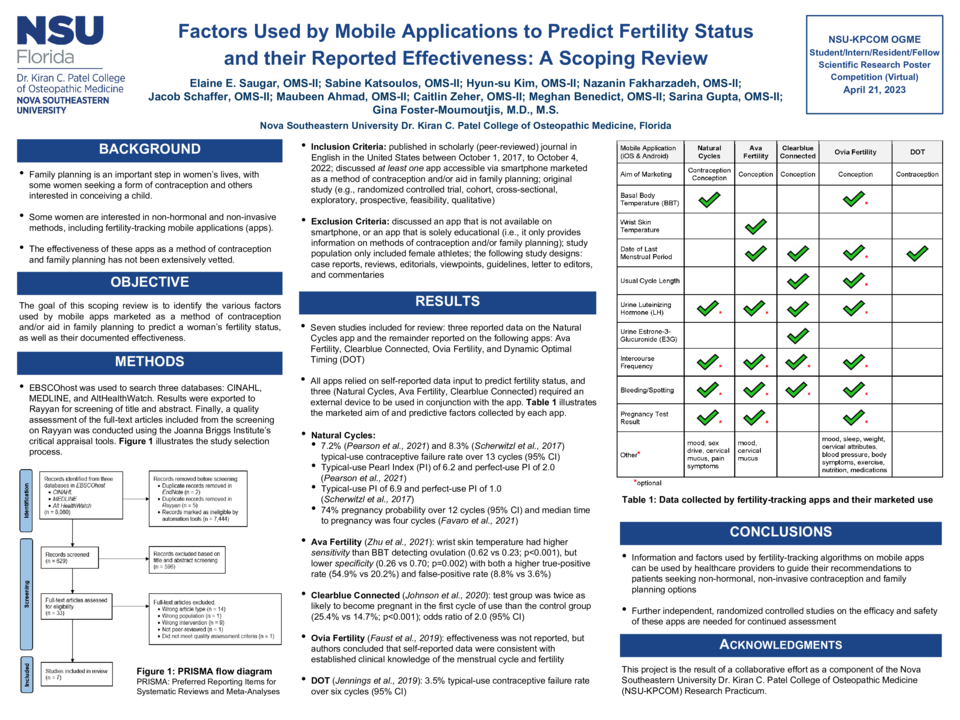
Methods: This scoping review followed the Preferred Reporting Items for Systematic Reviews and Meta-Analyses (PRISMA) Extension for Scoping Reviews guidelines. Within EBSCOhost, three databases–CINAHL, MEDLINE, and Alt HealthWatch–were searched for articles published in academic journals between October 1, 2017, to October 4, 2022, in English and in the United States. Results from the database search on EBSCOhost were exported to Rayyan for screening of title and abstract. Finally, a quality assessment of the full-text articles included from the screening on Rayyan was conducted using the Joanna Briggs Institute’s (JBI) critical appraisal tools.
Results: The database search on EBSCOhost yielded 8,080 records. After removal of 7,444 records identified as ineligible by automation tools and seven duplicate records, the remaining 629 records were independently assessed for inclusion by all nine reviewers in Rayyan. Five hundred ninety-six records were excluded and 33 records underwent quality assessment according to JBI critical appraisal guidelines. Finally, seven studies were included in this scoping review. Three studies reported data on the Natural Cycles app and the remainder reported on the following apps: Ava Fertility, Clearblue Connected, Ovia Fertility, and Dynamic Optimal Timing (DOT). All apps provided predictions on fertility status throughout a woman’s menstrual cycle using proprietary algorithms; the majority relied on self-reported data and three required an external device to measure oral or skin temperature, or urine hormone levels.
Conclusion: This scoping review provides valuable information on the different factors used by fertility-tracking mobile apps to predict a woman’s fertility status and their reported effectiveness, which could guide healthcare providers’ recommendations to their patients seeking to use this technology for contraception or family planning. However, further research, particularly independent research following a randomized controlled design, is needed to assess the efficacy and safety of these apps and yield results with greater generalizability, as well as inform national clinical guidelines and regulatory policy.



