Abstract
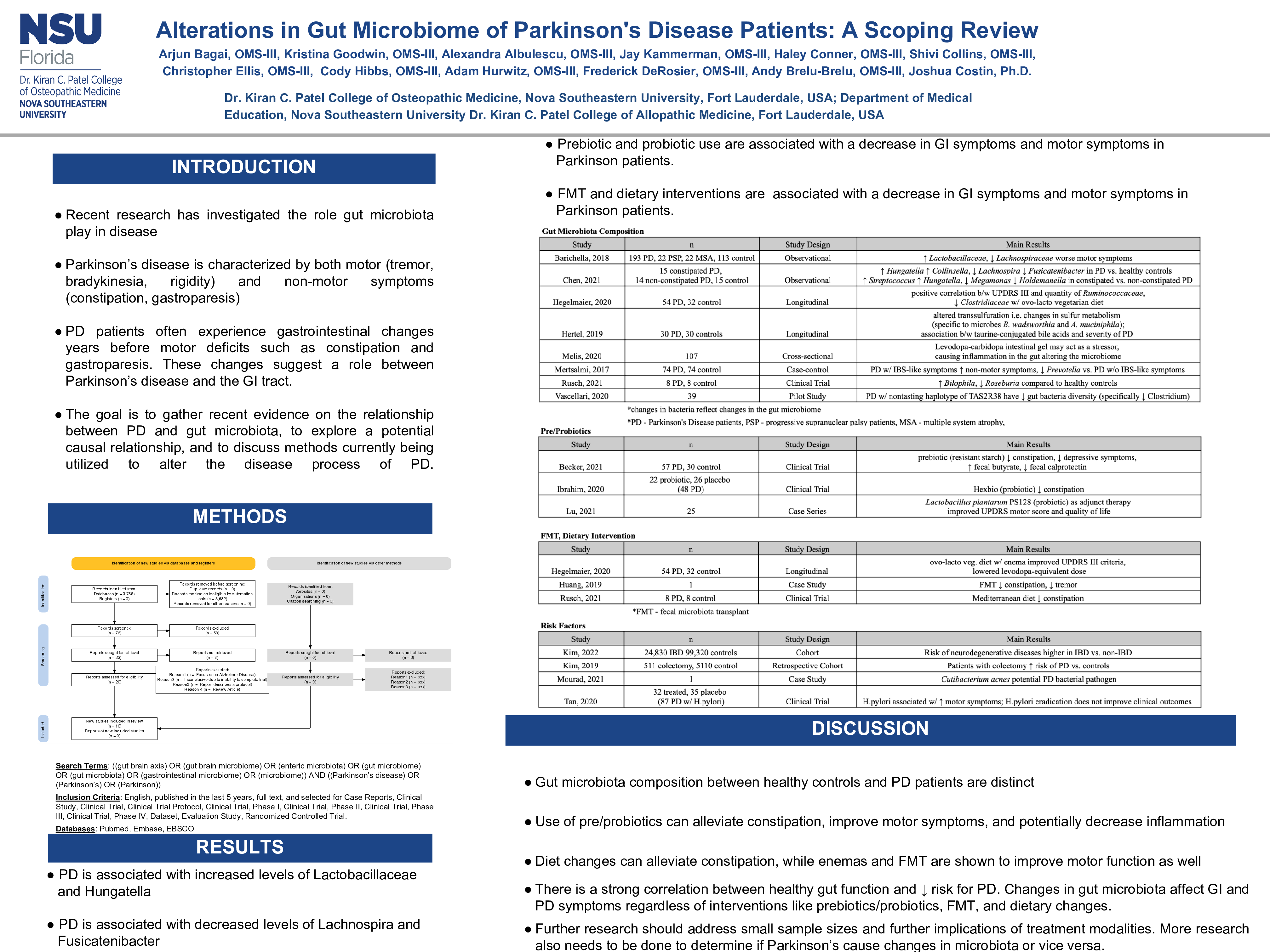
Introduction: Parkinson’s Disease is a neurodegenerative disorder that destroys dopaminergic neurons in the substantia nigra pars compacta, a region in the basal ganglia. Patients present with resting tremors, rigidity, bradykinesia, and postural instability. Additionally, gastrointestinal symptoms such as constipation are common and often present years before diagnosis. Recent research has shown connections between the gastrointestinal system and the nervous system, especially in Parkinson patients, which are mediated by alterations in the gut microbiome. The purpose of this scoping review is to understand the role of the gut microbiome in patients presenting with Parkinson’s disease and how an altered gut microbiome contributes to Parkinson pathogenesis.
Methods: This scoping review was conducted using the databases PubMed, Embase, and EBSCO. The databases initially identified 3758 articles. The inclusion criteria was: English, published in the last 5 years, full text, and selected for Case Reports, Clinical Study, Clinical Trial, Clinical Trial Protocol, Clinical Trial, Phase I, Clinical Trial, Phase II, Clinical Trial, Phase III, Clinical Trial, Phase IV, Dataset, Evaluation Study, Randomized Control Trial. Search terms included the following: (gut brain axis) OR (gut brain microbiome) OR (enteric microbiota) OR (gut microbiome) OR (gut microbiota) OR (gastrointestinal microbiome) OR (microbiome)) AND ((Parkinson’s disease) OR (Parkinson’s) OR (Parkinson)). After screening, the selection of articles was narrowed down to 16 articles used in the scoping review.
Results: Alterations in microbiota of Parkinson’s patients are consistently observed. Increases in Lactobacillacea and Hungatella are frequently associated with Parkinson’s disease while decreases are usually observed in Lachnospira and Fusicatenibacter. Prebiotic use, probiotic use, and fecal microbiota transfer were associated with decreased GI symptoms, such as constipation. FMT use also correlated with a decrease in tremor symptoms.
Conclusion: The gut microbiome plays a role in Parkinson patients and can contribute to the pathogenesis of neurodegenerative diseases. Prebiotic/probiotic use as well as FMT therapy alleviated gastrointestinal and neurological symptoms such as constipation and tremors. More research should be done to determine how microbiome effects change Parkinson symptoms and whether microbiota contribute to the disease process or are a symptom of the disease.