Spatial and Temporal Features of fMRI Networks to Distinguish Real Networks from Noise
Abstract
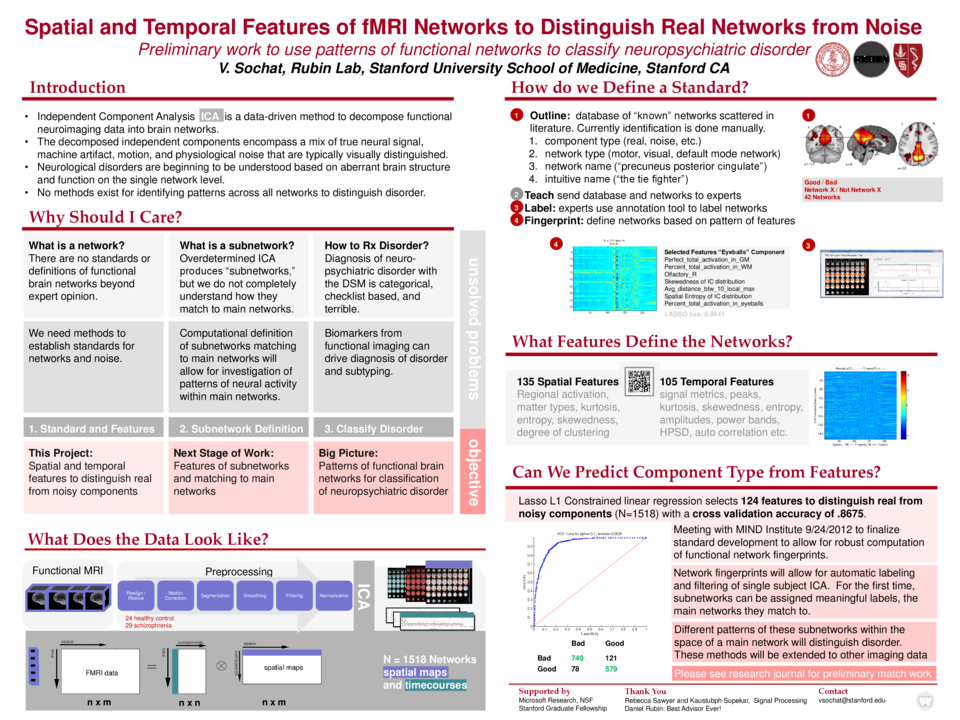
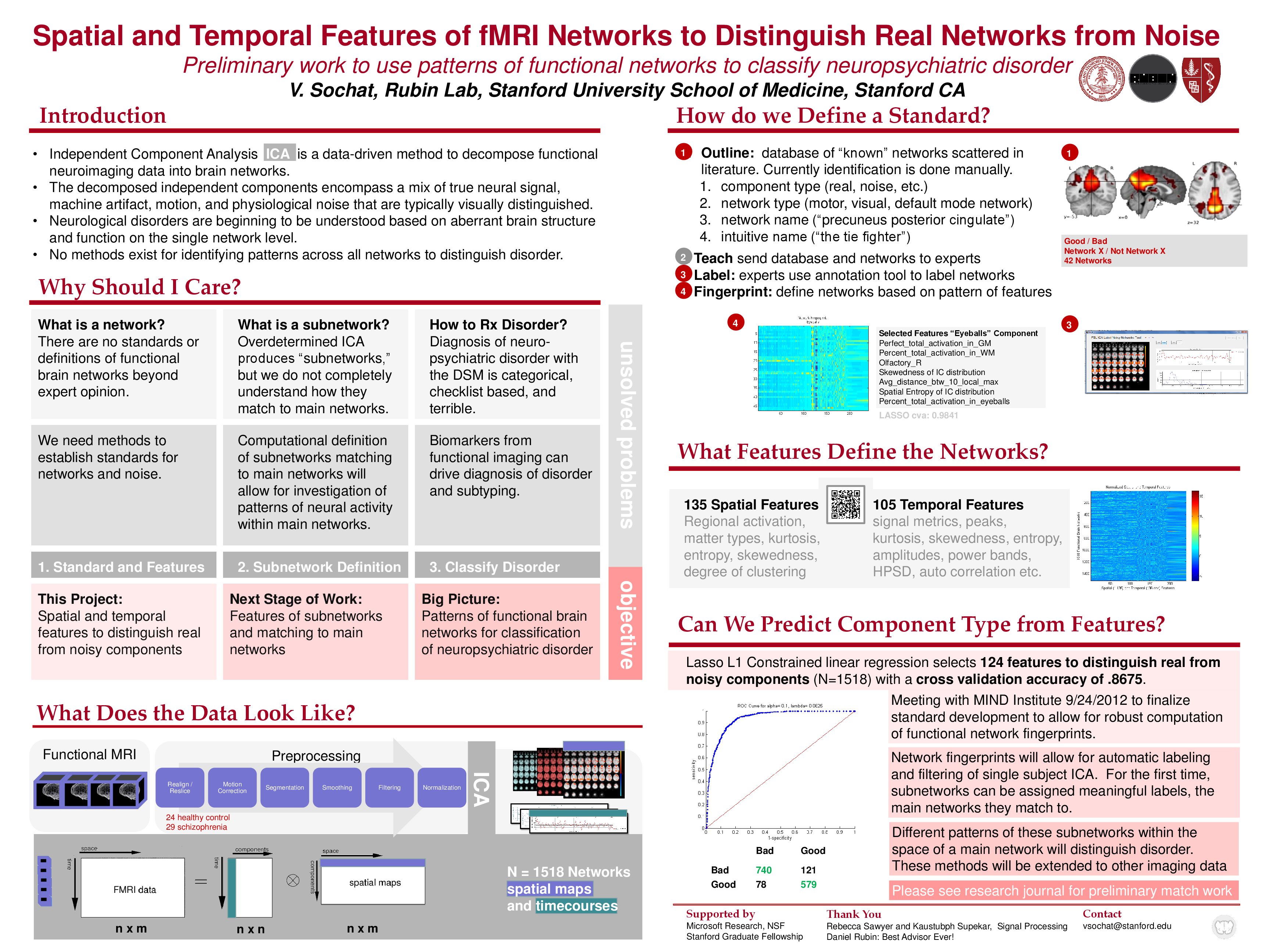
Functional neuroimaging has allowed for the investigation of brain differences that might characterize psychological disorder, however after two decades, little progress has been made in utilizing fMRI data across disorders to develop a robust system to predict disease based on group network differences. With substantial growth in the number of publicly available imaging data of neuropsychiatric populations, the time is right for the development of methods that use imaging to diagnose disorder. This project used independent component analysis (ICA) to decompose functional MRI data from 53 healthy control and individuals with schizophrenia into components representing real functional networks, physiological noise, and machine artifact. Robust spatial and temporal features were developed and extracted, and Lasso L1 constrained linear regression was used to distinguish real networks from noise and artifact (cva = .8675). These robust features can be assessed for each type of functional brain network to both define the functional network (a network “fingerprint”), and the unique combination of these fingerprints will be used to characterize neuropsychiatric disorder and its subtypes.
Related articles