Abstract
Educational Objectives
- Examine the development of a medical student’s professional identity formation during community service learning activities through leadership narratives within the proposed adapted PIF framework.
- Assess how leadership development and community service learning promote students’ professional identity formation.
- Implement the adapted PIF framework into their institution’s student programs.
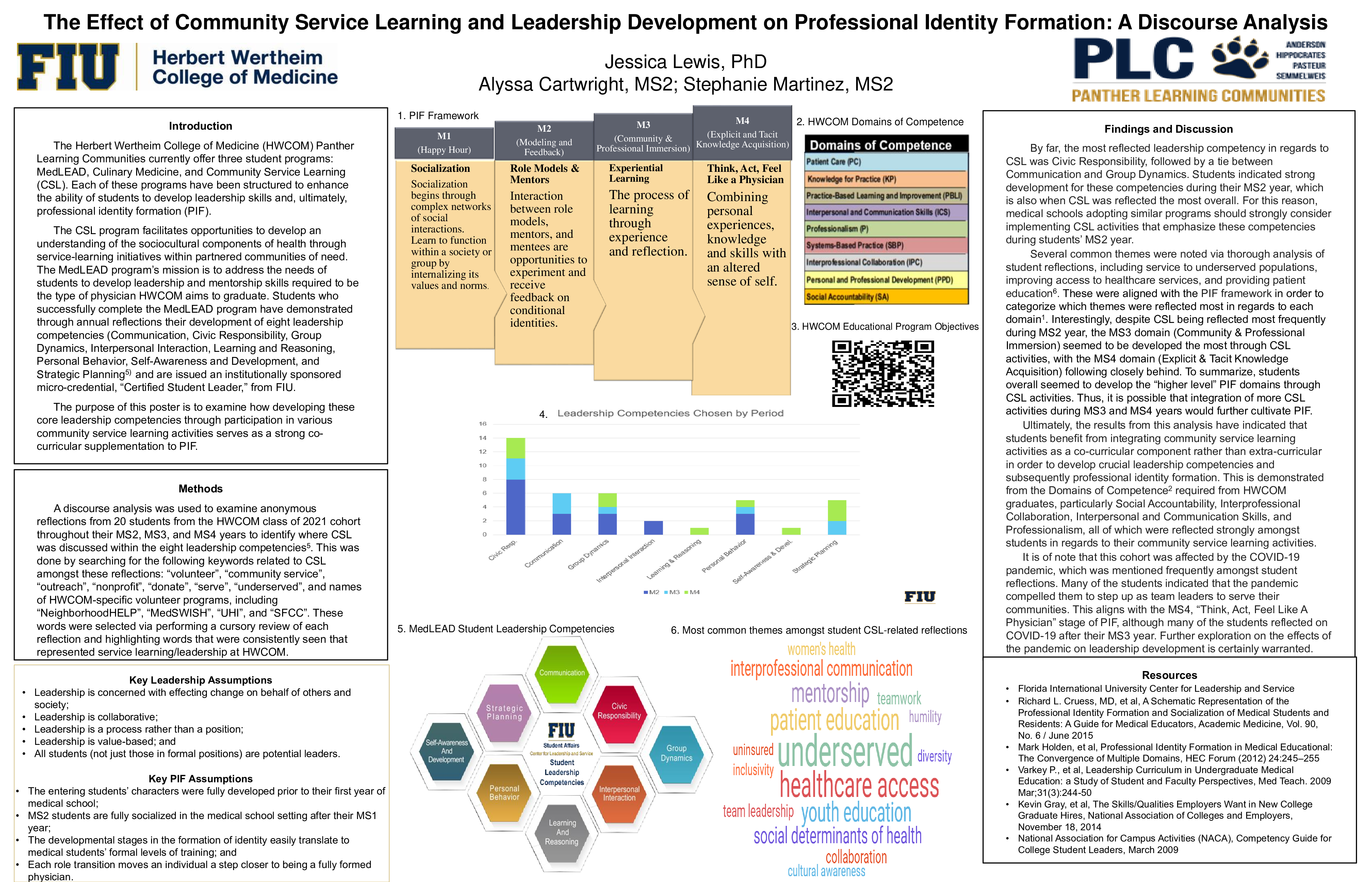
Background: The programs in the Panther Learning Communities (PLCs) at FIU HWCOM have been structured to enhance the ability of students to develop leadership skills and, ultimately, professional identity formation (PIF). Two of these programs are MedLEAD and Community Service Learning (CSL). The CSL program facilitates opportunities to develop an understanding of the sociocultural components of health through service-learning initiatives within partnered communities of need. The MedLEAD Program’s mission is to address the needs of students to develop leadership and mentorship skills required to be the type of physician HWCOM aims to graduate. Students who successfully complete the MedLEAD program have demonstrated through annual reflections their development of the following eight leadership competencies: Communication, Civic Responsibility, Group Dynamics, Interpersonal Interaction, Learning and Reasoning, Personal Behavior, Self-Awareness and Development, and Strategic Planning1, 2 – and are issued an institutionally sponsored micro-credential, “Certified Student Leader”, from FIU.
Methods: A discourse analysis will be used to examine anonymous reflections from 20 students from the class of 2021 cohort throughout their M2, M3, and M4 years to identify where CSL was discussed within the eight leadership competencies. This will be done by searching for keywords related to CSL amongst these reflections (e.g., “volunteering” and “community service”). Our goal is to examine how developing core leadership competencies throughout participation in various community service learning activities serves as a strong co-curricular supplementation to PIF.
Discussion: We hope to highlight how the combination of leadership development and service learning can develop PIF amongst students, and demonstrate how HWCOM’s CSL & MedLEAD programs work hand-in-hand in developing core tenets of PIF. The goal of this qualitative analysis is to encourage other medical schools to adopt similar programs to better assist their students in developing PIF and, in turn, becoming better physicians by supporting communities in need.
Outcomes: Ultimately, the results from this analysis have indicated that students benefit from integrating community service learning activities as a co-curricular component rather than extra-curricular in order to develop crucial leadership competencies and subsequently professional identity formation.
References
1. Brill, K., Croft, L., Ogle, J., Russell, S., Smedick, B., Hicks, M., & Coats, S. (2009). Competency guide for college student leaders. National Association for Campus Activities.
2. Wald, H. S. (2015). Professional identity (trans) formation in medical education: reflection, relationship, resilience. Academic Medicine, 90(6), 701-706.