Abstract
Background:
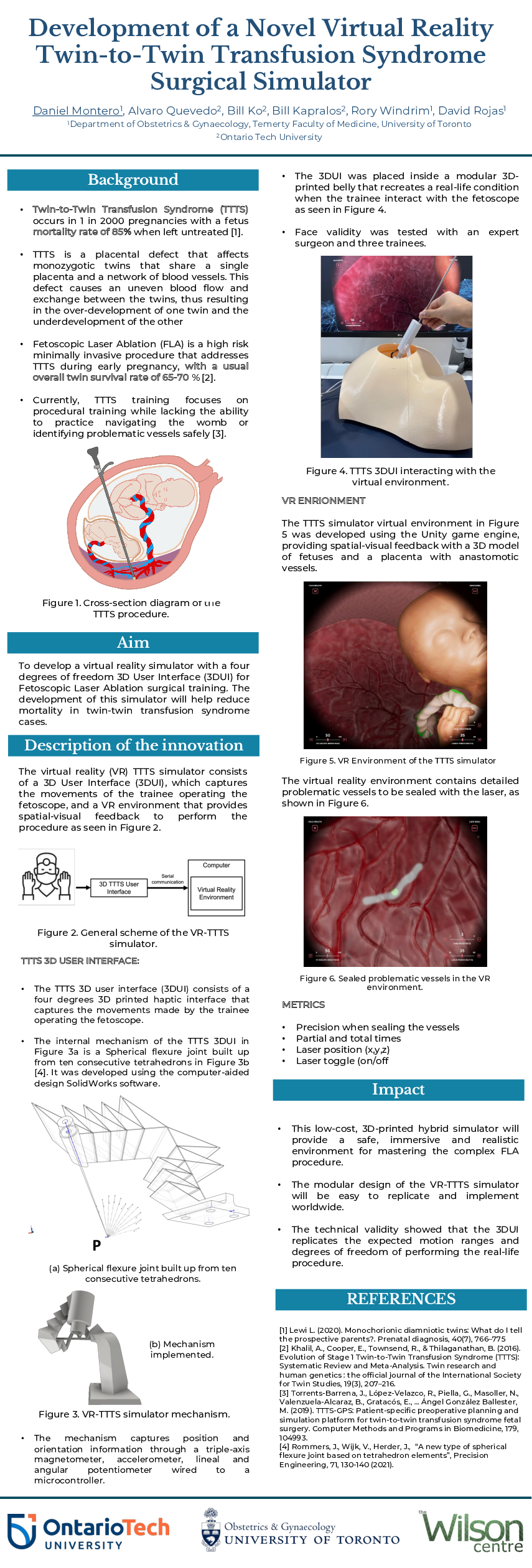
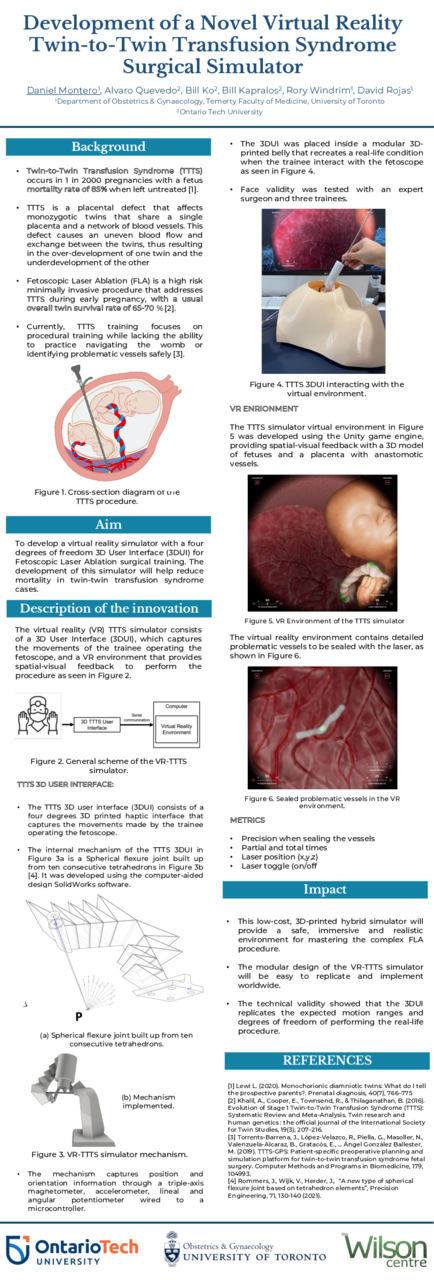
Twin-to-Twin Transfusion Syndrome (TTTS) has a mortality rate of 85% if left untreated. TTTS is a placental defect that affects monozygotic twins that share a single placenta and a network of blood vessels. This defect causes an uneven blood flow and exchange between the twins, thus resulting in the over-development of one twin and the underdevelopment of the other. Fetoscopic Laser Ablation (FLA) is a minimally invasive procedure that addresses TTTS during early pregnancy, with a usual twin survival rate of 70%. Currently, FLA training focuses on procedural training while lacking the ability to identify problematic vessels safely when navigating in the womb.
We present here the development and technical validity of a low-cost hybrid novel virtual reality (VR) TTTS Simulator that consists of a virtual womb environment and a 3D-printed physical belly with a four-degrees of freedom 3D-printed user interface (3DUI) to help master the FLA skill.
Description of the innovation:
The virtual environment of the hybrid novel VR TTTS Simulator consists of a detailed womb with two fetuses and placental vascular anastomoses replicating the FLA procedure's real conditions and providing spatial-audio-visual feedback. The physical component consists of a 3D-printed belly coupled with four degrees-of-freedom 3DUI, which allows mapping the natural fetoscope movement into the simulation. The 3DUI employed a 3D printed spherical flexure joint built up from ten consecutive tetrahedrons with a triple-axis inertial measurement unit (IMU) and a rotary sensor located in the center of rotation of the mechanism and a linear position sensor along the fetoscope. The simulator is able to generate metrics by recording the movements, time, and accuracy when sealing off the problematic shared vessels to provide practitioner feedback.
Impact:
This low-cost, 3D-printed hybrid simulator will provide a safe and realistic environment for mastering the complex FLA procedure, which will be easy to replicate and implement worldwide. The technical validity showed that the 3DUI replicates the expected motion ranges and degrees of freedom of performing the real-life procedure, and the virtual reality environment presented an immersive render of the mother's womb.