Abstract
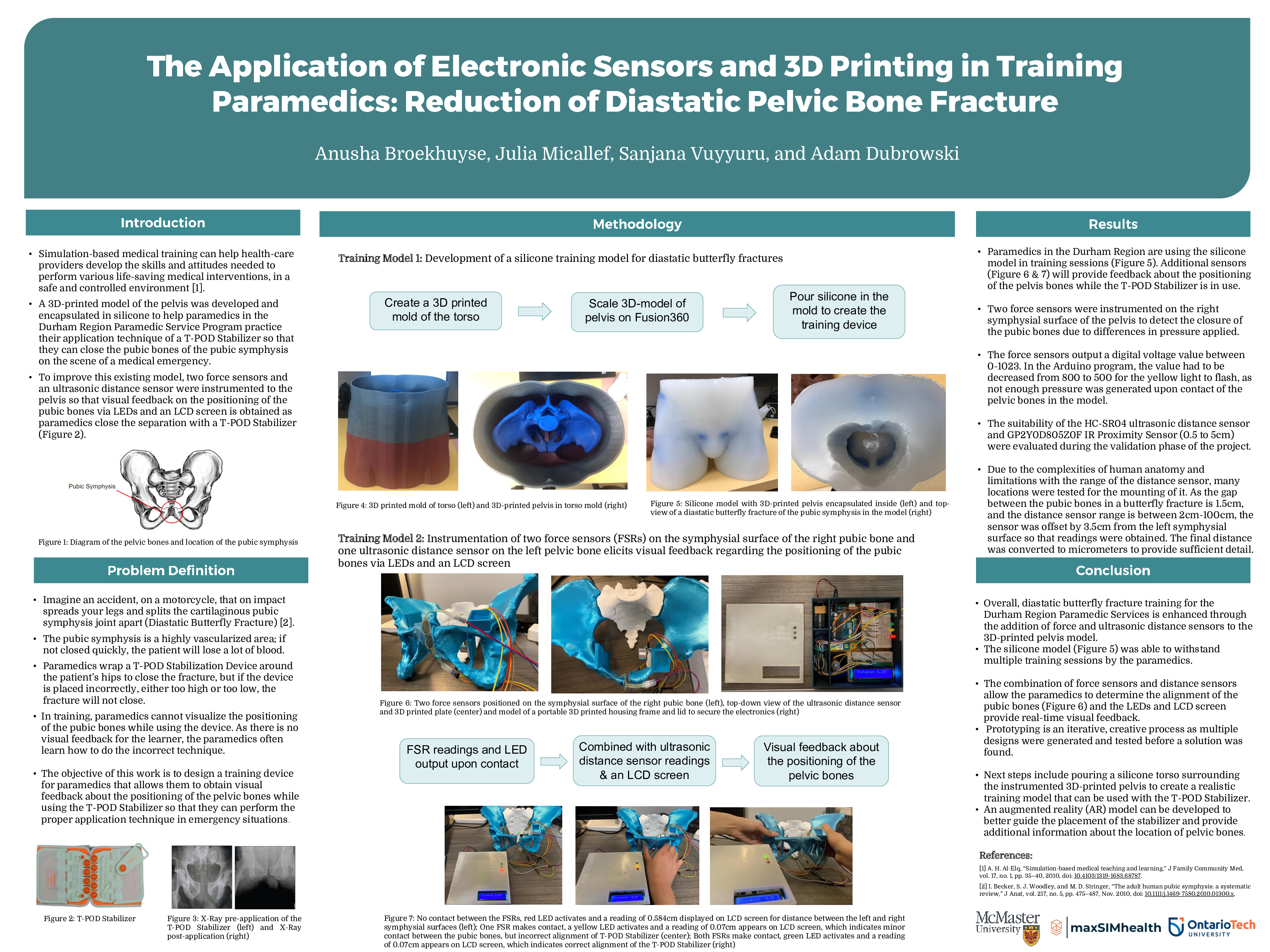
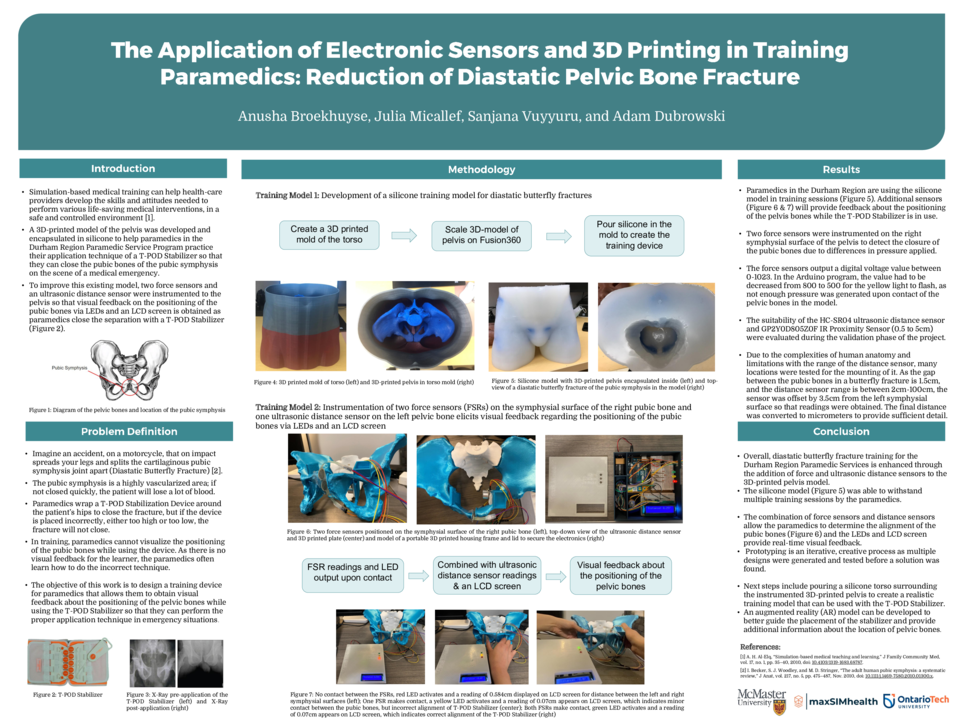
Simulation-based medical training can help paramedics develop the skills and attitudes needed to perform various life-saving medical interventions, such as the application of a T-POD Stabilizer to a patient with a diastatic butterfly fracture of the pubic symphysis. The pubic symphysis is a cartilaginous joint between the left and right pubic bones and consists of a fibrocartilaginous disc between them. A diastatic butterfly fracture occurs when the pubic symphysis splits apart, often during high-impact motor-vehicle accidents. As the pubic symphysis is a highly vascularized area, the patient will lose a substantial amount of blood if the fracture is not closed quickly. To close the pubic symphysis, paramedics wrap a T-POD Stabilizer around the patient's hips, but if the device is placed too high or too low relative to the hips, the separated pubic bones will not close. In training, it is difficult for paramedics to visualize the positioning of the pubic bones and know if they have correctly placed the stabilizer around the hips. As there is no visual feedback regarding the positioning of the pubic bones during training, paramedics often learn the incorrect application technique. Thus, the objective of this work is to design a training device that allows paramedics to obtain visual feedback about the positioning of the pelvic bones while using the T-POD Stabilizer so that they can perform the correct application technique in emergency scenarios. Initially, a 3D-printed model of the pelvis was developed and encapsulated in silicone to enhance the Durham Region Paramedic Training Program. The model was further refined by the addition of two force sensors and one ultrasonic distance sensor to provide information regarding the alignment and distance between the pubic bones while the T-POD Stabilizer is used in training. The ultrasonic distance sensor was attached to a vertical 3D-printed mount on the left pubic bone and the two force sensors were attached to the symphysial surface on the right pubis. An LCD screen displayed the distance between the symphysial surfaces, and a set of three LEDs provided visual feedback of the positioning of the pubic bones. If there is no contact between the force sensors and the left symphysial surface, a red LED will flash, but if one force sensor contacts the left symphysial surface, a yellow LED will flash to indicate that realignment of the T-POD Stabilizer is needed. When both force sensors contact the symphysial surface, a green LED will flash, indicating perfect alignment and placement of the stabilizer. Overall, this new model will further enhance paramedic's training of diastatic butterfly fractures of the pubic symphysis.