Abstract
Background:
Simulation is a vital learning modality for equity, diversity and inclusion (EDI). Learners are immersed in a safe rehearsal space to engage with others on a complex topic. The workforce in long-term care is diverse, and residents often experience age and illness-related health changes and have long and complex social and health histories.
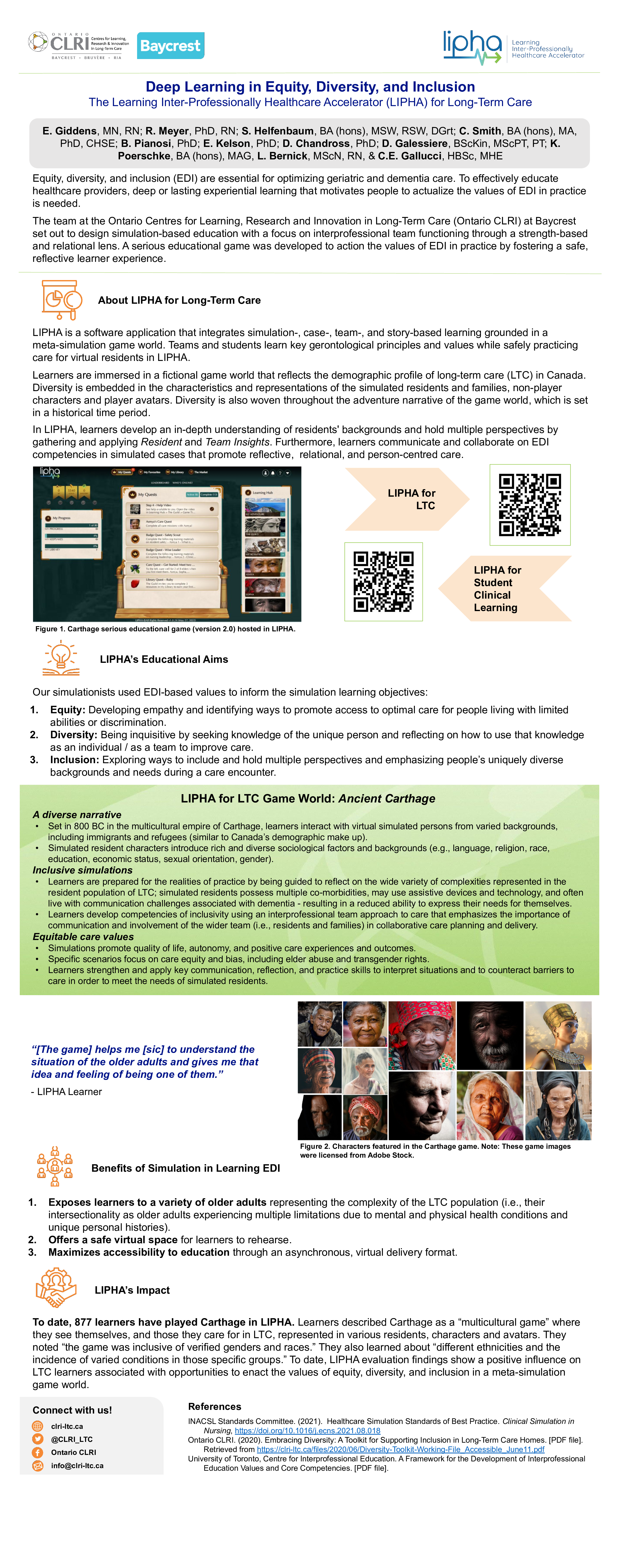
We used the Learning Inter-Professionally Healthcare Accelerator (LIPHA) to foster EDI learning through an intersectional lens. LIPHA is a self-authoring software application designed for healthcare education and training that integrates team and case-based learning in a meta-simulation game world.
Objective:
As part of a broader curriculum, our objective was to promote deep learning in clusters of competencies. Equity is demonstrated through access to positive care experiences and outcomes for residents with reduced ability to express needs. Diversity is illustrated through heterogenous backgrounds and day-to-day needs of community members. Inclusion is fostered by the development of empathy, inquiry and communication skills to promote a team approach to care.
Design (above) enabled us/learner to achieve the following objectives:
- Seek knowledge of a person’s uniquely diverse background and needs;
- Hold multiple perspectives on a care issue or situation; and,
- Reflect on how to use that knowledge to improve care, and include that resident and family in care planning and delivery.
Innovation:
Learners are immersed in a meta-simulation game world that reflects the profile of LTC in Canada. Set in the historical, multicultural empire of Ancient Carthage, diversity is embedded in the simulated residents and families, non-player characters, adventure narrative and player avatars. Learners develop an in-depth understanding of residents' backgrounds and hold multiple perspectives by gathering and applying Resident and Team Insights. Furthermore, learners communicate and collaborate on EDI competencies in simulated cases that promote reflective and relational-centred care.
Impact:
To date, 877 learners have played LIPHA. Learners describe LIPHA as a “multicultural game” that represents themselves, as well as those they care for in LTC. They noted that “the game was inclusive of verified genders and races.” They also learned about “different ethnicities and incidence of varied conditions in those specific groups.”