Using Residents as Teachers: Developing a Course to Maintain Clinical Skills for MD/PhD Students in their Graduate Years
Abstract
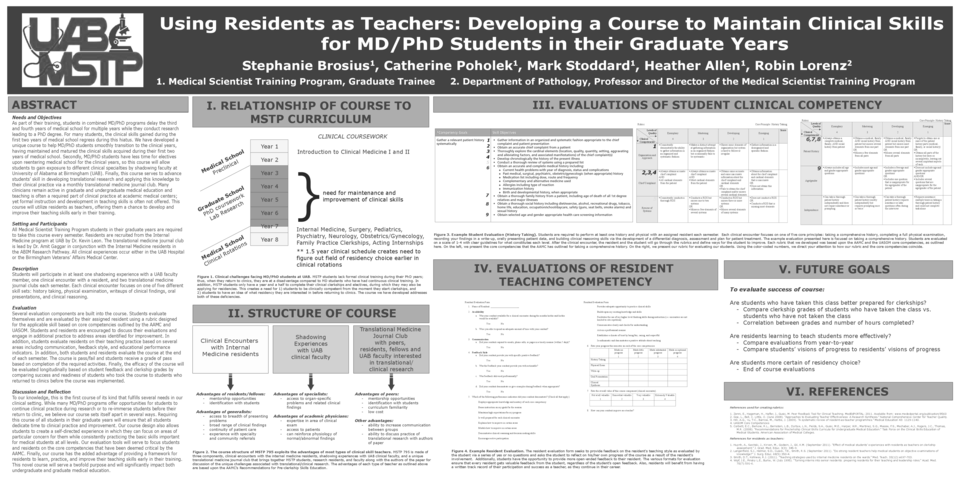
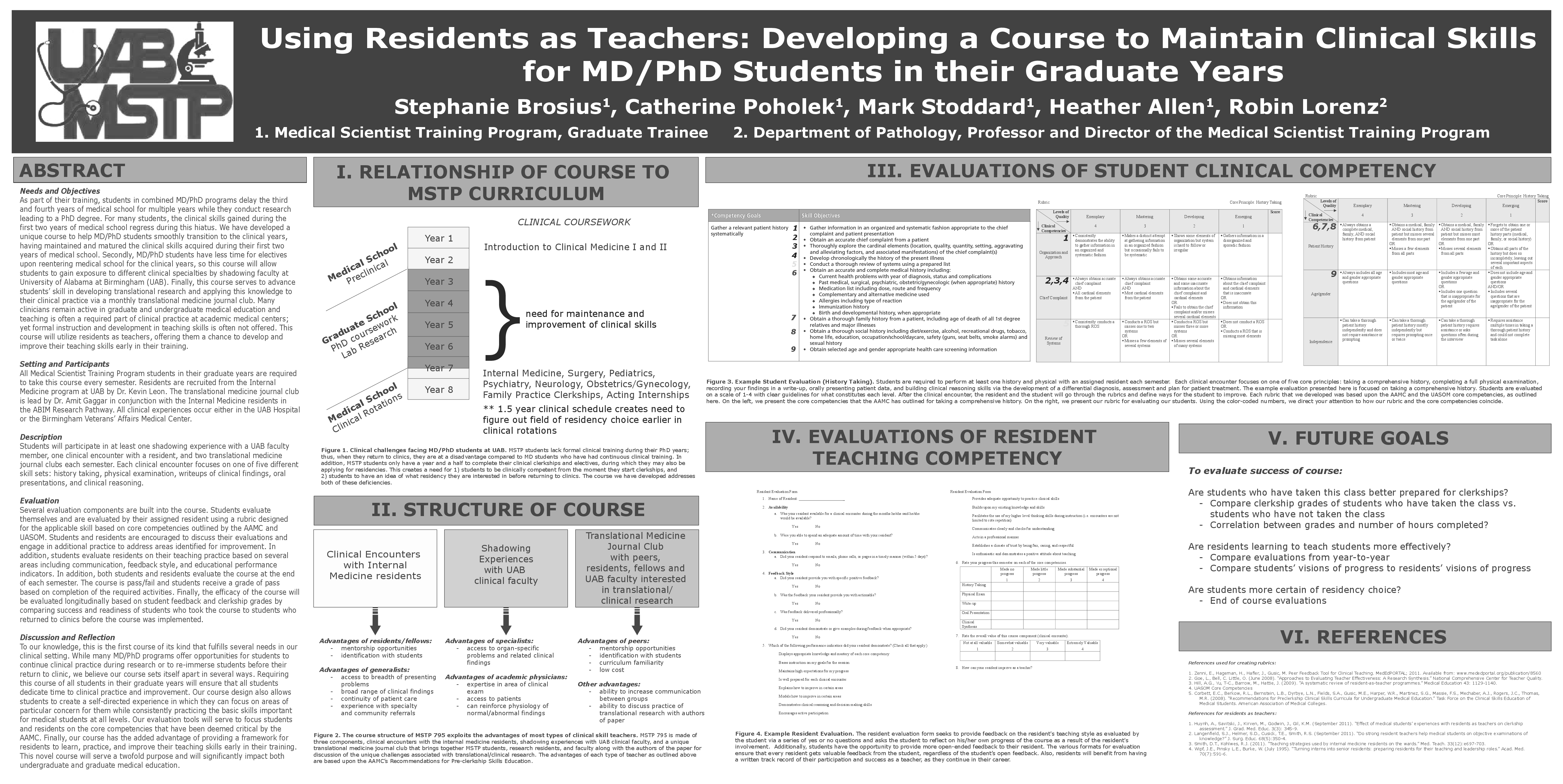
Needs and Objectives: As part of their training, students in combined MD/PhD programs delay the third and fourth years of medical school for multiple years while they conduct research leading to a PhD degree. For many students, the clinical skills gained during the first two years of medical school regress during this hiatus. We have developed a unique course to help MD/PhD students smoothly transition to the clinical years, having maintained and matured the clinical skills acquired during their first two years of medical school. Secondly, MD/PhD students have less time for electives upon reentering medical school for the clinical years, so this course will allow students to gain exposure to different clinical specialties by shadowing faculty at University of Alabama at Birmingham (UAB). Finally, this course serves to advance students’ skill in developing translational research and applying this knowledge to their clinical practice via a monthly translational medicine journal club. Many clinicians remain active in graduate and undergraduate medical education and teaching is often a required part of clinical practice at academic medical centers; yet formal instruction and development in teaching skills is often not offered. This course will utilize residents as teachers, offering them a chance to develop and improve their teaching skills early in their training.
Setting and Participants: All Medical Scientist Training Program students in their graduate years are required to take this course every semester. Residents are recruited from the Internal Medicine program at UAB by Dr. Kevin Leon. The translational medicine journal club is lead by Dr. Amit Gaggar in conjunction with the Internal Medicine residents in the ABIM Research Pathway. All clinical experiences occur either in the UAB Hospital or the Birmingham Veterans’ Affairs Medical Center.
Description: Students will participate in at least one shadowing experience with a UAB faculty member, one clinical encounter with a resident, and two translational medicine journal clubs each semester. Each clinical encounter focuses on one of five different skill sets: history taking, physical examination, write-ups of clinical findings, oral presentations, and clinical reasoning.
Evaluation: Several evaluation components are built into the course. Students evaluate themselves and are evaluated by their assigned resident using a rubric designed for the applicable skill based on core competencies outlined by the AAMC and UASOM. Students and residents are encouraged to discuss their evaluations and engage in additional practice to address areas identified for improvement. In addition, students evaluate residents on their teaching practice based on several areas including communication, feedback style, and educational performance indicators. In addition, both students and residents evaluate the course at the end of each semester. The course is pass/fail and students receive a grade of pass based on completion of the required activities. Finally, the efficacy of the course will be evaluated longitudinally based on student feedback and clerkship grades by comparing success and readiness of students who took the course to students who returned to clinics before the course was implemented.
Discussion and Reflection: To our knowledge, this is the first course of its kind that fulfills several needs in our clinical setting. While many MD/PhD programs offer opportunities for students to continue clinical practice during research or to re-immerse students before their return to clinic, we believe our course sets itself apart in several ways. Requiring this course of all students in their graduate years will ensure that all students dedicate time to clinical practice and improvement. Our course design also allows students to create a self-directed experience in which they can focus on areas of particular concern for them while consistently practicing the basic skills important for medical students at all levels. Our evaluation tools will serve to focus students and residents on the core competencies that have been deemed critical by the AAMC. Finally, our course has the added advantage of providing a framework for residents to learn, practice, and improve their teaching skills early in their training. This novel course will serve a twofold purpose and will significantly impact both undergraduate and graduate medical education.
Related articles