Abstract
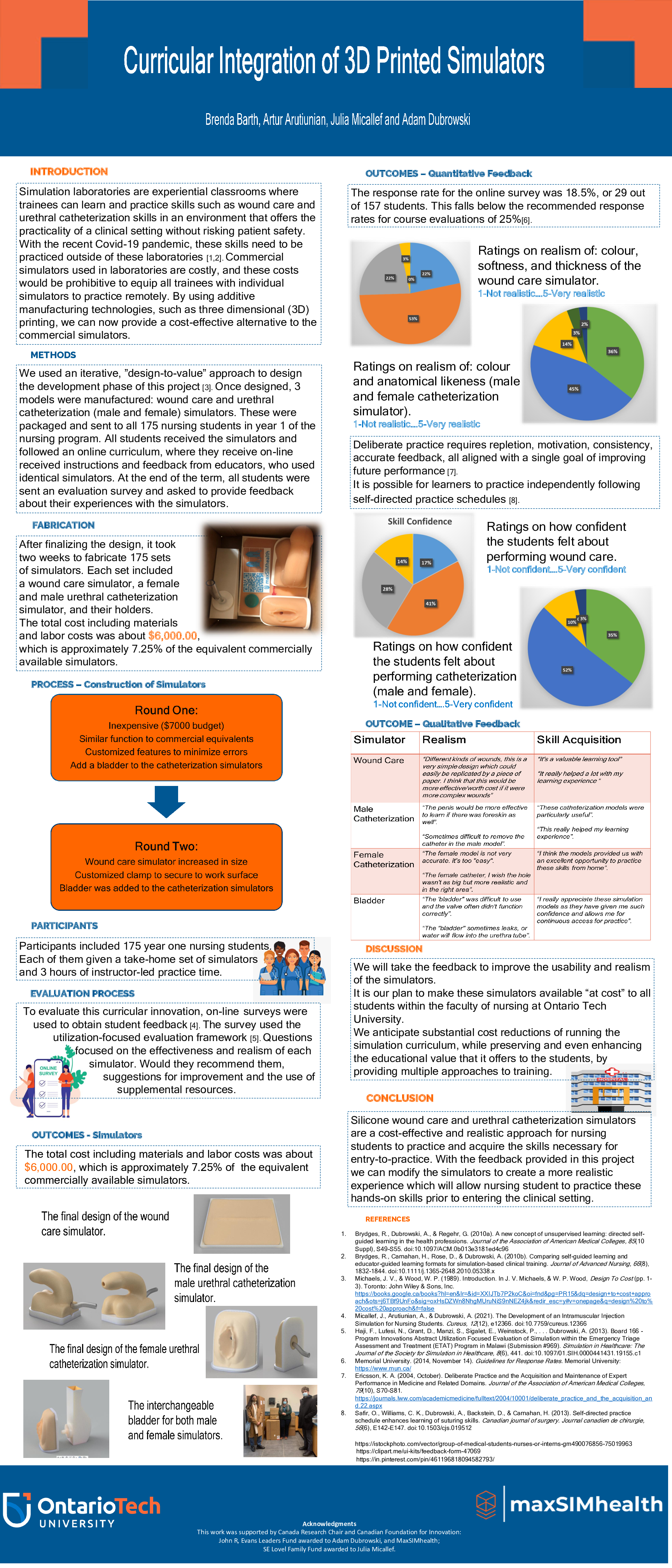
In a centralized model of simulation based education (Ce-SBE), students practice skills in simulation laboratories, while in a decentralized model (De-SBE), students practice skills outside of these laboratories. Cost of “take-home” simulators is a barrier, which can be overcome with additive manufacturing (AM). Our objective was to develop and evaluate AM-simulators by year one nursing students participating in De-SBE.
A “design-to-cost” approach was used to develop three simulators: wound care and urethral catheterization (male and). These were sent to all year one nursing students, who followed an online curriculum. At the end of practice, students were asked to provide feedback about their experiences.
The simulators were designed in two iterative cycles. The total cost of manufacturing of all three models was $5,000.00 USD. Twenty-nine students completed the survey, which indicated that the simulators supported the students’ learning needs, and several changes were requested to improve the educational value.
The results indicate that AM-simulators provide an acceptable simulation alternative for nursing students to learn wound care and urethral catheterization off campus in De-SBE. The feedback also provided suggestions to improve each of the simulators to make the experience more authentic.