Abstract
Background
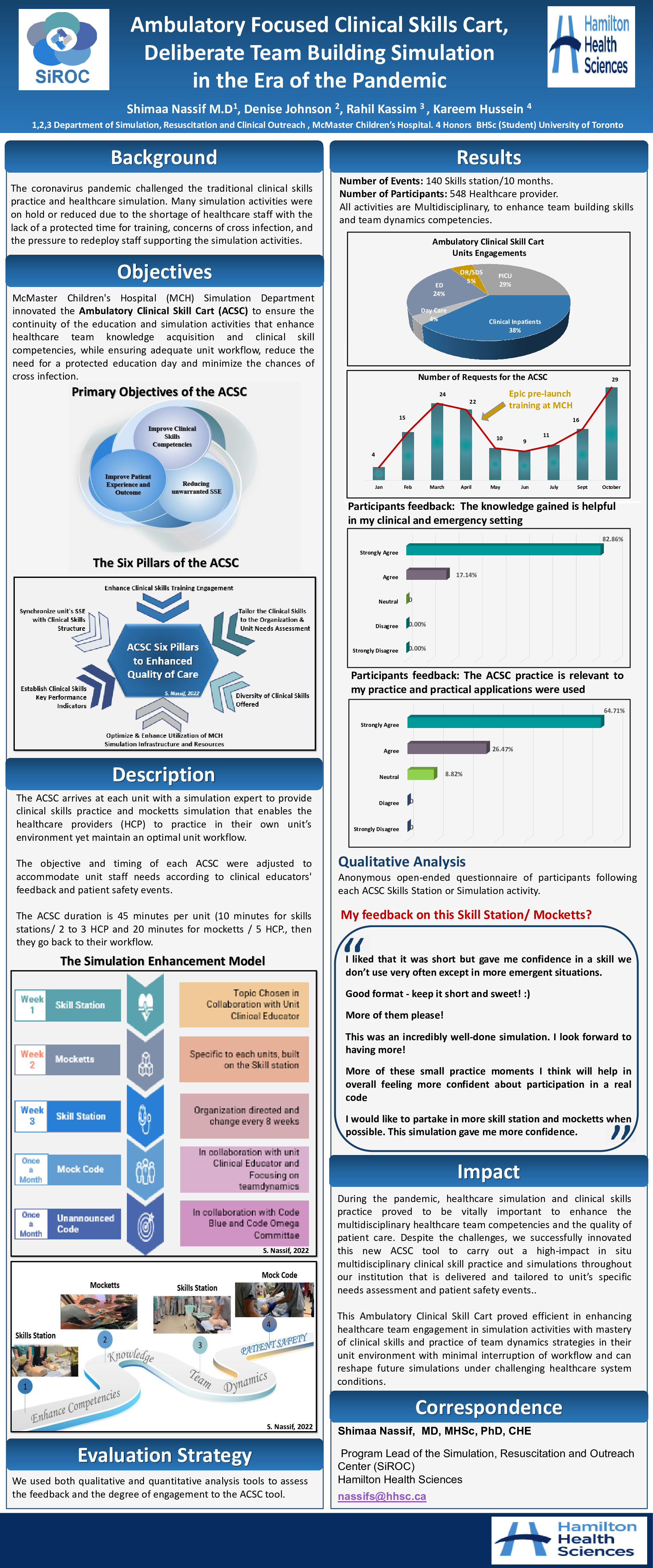
The coronavirus pandemic challenged the traditional clinical skills practice and healthcare simulation. Many simulation program activities were on hold or reduced due to the shortage of healthcare staff with the lack of a protected time for training, concerns of cross infection for in-person events, and the pressure to redeploy staff supporting the simulation activities.
Objective
Despite the challenges and restrictions related to the pandemic, McMaster Children's Hospital Simulation Department innovated the Ambulatory Clinical Skill Cart (ACSC) to ensure the continuity of the education and simulation activities that enhance healthcare team knowledge acquisition and clinical skill competencies, while ensuring adequate unit workflow, reduce the need for a protected education day and minimize the chances of cross infection.
Description
The ACSC arrives at each unit with a simulation expert to provide clinical skills practice and small mocketts simulation that allows the healthcare team to maintain an optimal clinical unit workflow. In addition, ACSC enables the healthcare team to practice the skills and apply them to their unit resources and with their multidisciplinary team.
The objective and timing of each clinical skills station or mocketts were adjusted to accommodate unit staff needs according to clinical educators' feedback and patient safety events.
In each unit, two to three HCP attend a 10 minutes skill station or 20 minutes mockett, then they go back to their workflow. The total duration of ACSC in each unit was a maximum of 45 minutes.
Impact
During the pandemic, healthcare simulation and clinical skills practice proved to be vitally important to enhance the multidisciplinary healthcare team competencies and the quality of patient care. Despite the challenges, we successfully innovated this new ACSC tool to carry out a high-impact in situ multidisciplinary clinical skill practice and simulations throughout our institution that is delivered to each unit and tailored to their needs.
This Ambulatory Clinical Skill Cart proved efficient in maintaining healthcare team engagement in simulation activities during the pandemic with mastery of clinical skills and practice of team dynamics strategies in their unit environment with minimal interruption of workflow and can reshape future simulations under challenging healthcare system conditions.