Abstract
Background
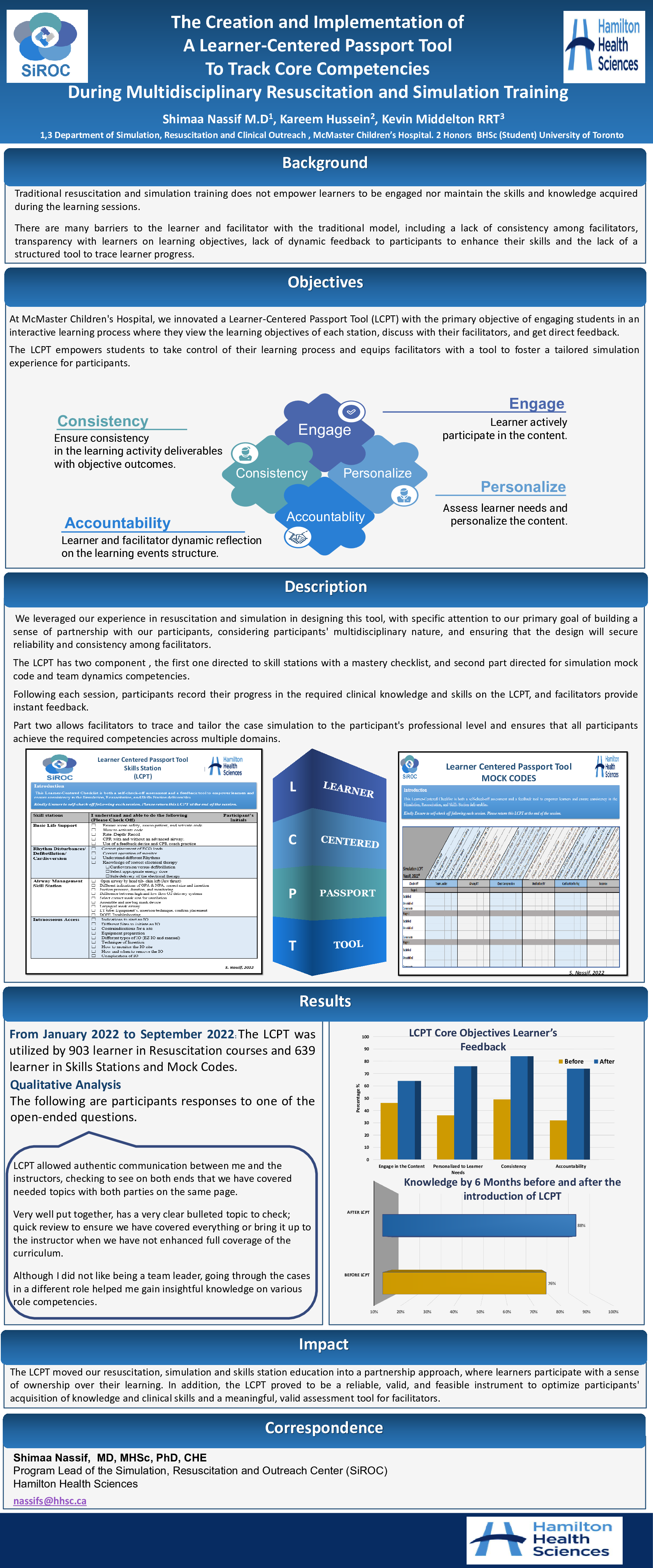
Traditional resuscitation and simulation training does not empower learners to be engaged nor maintain the skills and knowledge acquired during the learning sessions. In addition, there are many barriers to the learner and facilitator with the traditional model, including a lack of consistency among facilitators, transparency with learners on learning objectives, lack of dynamic feedback to participants to enhance their skills and the lack of a structured tool to trace learner progress.
Objective
At McMaster Children's Hospital, we innovated a Learner-Centered Passport Tool (LCPT) with the primary objective of engaging students in an interactive learning process where they view the learning objectives of each station, discuss with their facilitators, and get direct feedback. The LCPT empowers students to take control of their learning process and equips facilitators with a tool to foster a tailored simulation experience for participants.
Description
We leveraged our experience as leaders in resuscitation and simulation in designing this tool, with specific attention to our primary goal of building a sense of partnership with our participants, considering participants' multidisciplinary nature, and ensuring that the design will secure reliability and consistency among facilitators.
The LCPT is a double-sided one page with part one directed to skill stations with a mastery checklist and part two for simulation and team dynamics competencies.
Following each session, participants record their progress in the required clinical knowledge and skills on the LCPT, and facilitators provide instant feedback.
Part two allows facilitators to trace and tailor the case simulation to the participant's professional level and ensures that all participants achieve the required competencies across multiple domains.
Impact
The LCPT moved our resuscitation, simulation and skills station education into a partnership approach, where learners participate with a sense
of ownership over their learning In addition, the LCPT proved to be a reliable, valid, and feasible instrument to optimize participants'
acquisition of knowledge and clinical skills and a meaningful, valid assessment tool for facilitators.