Abstract
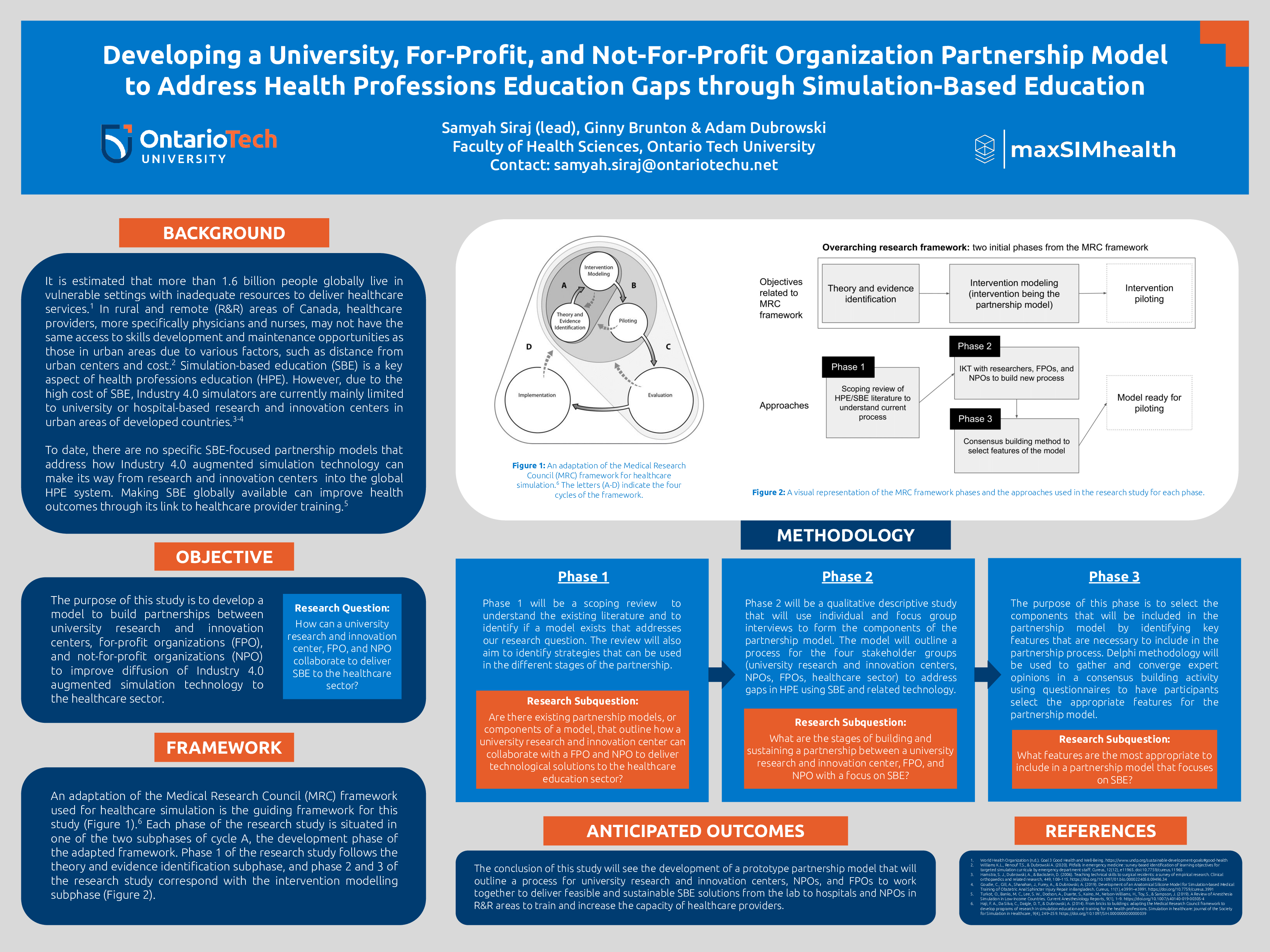
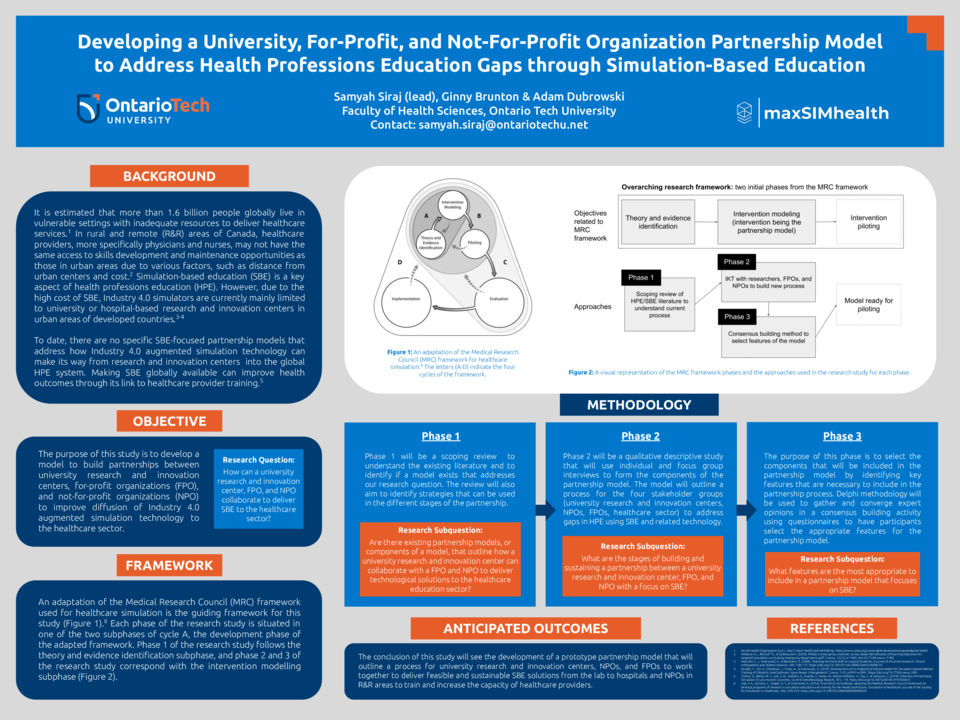
Introduction: Simulation-based education (SBE) serves as an optimal tool to allow healthcare providers to develop and maintain skills. Healthcare providers in rural and remote (R&R) areas of Canada may not have the same access to skills development and maintenance opportunities due to various factors, such as distance and cost. Due to the high cost, SBE is mainly limited to university or hospital-based research and innovation centers in urban areas of developed countries. To date, there are no specific partnership models that address how SBE, specifically simulators, can make its way from research and innovation centers into the health professions education (HPE) system.
Objective: The objective is to develop a partnership between university research and innovation centers, for-profit organizations (FPO), and not-for-profit organizations (NPO) to improve diffusion of simulation technology to R&R areas for healthcare provider training. The research question is: How can a university research and innovation center, FPO, and NPO collaborate to deliver SBE to the healthcare sector?
Methods: The research study will follow an adaptation of the Medical Research Council (MRC) framework specific to healthcare simulation and will be divided into three phases. Phase 1 will be a scoping review to understand the scope of existing research and identify if a model exists that addresses the research question. Phase 2 will use the qualitative descriptive approach to conduct individual and focus group interviews to collect data from stakeholders on the partnership process. Phase 3 will use Delphi methodology to build consensus using questionnaires by having stakeholders select the key components to include in the partnership model.
Conclusion: The findings from the three phases will be synthesized to develop a prototype partnership model that encompasses the perspective of all the stakeholders involved in the partnership and that addresses the gap to deliver SBE from research and innovation centers to healthcare providers in R&R areas. Proposed future work involves testing the prototype model in a piloting phase and expanding the scope of the model from domestically to internationally, specifically in low and middle income countries (LMIC).