
Abstract
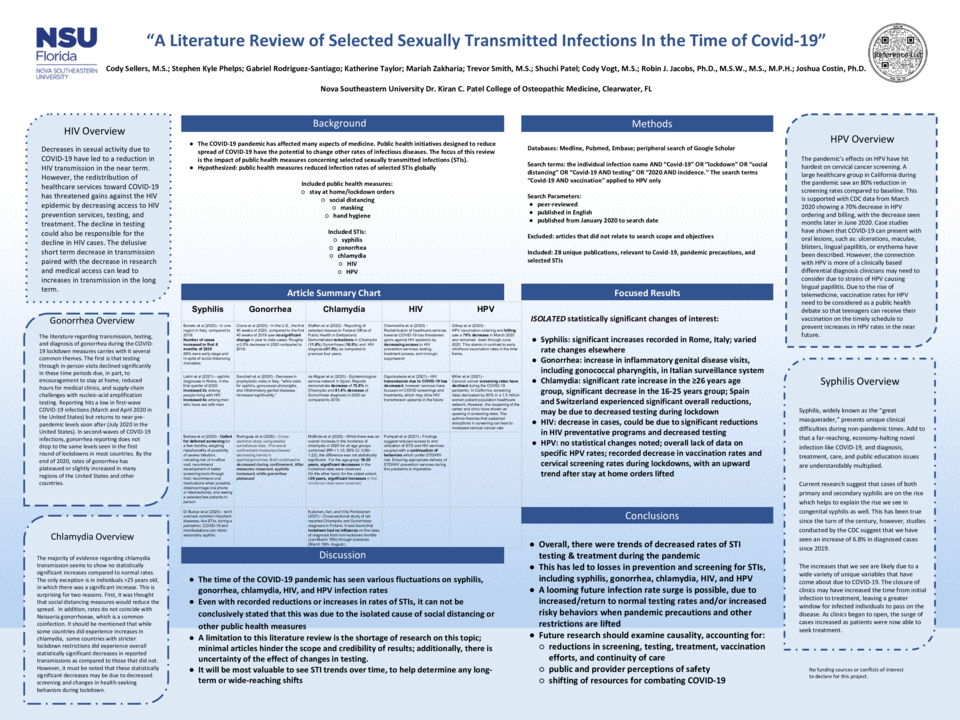
Background: Public health initiatives designed to reduce the spread of COVID-19 have the potential to affect the infection rates of other diseases. This review investigates current publications germane to the impact of pandemic precautions, such as masking, social distancing, limiting social gatherings, and state-mandated lockdowns, on the infection rates of selected sexually transmitted infections (STIs). Selected STIs included syphilis, gonorrhea, chlamydia, HIV, and HPV.
Objectives: To investigate, synthesize, and analyze the most current body of literature surrounding COVID-19 pandemic precautions and STI rates globally. A secondary aim examined if the literature supports the hypothesis that such precautions helped to decrease said STI rates.
Methods: A thorough search of Medline, Pubmed, Embase and Google Scholar was conducted, with peer-reviewed, English language, and 2020 to search date parameters, and a standardized set of search terms. Only relevant articles discussing infection rates and status of selected STIs were included. From the resultant 636 non-unique search results, 28 articles proved relevant to scope and objectives after abstract and title reviews.
Results: Literature exploring the rates of STIs during the pandemic, with lockdowns and precautionary public health measures, did not show a sharp reduction in infections as was originally expected. Changes to disease rates were variable across region. Additionally, there were changes within the same region. If a reduction in STI rates was identified, it was not clear if this was due to changes in sexual practices, or reductions in screenings and provider visits, which may be due to both public and provider perceptions of visit safety, and also shifting of funding and resources in order to combat COVID-19.
Conclusions: In the search for literature regarding the reduction of transmission rates of STIs directly due to social distancing and lockdown mandates, results were varied. Most notably, the preventive and screening measures for STIs have lapsed in critical aspects. This has led to backwards steps in the prevention and screening for STIs, including syphilis, gonorrhea, chlamydia, HIV, and HPV. This may lead to a perceptual or actual surge of infection rates in the near future. Furthermore, additional studies, investigations and publications are necessary to establish causality and the current status of global rates of STIs.




