Abstract
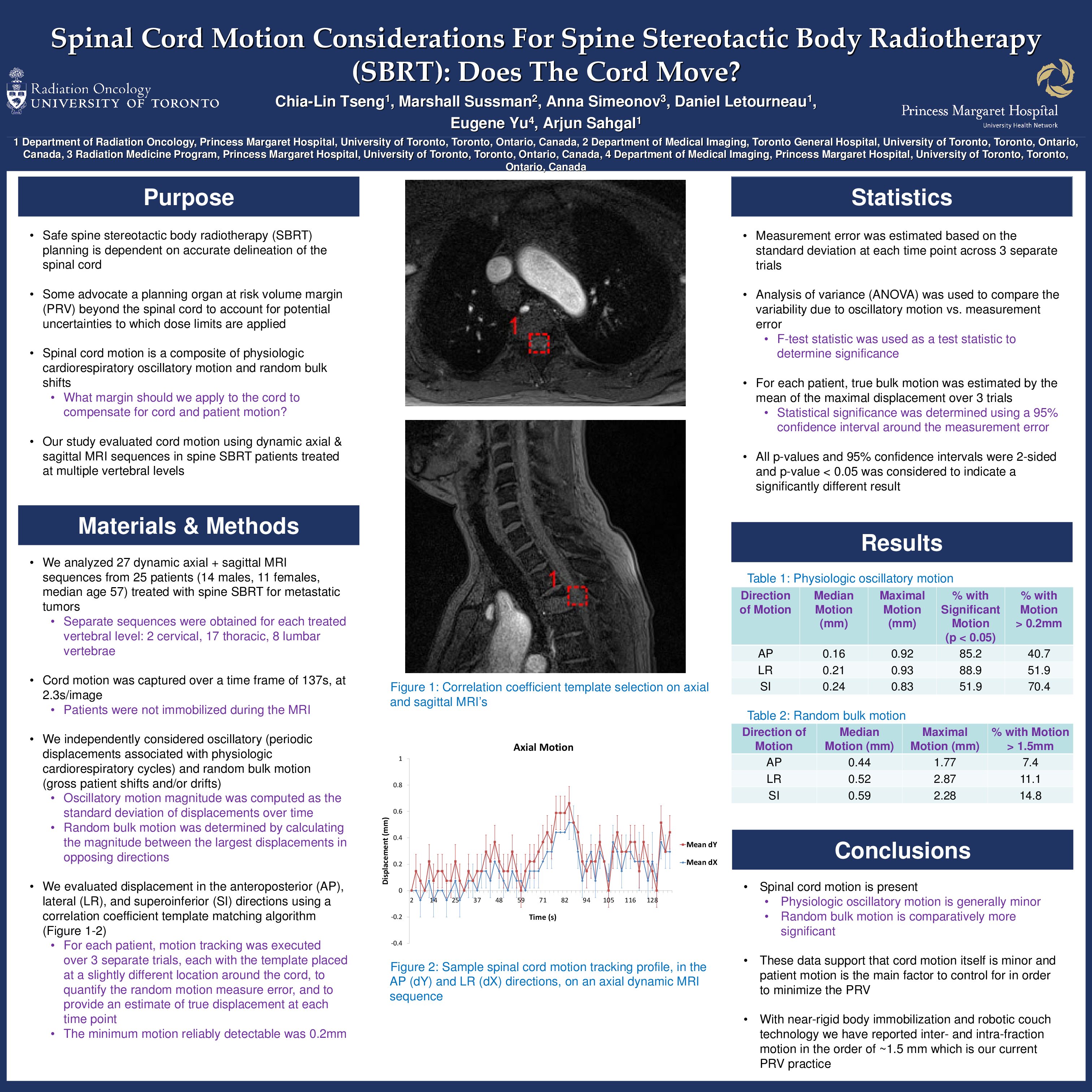
Purpose: An accurate assessment of spinal cord motion is an important consideration when evaluating the appropriateness of a spinal cord planning organ at risk margin (PRV) for spine SBRT.
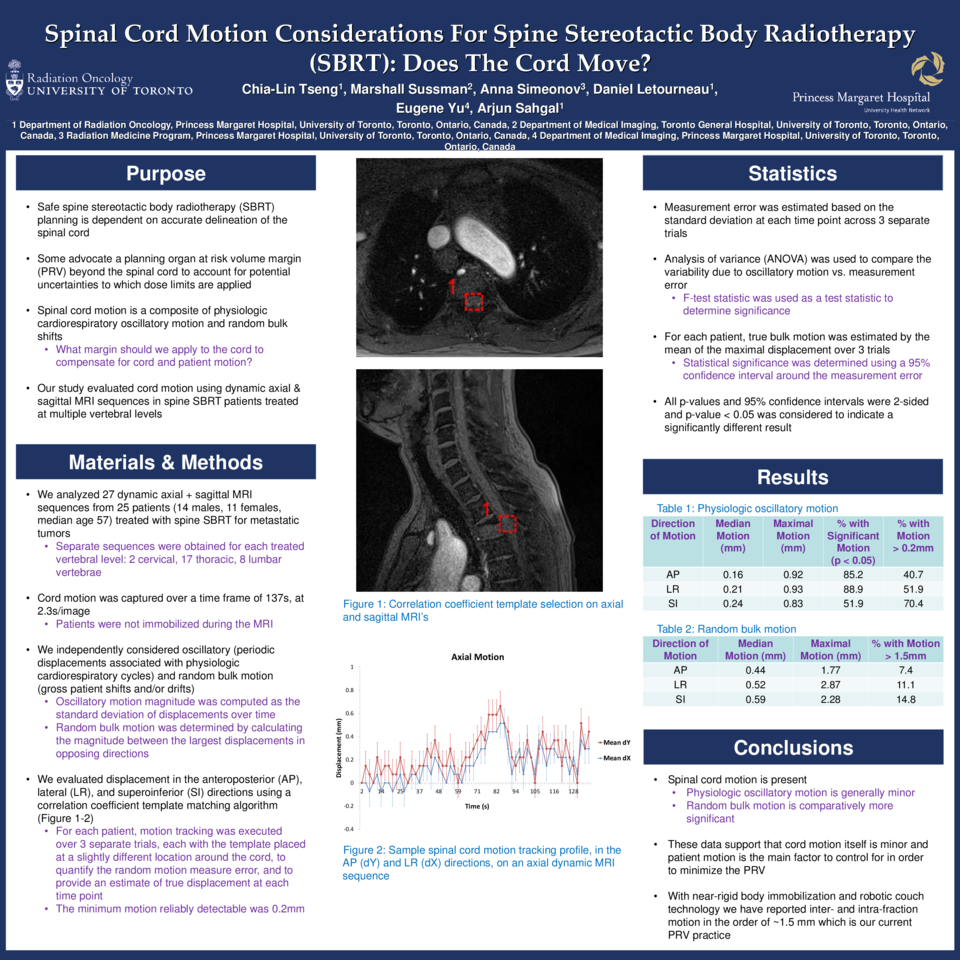
Materials and Methods: We analyzed spinal cord motion in 25 patients (14 males, 11 females, median age 57) treated with spine SBRT (2 cervical, 17 thoracic, 8 lumbar vertebrae) for metastatic tumours using dynamic axial and sagittal magnetic resonance imaging (MRI) sequences (3T Verio, Siemens). The scan interval was over 137 seconds and focused on the treated vertebral level. Patients were not in an immobilization device during the MRI. We independently considered oscillatory and random bulk motion. Oscillatory motion was defined as periodic displacements associated with physiologic phenomena, such as cardiac and respiratory cycles, and its magnitude assessed by computing the standard deviation of displacements over time. Random bulk shifts were defined as those associated with gross patient motion, and determined by calculating the magnitude between the largest displacements in opposing directions. Using a correlation coefficient template matching algorithm, we evaluated displacement in the anteroposterior (AP), lateral (LR), and superoinferior (SI) directions. For each patient, we executed the motion tracking algorithm over 3 separate trials, each with the template placed at a slightly different location around the cord, to quantify the random motion measure error, and to provide an estimate of true displacement at each time point.
Results: The median oscillatory spinal cord motion in the AP, LR, and SI directions were 0.16mm, 0.21mm, and 0.24mm, respectively, and maximal oscillatory motion were 0.92mm, 0.93mm, and 0.83mm, respectively. In the AP, LR, and SI directions, oscillatory motion was statistically significant in 85.2%, 88.9%, and 51.9%, respectively, of the vertebral levels analyzed. The median bulk displacements in the AP, LR, and SI directions were 0.44mm, 0.52mm and 0.59mm, and maximal displacements were 1.77mm, 2.87mm, and 2.28mm, respectively. In the AP, LR, and SI directions, bulk displacements were greater than 1.5mm in
7.4%, 11.1%, and 14.8%, respectively, of the vertebral levels assessed.
Conclusions: There is spinal cord motion, however, physiologic oscillatory motion was generally minor. In select patients, random bulk motion may be significant and more than 1.5mm, which reinforces the role of near-rigid body immobilization during spine SBRT.